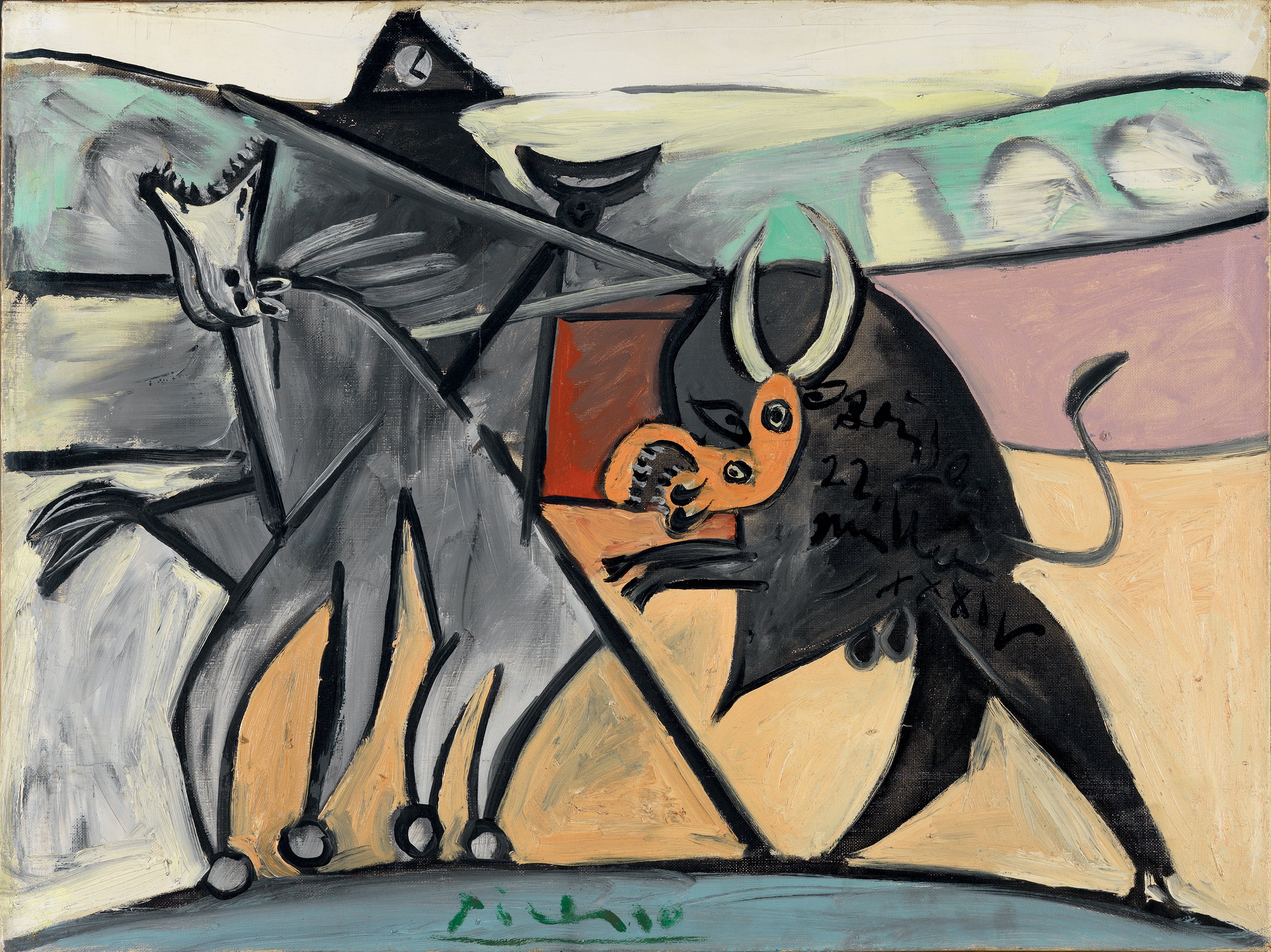
Bullfight
The close relationship between the world of bullfighting and Picasso’s oeuvre is unquestionable. From his childhood days in Málaga, where his father often took him to the bullring, he was greatly fascinated by the national sport. In addition to the artistic possibilities of the bullfight — a theme steeped in drama, which would prove very useful at certain conflictive times — Picasso regarded it as an expression of Spanishness: “The life of the Spanish consists of Mass in the morning, the bullfight in the afternoon, and the whorehouse at night. What element do they have in common? Sadness, ” he came out with to André Malraux one day.
The bull, the artist’s alter ego, is laden with symbolism, although always infused with ambiguous meanings. It can be a metaphor for different types of human conduct — be it violence, eroticism or love — and can also be portrayed as a violent killer or poor victim. On other occasions Picasso identifies with Minotaur, the mythological brother of the bull. Born in Crete of the relationship between a woman and a bull, the figure of Minotaur is repeated in numerous drawings and prints produced between 1933 and 1935, almost always locked in a loving embrace with a female figure who is none other than Marie-Thérèse, then his mistress.
The Bullfight in the permanent collection of the Museo Thyssen-Bornemisza belongs to a series of works on bullfight themes that Picasso painted at the Château de Boisgeloup between June and September 1934. The series focused on the suerte de varas, the moment in the bullfight when the bull is pitted against the horse, as a symbolic embodiment of the struggle between man and woman. In some versions the bull is kept at bay by the picador’s lance; in others the ferocious animal succeeds in toppling the horse and even disembowelling it.
The violence unleashed in these works should also be related to Picasso’s anger at the last of the pitiful events involving the Nazis, which culminated three years later in the political testament of Guernica. When Picasso started on the sketches and drawings for this great canvas he was experiencing a profound crisis triggered, on the one hand, by the unstoppable rise of the fascist movements in Europe and, on the other, by his delicate personal situation since the young Marie-Thérèse had secretly entered his life and his marriage to Olga had reached a critical stage beyond solution, leading to their separation in 1935. This emotional instability drove Picasso to rekindle his fascination with the rite of bullfighting and his work once again became filled with images of the bullfighter’s art, picadors, bullfights and minotaurs.
As a result of Picasso’s return to bull iconography, bulls and bullfights began to enjoy an unforeseen importance in Europe. Intellectual circles, which had branded the fiesta as contrary to the idea of modernisation, shifted to the opposite opinion and numerous artists belonging to Picasso’s milieu — Picabia, Braque, Gris and André Masson — developed an interest in bullfighting from the avant-garde point of view. In 1933 the Surrealists published their review entitled Minotaure, for which Picasso made the cover illustration, and later André Masson showed some works on bullfight themes at the Galerie Simon in 1937 which the anthropologist Michel Leiris compared to the act of creation: “through bullfights, André Masson takes us to the crucial point of art: inexpiable war of the creator with his work.”
Paloma Alarcó