Portrait of a Young Woman in Profile with a Mask in her Right Hand
ca. 1720 - 1730
Oil on canvas.
46 x 36.2 cm
Carmen Thyssen Collection
Inv. no. (
CTB.1999.5
)
Room 16
Level 2
Permanent Collection
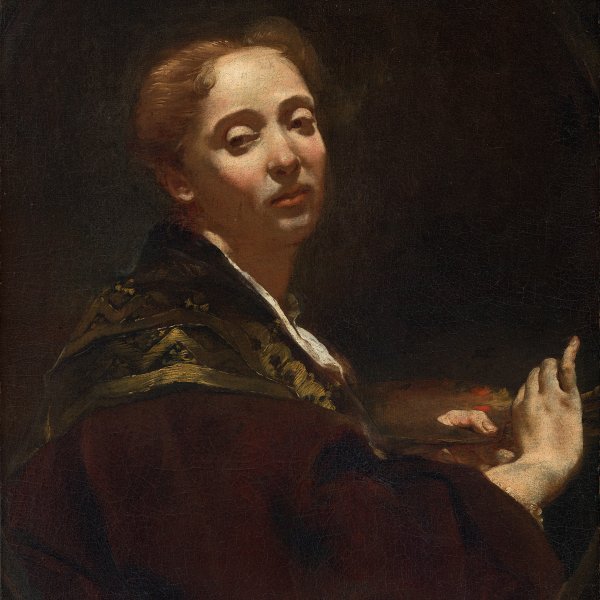
This young woman, who seems to have suddenly turned to her right, looks as if she has been portrayed during an interlude in the celebrations of Carnival, as she delicately holds between her index finger and her thumb the small mask which will make her identification difficult. On her shoulders, slightly open to reveal the chaste neckline, is the black cloak of the bautta, the traditional dress of Venetian women.
The chronological attribution of the painting -on which is based the engraving Franz Xaver Jungwirth made, among others, shortly after the middle of the 18th century- to the first mature years of the artist, that is, the 1720s, a fact undoubtedly plausible from a stylistic point of view, could also be deduced from an external detail: the woman portrayed has been identified as being Rosa Muziolo (1701-1771), a model and, from 1724, Piazzetta's wife.
Even if this identification were incorrect, there is no doubt that the face of the woman portrayed in the small Thyssen canvas appears many times in the works of Piazzetta, and with such insistence that it may at least be supposed there was a certain familiarity between the artist and the model.
If, as Knox believes, Rosa Muziolo, just over the age of twenty, is the person portrayed in a drawing belonging to the Royal Collections in Windsor Castle, in which we can see the bust of a young woman in left profile, her hands together, then we should identify also as Rosa the Susanna of the famous painting by Piazzetta today at the Uffizi (and which belonged for some time to Francesco Algarotti's brother, Count Bonomo), whose execution, at the latest in the first years of the 1720s, would confirm Knox's hypothesis.
If we limit ourselves to following the fil rouge of this image of a young woman in profile holding in her right hand her Carnival mask (il volto), we will see that, in spite of the limitations of the subject, we will have made a useful-not only iconographically-journey into the world of Piazzetta.
So it seems that Rosa Muziolo has to be considered as the protagonist of some of the most famous paintings by her illustrious husband, in spite of the fact that they show the marks of a "neo-17th-century" style and offer a chiaroscuro approach which are not to be found in the delicate "domestic" characterisation of the Thyssen portrait.
Indeed, how can we not think of the implacable executor in Judith and Holofernes, from the Academy of Saint Luke in Rome, with her slightly rounder cheeks, or the protagonist of Rebecca by the Well from the Brera Museum?
The execution of the masterpiece is usually dated around the middle of the 1730's, which could explain, in contrast with the freshness of the young woman in her early twenties in the Carmen Thyssen painting, a slightly fuller, more florid figure.
If the analogy between this painting and the profile of the figure in the oval panel of the Fortitude in the chapel of the Sacrament in the church of San Zanipolo in Venice may seem simply mechanical (it is, in any case, a painting executed in 1727, a date not far from that of the Thyssen Portrait), what is striking is the woman standing in the famous Walk in the Countryside at the Wallraf-Richartz-Museum in Cologne, painted for Marshal von der Schulenburg (together with the no less famous Pastoral Scene now in Chicago, whose main character should be identified as Rosa Piazzetta). However, it is true that this feminine profile, strongly foreshortened, with half-closed eyelids, all in all rather stereotypical and of a marked geometry -and, for this reason, almost worthy of Bencovich- seems to be more indebted to the ideal image d'antan of his wife, who, at the time when the Schulenburg picture was painted, was well into her forties.
The physiognomy of a young woman, with a slightly more bony face, can be recognised in a drawing from the Gallerie dell'Accademia in Venice (Girl with Vase, 37.5 x 27 cm); and we should also bear in mind the study kept at the Civiche Raccolte di Disegni e Stampe at the Castello Sforzesco (charcoal and touches of white chalk, 24.1 x 18.6 cm), in Milan, made for the Fiorellin d'Amore at the Cleveland Museum of Art (40.2 x 54.9 cm).
Roberto Contini
The chronological attribution of the painting -on which is based the engraving Franz Xaver Jungwirth made, among others, shortly after the middle of the 18th century- to the first mature years of the artist, that is, the 1720s, a fact undoubtedly plausible from a stylistic point of view, could also be deduced from an external detail: the woman portrayed has been identified as being Rosa Muziolo (1701-1771), a model and, from 1724, Piazzetta's wife.
Even if this identification were incorrect, there is no doubt that the face of the woman portrayed in the small Thyssen canvas appears many times in the works of Piazzetta, and with such insistence that it may at least be supposed there was a certain familiarity between the artist and the model.
If, as Knox believes, Rosa Muziolo, just over the age of twenty, is the person portrayed in a drawing belonging to the Royal Collections in Windsor Castle, in which we can see the bust of a young woman in left profile, her hands together, then we should identify also as Rosa the Susanna of the famous painting by Piazzetta today at the Uffizi (and which belonged for some time to Francesco Algarotti's brother, Count Bonomo), whose execution, at the latest in the first years of the 1720s, would confirm Knox's hypothesis.
If we limit ourselves to following the fil rouge of this image of a young woman in profile holding in her right hand her Carnival mask (il volto), we will see that, in spite of the limitations of the subject, we will have made a useful-not only iconographically-journey into the world of Piazzetta.
So it seems that Rosa Muziolo has to be considered as the protagonist of some of the most famous paintings by her illustrious husband, in spite of the fact that they show the marks of a "neo-17th-century" style and offer a chiaroscuro approach which are not to be found in the delicate "domestic" characterisation of the Thyssen portrait.
Indeed, how can we not think of the implacable executor in Judith and Holofernes, from the Academy of Saint Luke in Rome, with her slightly rounder cheeks, or the protagonist of Rebecca by the Well from the Brera Museum?
The execution of the masterpiece is usually dated around the middle of the 1730's, which could explain, in contrast with the freshness of the young woman in her early twenties in the Carmen Thyssen painting, a slightly fuller, more florid figure.
If the analogy between this painting and the profile of the figure in the oval panel of the Fortitude in the chapel of the Sacrament in the church of San Zanipolo in Venice may seem simply mechanical (it is, in any case, a painting executed in 1727, a date not far from that of the Thyssen Portrait), what is striking is the woman standing in the famous Walk in the Countryside at the Wallraf-Richartz-Museum in Cologne, painted for Marshal von der Schulenburg (together with the no less famous Pastoral Scene now in Chicago, whose main character should be identified as Rosa Piazzetta). However, it is true that this feminine profile, strongly foreshortened, with half-closed eyelids, all in all rather stereotypical and of a marked geometry -and, for this reason, almost worthy of Bencovich- seems to be more indebted to the ideal image d'antan of his wife, who, at the time when the Schulenburg picture was painted, was well into her forties.
The physiognomy of a young woman, with a slightly more bony face, can be recognised in a drawing from the Gallerie dell'Accademia in Venice (Girl with Vase, 37.5 x 27 cm); and we should also bear in mind the study kept at the Civiche Raccolte di Disegni e Stampe at the Castello Sforzesco (charcoal and touches of white chalk, 24.1 x 18.6 cm), in Milan, made for the Fiorellin d'Amore at the Cleveland Museum of Art (40.2 x 54.9 cm).
Roberto Contini