Pissarro
4 June to 15 September 2013
Advance purchase is recommended
<exchanging gazes> 6: Reflections. From Van Eyck to Magritte
New Display of the Collections
From 10 June to 15 September 2013
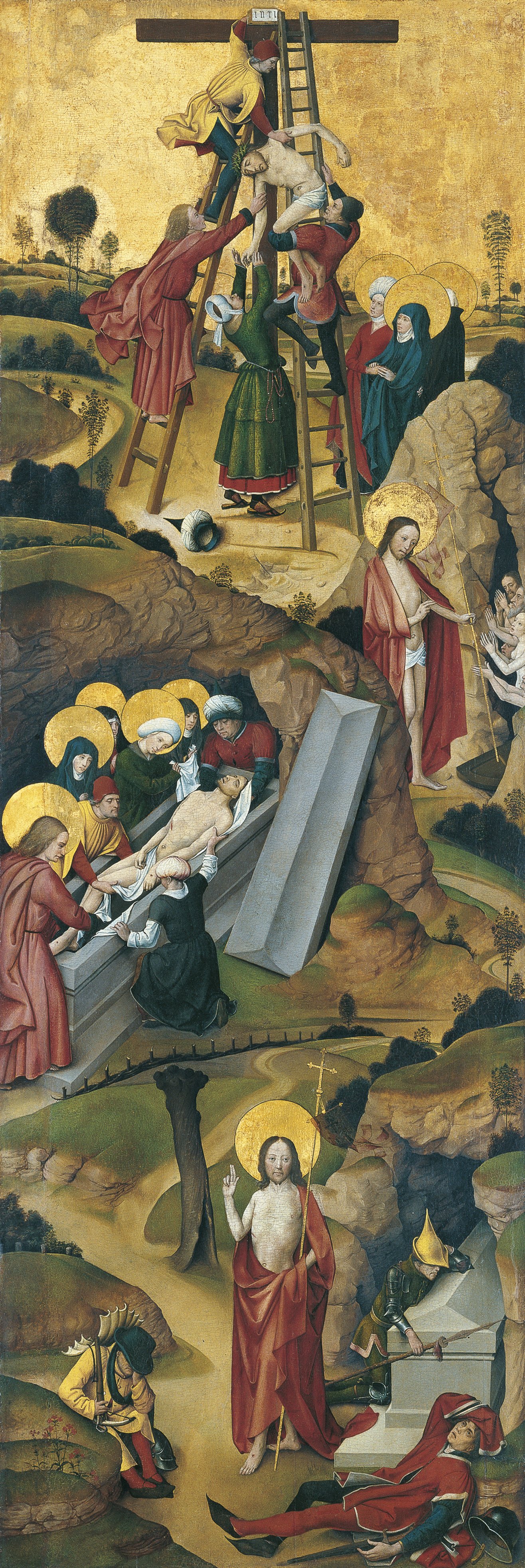
Cataloguing these works has not been a simple task as they combine characteristics of the school of Cologne and of the region of Westphalia. Isolde Lübbeke located them around the area of Düren, whose local style combined the two trends. The anonymous artist used a narrow panel to depict four scenes: The Descent from the Cross, The Burial of Christ, Christ’s Descent into Limbo, and The Resurrection. The narrative starts at the upper part with the scenes connected by a long, winding path. The first episode is The Descent from the Cross, constructed using the traditional triangular composition formed by the cross with the ladders on either side. It is followed by The Burial of Christ, organised around a marked diagonal with the figures crowded together on the left side of the tomb. The next scene is Christ’s Descent into Limbo, with the souls of the Just depicted in prayer, emerging from a small crack in the rock. At the bottom and completing the narrative is The Resurrection.
NR
This narrow panel depicts the four episodes of The Descent from the Cross, The Burial of Christ, Christ’s Descent into Limbo and The Resurrection of Christ. The painter made use of the rocky outcrops in the landscape to separate the episodes as well as the narrow, winding path with its twists and turns that connects the four events. The Descent from the Cross, at the top of the composition, is organized in the traditional triangular format formed by the horizontal section of the cross and the two ladders leaning against it that were used to carry down Christ’s body. The artist located three figures at the base: Joseph of Arimathaea, Nicodemus and Saint John, while the Virgin and two of the holy women wait at the foot of the cross. The background takes the form of a gentle landscape with rounded forms in which the sky has been replaced by a typical gold background. The Burial, the scene that chronologically follows the Crucifixion, is organised around the marked diagonal of the tomb, with the most of the figures located on one side. Following the traditional order of events, Christ descended into Limbo in order to liberate the souls of the righteous, depicted at the mouth of a cave with their hands joined in prayer and supplication. The last scene, again in order, is The Resurrection of Christ in which Christ’s figure is located on the vertical axis of the painting. Having defeated death he is depicted as triumphant in the habitual manner, blessing with one hand while the other holds a slender cross. Of the three soldiers, two remain asleep while one awakes and witnesses the miraculous event.
The use of gold and the way the scenes are organised has led to the suggestion that the panel was possibly the interior right wing of an altarpiece which, to judge from its relatively small size, was not painted for a high altar. The painting was previously in a Franciscan monastery in Düren. This presumably lateral panel, which may have flanked a Crucifixion or a sculptural ensemble in the centre, had an exterior face with an image of Saint Louis of Toulouse, now in the Leopold-Hörsch Museum in Düren.
The painting, which has proved difficult to catalogue due to its characteristics, has been associated with artists working in Westphalia and Cologne. Following a study of the various surviving elements of the overall composition, Lübbeke located it origins in the Düren area where artists fused the influences of the two schools that inspired this painter and where the traditional style was combined with new artistic trends
Mar. Borobia
Necklace The Cabbage Field
Add to Basket
Earrings Leaves
Add to Basket
Necklace Landscape
Add to Basket
Headband Easter Morning
Add to Basket
Earrings Schiele
Add to Basket
Bracelet Schiele
Add to Basket
Necklace The Kimono
Add to Basket
Catalogue of the Exhibition Hyperrealism 1967-2012 (Spanish edition)
Add to Basket
Catalogue of the exhibition Pisarro (Spanish edition)
Add to Basket
Ipad Cleaning Cloth Martha Mckeen
Add to Basket
Air Freshener sticks Lime Tree
Add to Basket
Camille y Lucien Pisarro. Cartas 1883-1903
Add to Basket
Case with Mugs Delaunay
Add to Basket
Big Bowl Melon
Add to Basket
Bottles and Vases Paul Klee
Add to Basket
Pendant Vincent van Gogh
Add to Basket
Pendant Leaves
Add to Basket
Glass Tray Peony
Add to Basket
Glasses Case with cleaning cloth Peony
Add to Basket
Tote Bag Pissarro
Add to Basket
Brooch The Forest of Marly
Add to Basket
© 2009 Museo Thyssen-Bornemisza
Paseo del Prado 8, 28014 Madrid, España