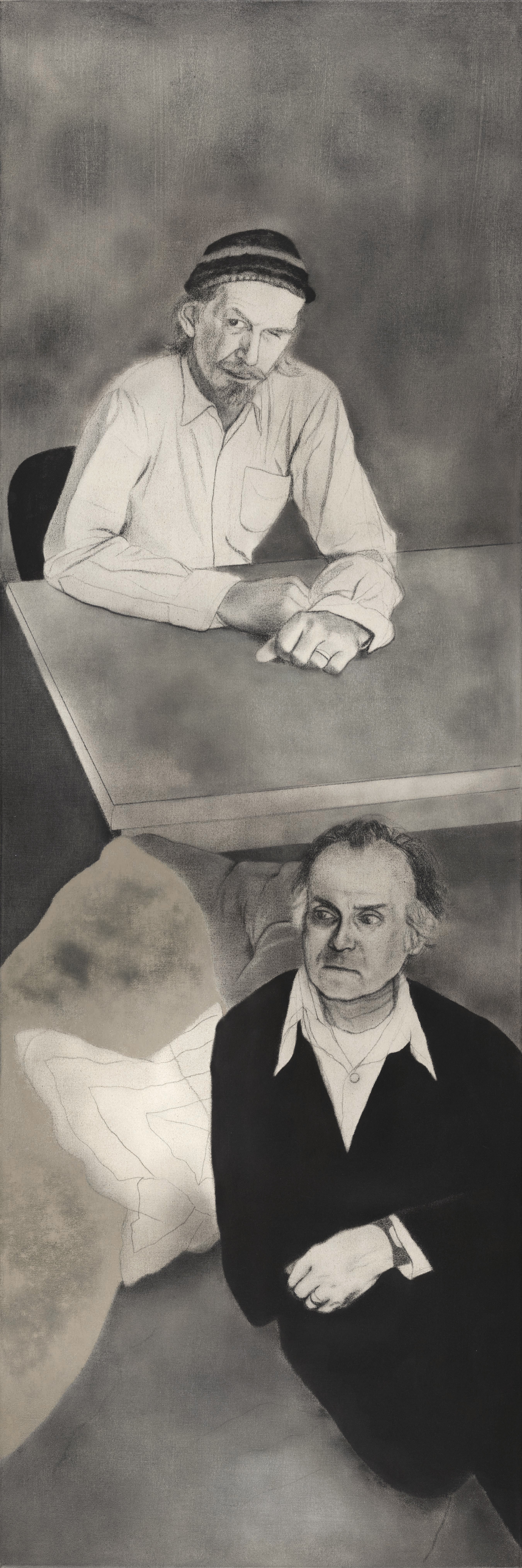
A Visit to London (Robert Creeley and Robert Duncan)
1977
Oil and graphite on canvas.
182.9 x 61 cm
Museo Nacional Thyssen-Bornemisza, Madrid
Inv. no.
620
(1981.75
)
Room 52
Level 1
Permanent Collection
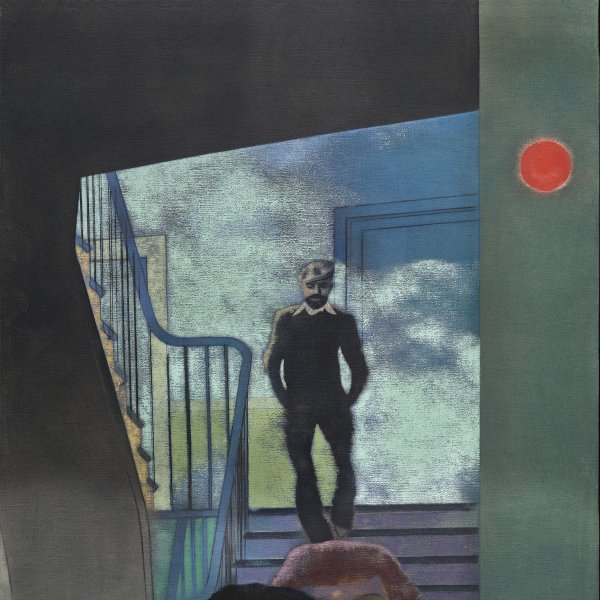
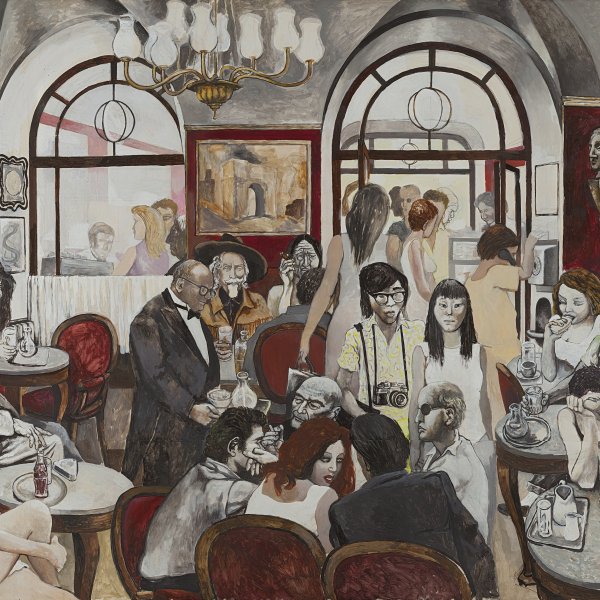
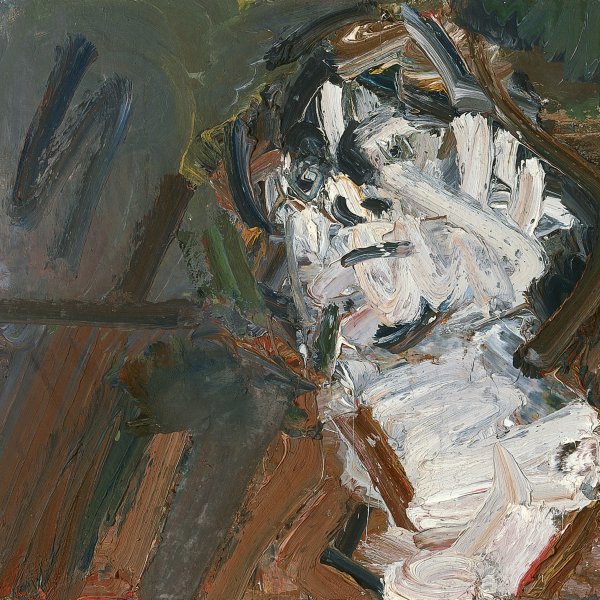
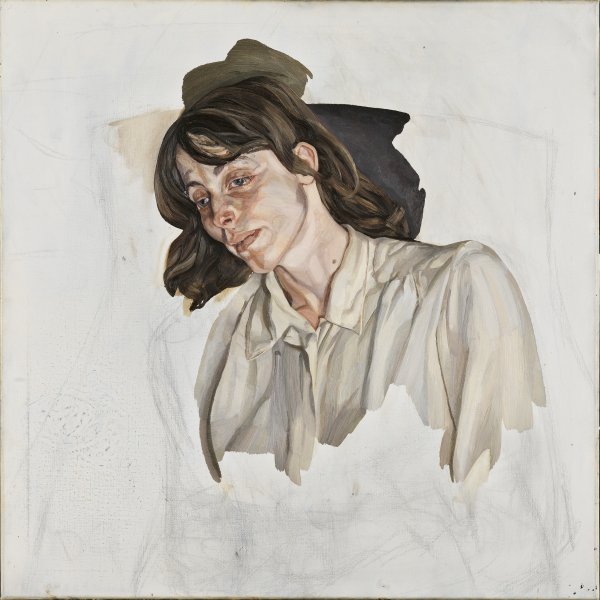
Ronald Brooks Kitaj, an American Jew who spent most of his life in London, was a controversial artist — accursed even — who always went against the grain of his time. Although when starting out he became one of the pioneers of British Pop Art, in 1976 he proposed the name School of London to encompass the group of friends concerned with capturing in painting their observations of the human being, he generally kept out of, or even went against, any fashion or trend in art. His intention was to understand his time through the great historical tradition of painting and he adopted a critical attitude towards modern movements and stances that advocated art for art’s sake. Like the painting of Bacon, Auerbach or Freud, Kitaj’s oeuvre is centred on representing the human figure, but always infused with literary undertones. Furthermore, Kitaj remained convinced that there was a connection between images and ideas and therefore his paintings are a sort of collage of images that convey diverse meanings.
In the early 1970s, Kitaj established his studio in Queensbury Park, opposite the Victoria and Albert Museum, and began painting on large, elongated canvases which enabled him to depict full-length figures. It was then that he found in his Jewish nature a new redemptive narrative, and in the figure of the modern Jew a metaphor of the human condition. A Visit to London (Robert Creeley and Robert Duncan), executed in 1977, belongs to a set of double portraits dating from the second half of the 1970s. This large grisaille was painted from life while the painter’s friends Robert Creeley and Robert Duncan were visiting his London home. These two American poets, who belonged to the Black Mountain College group and were editors of the Black Mountain Review, under the patronage of the great scholar Charles Olson, had become Kitaj’s chief link to the intellectual circles of California and New York. Duncan is shown reclining in an armchair in the lower part of the painting with crossed arms and an absent look, while Creeley, with his inseparable woollen hat, is seated in the background resting his hands on a table. As in all his portraits, chiefly of writers, artists and intellectuals, Kitaj explores the relationship between the visual and the poetic through a subtle hotchpotch of photographic images, references to his own experiences and allusions to literature and popular culture.
Paloma Alarcó
In the early 1970s, Kitaj established his studio in Queensbury Park, opposite the Victoria and Albert Museum, and began painting on large, elongated canvases which enabled him to depict full-length figures. It was then that he found in his Jewish nature a new redemptive narrative, and in the figure of the modern Jew a metaphor of the human condition. A Visit to London (Robert Creeley and Robert Duncan), executed in 1977, belongs to a set of double portraits dating from the second half of the 1970s. This large grisaille was painted from life while the painter’s friends Robert Creeley and Robert Duncan were visiting his London home. These two American poets, who belonged to the Black Mountain College group and were editors of the Black Mountain Review, under the patronage of the great scholar Charles Olson, had become Kitaj’s chief link to the intellectual circles of California and New York. Duncan is shown reclining in an armchair in the lower part of the painting with crossed arms and an absent look, while Creeley, with his inseparable woollen hat, is seated in the background resting his hands on a table. As in all his portraits, chiefly of writers, artists and intellectuals, Kitaj explores the relationship between the visual and the poetic through a subtle hotchpotch of photographic images, references to his own experiences and allusions to literature and popular culture.
Paloma Alarcó