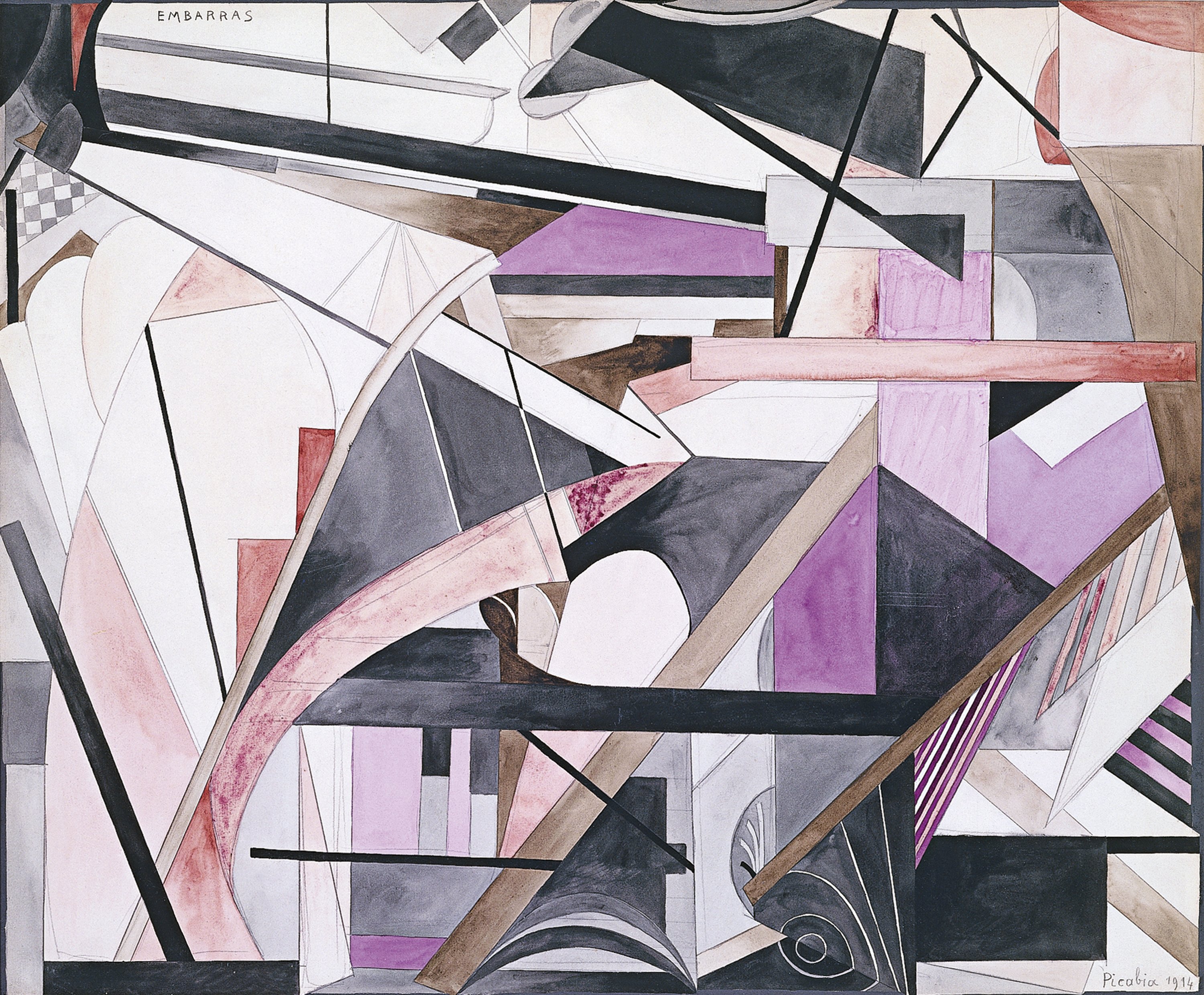
Predicament
1914
Watercolor and pencil on paper mounted on cardboard.
53.8 x 64.7 cm
Museo Nacional Thyssen-Bornemisza, Madrid
Inv. no.
703
(1982.41
)
Rooms Exposiciones Temporales Planta Primera
Level 1
Permanent Collection
Picabia’s relationship with abstract art was very short lived. The Thyssen-Bornemisza Predicament, a watercolour that predates Picabia’s conscription in summer 1914 and belonged to his friend Marcel Duchamp, was part of a suite of abstract works executed after he returned to Paris from New York. They may be considered in the same context as the watercolours he had shown at Alfred Steiglitz’s Photo Secession Gallery from March to April 1913, which expressed what he described as “the spirit of New York as I feel it.” Impressed by the American city’s modernity and vitality, Picabia threw himself into exalting the urban progress of Manhattan: “I have enlisted the machinery of the modern world and introduced it in my studio, ” he stated. Furthermore, the interviews and writings published during his period of residence in the American metropolis, which coincided with the Armory Show, reveal his insistence on the spontaneous, the expressive and the musical, denoting a particular closeness to the work of Kandinsky. This closeness may also be glimpsed in his own writings, as for him art consisted of an attempt “to render external an internal state of mind or feeling, to project onto the canvas emotional, temperamental, mental, subjective states.”
Towards 1914 Picabia often incorporated the title of the work into the image, a device which enabled him to add certain thought-provoking ideas or contents. Embarras, the title inscribed on the upper part of the composition, which is generally translated as Predicament, has many connotations. It can also denote “problem” or “awkward situation, ” as well as “embarrassment, ” and therefore has various meanings depending on whether it refers to the nature of the image or to the state of mind of the artist or the viewer. Provocative titles of this kind, which began to enjoy a certain importance in Picabia’s pre-Dadaist works, became a decisive element in his Dadaist works produced between 1915 and 1920. It was precisely this provocative aspect of his oeuvre that was highlighted by André Breton, the painting’s owner from 1926, at the artist’s funeral in 1953: “Only someone who was a great aristocrat in spirit could dare do what you have done.”
Paloma Alarcó
Towards 1914 Picabia often incorporated the title of the work into the image, a device which enabled him to add certain thought-provoking ideas or contents. Embarras, the title inscribed on the upper part of the composition, which is generally translated as Predicament, has many connotations. It can also denote “problem” or “awkward situation, ” as well as “embarrassment, ” and therefore has various meanings depending on whether it refers to the nature of the image or to the state of mind of the artist or the viewer. Provocative titles of this kind, which began to enjoy a certain importance in Picabia’s pre-Dadaist works, became a decisive element in his Dadaist works produced between 1915 and 1920. It was precisely this provocative aspect of his oeuvre that was highlighted by André Breton, the painting’s owner from 1926, at the artist’s funeral in 1953: “Only someone who was a great aristocrat in spirit could dare do what you have done.”
Paloma Alarcó