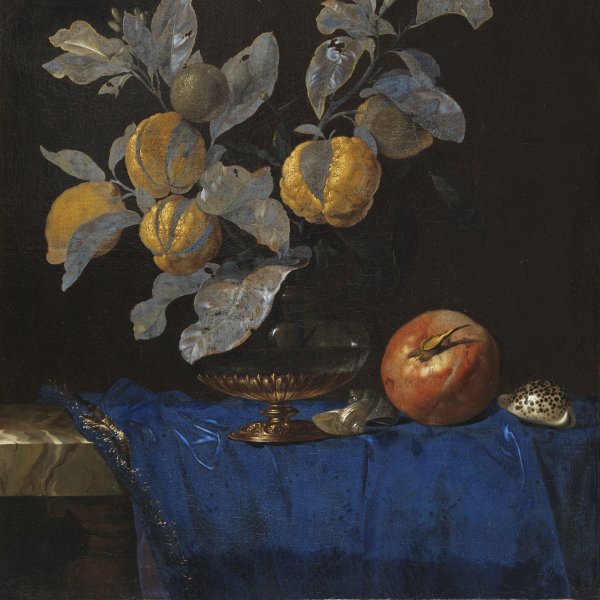
Willem van Aelst
Delft, 1627-Amsterdam, after 1687 (?)
Willem van Aelst was born in Delft in 1627. He was the nephew of the still-life painter Evert van Aelst, with whom he first trained. In 1643 he is first mentioned as registered in the painters’ guild in Delft. From 1645 to 1649 he lived and worked in France, leaving there for Italy. In Florence, Van Aelst was Court Painter to Ferdinand II de’Medici, Grand Duke of Tuscany. In Florence the artist made contact with his fellow Dutch still-life painters Matthias Withoos and Otto Marseus van Schrieck. He was part of the Schildersbent, the association of northern painters living in Italy and from them received the nickname of Vogelverschrikker [Scarecrow]. In 1656 he returned to Holland, taking up permanent residence in Amsterdam. From 1658 Van Aelst signed his work with the name of Guillmo van Aelst or with his nickname in memory of his time in Italy. The date of his death is unknown, but it was after 1687, the date of his last known work. Van Aelst produced four types of still life: floral compositions, fruit, breakfast pieces and bird compositions, the latter with or without hunting implements. His still lifes reveal the influence of Jan Davidsz. de Heem, from whom he derived his brown backgrounds, extensive foliage and the way in which the stalk or branch trails down and occupies the pictorial space. Van Aelst’s works can be distinguished from those of De Heem in his use of a cool palette of blues, mauves and greens, probably deriving from the influence of his time in France and Italy, as well as in his delicate and harmonious manner of organising the elements. His most important contribution to the genre was the introduction of asymmetrical motifs that create vigorous diagonals. This new type of composition was soon taken up by his followers. More than 60 still lifes of game are known by the artist. They are characterised by their technical perfection and decorative nature and were also extremely influential and much imitated. Among Van Aelst’s followers were Maria van Oosterwyck, Rachel Ruysch and Jan van Huysum.