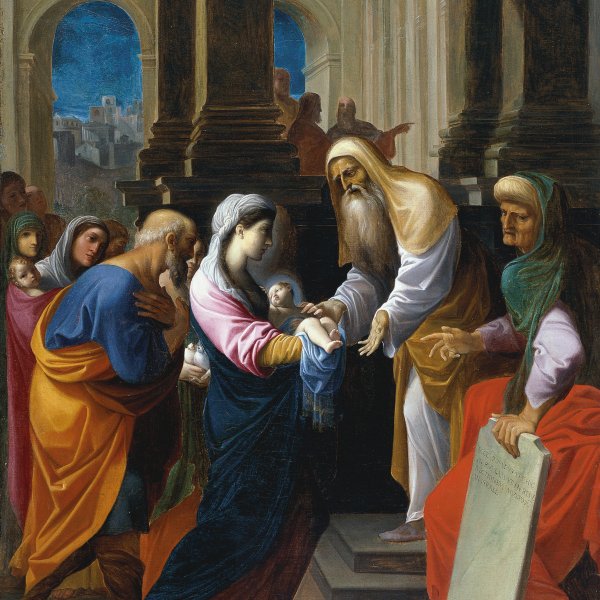
Ludovico Carracci
A painter, draughtsman and printmaker, Ludovico Carracci was born in Bologna in 1555. He embarked on his career as a painter at a relatively late age and was taught by Prospero Fontana. Carracci travelled to Florence, Mantua, Parma and Venice. In 1585 he and his cousins Agostino and Annibale founded the Accademia degli Incamminati, whose major innovation was the promotion of a direct study of nature and life through drawing, to which they conceded primary importance. These artists interpreted the human figure in a warmer, more simple and natural manner, endowing it with a more expressive character. The result was a change of direction and a move away from late Mannerism. Ludovico’s style, however, combines echoes of Mannerist art with an innate religiosity and a naturalism derived from his activities at the Accademia.
Among works from his early period are Saint Vincent Martyr (collection Credito Romagnolo, Bologna) and the Bargellini Altapiece of The Virgin and Child (Pinacoteca Nazionale, Bologna), the latter revealing his evolution and newfound artistic maturity. Portraits constitute an important part of Ludovico Carracci’s oeuvre. Portrait of the Tacconi Family (Pinacoteca Nazionale, Bologna) reveals his interest in psychological interpretation and the emotional states of his sitters. The artist collaborated with his cousins on the frescoes in the Palazzo Fava, and in 1590 on the decoration of the Palazzo Magnani. At that point Agostino and Annibale left for Rome while Ludovico remained in Bologna, where he came to occupy a prominent position. He continued to direct the Accademia, whose pupils included some of the most important painters of the day, such as Francesco Albani, Domenichino, Guercino and Guido Reni. In 1602 Ludovico travelled to Rome where he became acquainted with classical antiquity and the decorations by Annibale in the Palazzo Farnese. In 1604 he painted frescoes for the monastery of San Michele in Bosco, which are works of outstanding quality. Ludovico’s last phase was characterised by an eccentric, mystical style in which his palette became darker and more expressive, combined with marked contrasts of light and shadow.