Lovis Corinth
Tapiau, 1858-Holanda, 1925
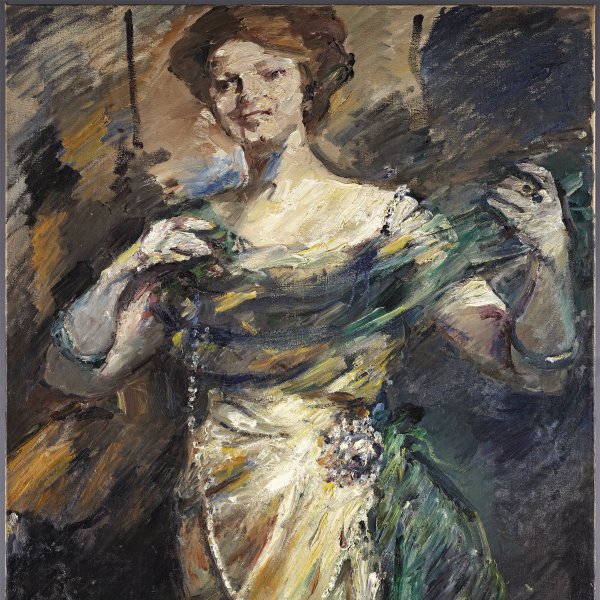
Having trained as an artist in the German realist tradition at the Kunstakademie in Königsberg and Munich, Lovis Corinth evolved towards a personal style that was initially affiliated with Impressionism and later veered towards Expressionism. While studying in Munich under Ludwig von Löfftz, he was greatly attracted by the work of Wilhelm Leibl and Wilhelm Trübner, naturalist painters who were familiar with the new trends in contemporary French painting spearheaded by Courbet and the Barbizon School. In 1884 Corinth embarked on a journey that took him to Antwerp and Paris, where he attended the Académie Julian and was taught by two well known painters of the Salon: Tony Robert-Fleury and Adolphe William Bouguereau.
In 1891, after returning to Munich, he became a member of the city’s Secession, although he left it barely two years later along with other artists to found the Freie Vereinigung in order to improve the possibilities of exhibiting his works. Finally, in 1901, discontent with his life in the city and troubled by financial problems, he moved to Berlin permanently. The art scene in the capital soon prompted him to frequent the innovative circles. He collaborated intensely with the Berlin Secession and his first exhibition was held in 1900 at the Paul Cassirer gallery, with which he remained connected in the following years. He also opened an art school for women. In 1903 he married Charlotte Berend, who had been its first student.
Corinth was elected president of the Secession following Max Liebermann’s retirement, but at the end of the year he suffered a stroke from which he never fully recovered. Even so, he managed to paint again and this period proved to be one of the most prolific of his career, during which he produced high quality works that can be linked to Expressionism. In 1915 he likewise resumed the presidency of the Secession and in 1917 he became a teacher at the Akademie der Bildenden Künste in Berlin. He died during a trip to Holland in 1925.
In 1891, after returning to Munich, he became a member of the city’s Secession, although he left it barely two years later along with other artists to found the Freie Vereinigung in order to improve the possibilities of exhibiting his works. Finally, in 1901, discontent with his life in the city and troubled by financial problems, he moved to Berlin permanently. The art scene in the capital soon prompted him to frequent the innovative circles. He collaborated intensely with the Berlin Secession and his first exhibition was held in 1900 at the Paul Cassirer gallery, with which he remained connected in the following years. He also opened an art school for women. In 1903 he married Charlotte Berend, who had been its first student.
Corinth was elected president of the Secession following Max Liebermann’s retirement, but at the end of the year he suffered a stroke from which he never fully recovered. Even so, he managed to paint again and this period proved to be one of the most prolific of his career, during which he produced high quality works that can be linked to Expressionism. In 1915 he likewise resumed the presidency of the Secession and in 1917 he became a teacher at the Akademie der Bildenden Künste in Berlin. He died during a trip to Holland in 1925.