Ilya Chashnik
Lucin, 1902-Saint Petersburg, 1929
Despite his early death, the Russian artist Ilya Chashnik was one of the foremost disciples of Kazimir Malevich and espoused the Suprematist principles advocated by the latter. He was born into a humble Jewish family in Latvia and spent his childhood in Vitebsk, where he was introduced to the world of painting by a local artist.
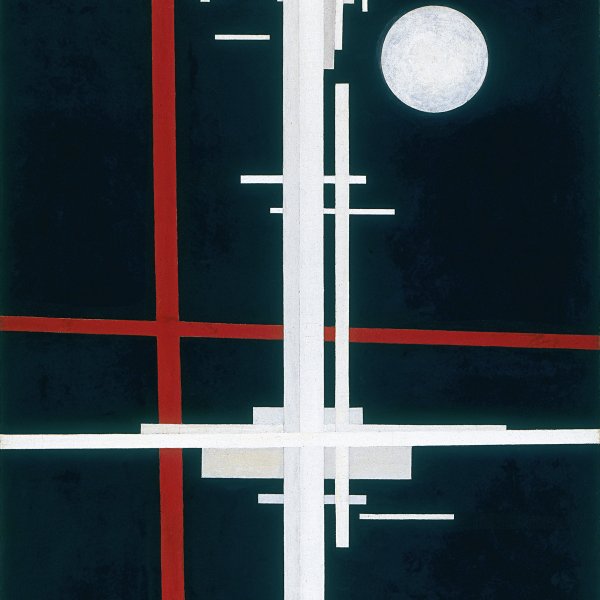
Chashnik moved to Moscow in 1919 to further his artistic training at the Higher State Art-Technical-Studios (Vkhutemas) in Moscow, but his attraction for the work of Marc Chagall spurred him to return to Vitebsk after a few months to attend the art school he directed. However, after he met Malevich, who taught at the same school, his art underwent a radical change of direction and he became one of the most talented and faithful followers of his Suprematist master. During the winter of 1919–20, Malevich and a group of students formed the group known as Unovis (Affirmers of the New Art). Among those involved in the initiative were Ilya Chashnik and Nikolai Suetin, who became close friends and went on to collaborate in various projects. Chashnik developed his own style within the Suprematist idiom, evolving from Malevich’s white compositions to paintings in which black was the predominant element. In these works geometric shapes form crossing planes with a tendency towards rhythm and symmetry.
After graduating in Vitebsk in 1922, he moved to Petrograd (now Saint Petersburg), where Malevich and other artists belonging to Unovis were already living. During this period Chashnik concentrated on exploring the possible applications of Suprematism in daily life: he designed textiles, posters and buildings and worked with Suetin in the Lomonossov factory. He began to collaborate with the Institute of Artistic Culture (Inkhuk) in 1923 and from 1925 with the Institute of Decorative Arts.
Chashnik moved to Moscow in 1919 to further his artistic training at the Higher State Art-Technical-Studios (Vkhutemas) in Moscow, but his attraction for the work of Marc Chagall spurred him to return to Vitebsk after a few months to attend the art school he directed. However, after he met Malevich, who taught at the same school, his art underwent a radical change of direction and he became one of the most talented and faithful followers of his Suprematist master. During the winter of 1919–20, Malevich and a group of students formed the group known as Unovis (Affirmers of the New Art). Among those involved in the initiative were Ilya Chashnik and Nikolai Suetin, who became close friends and went on to collaborate in various projects. Chashnik developed his own style within the Suprematist idiom, evolving from Malevich’s white compositions to paintings in which black was the predominant element. In these works geometric shapes form crossing planes with a tendency towards rhythm and symmetry.
After graduating in Vitebsk in 1922, he moved to Petrograd (now Saint Petersburg), where Malevich and other artists belonging to Unovis were already living. During this period Chashnik concentrated on exploring the possible applications of Suprematism in daily life: he designed textiles, posters and buildings and worked with Suetin in the Lomonossov factory. He began to collaborate with the Institute of Artistic Culture (Inkhuk) in 1923 and from 1925 with the Institute of Decorative Arts.