Sonia Delaunay
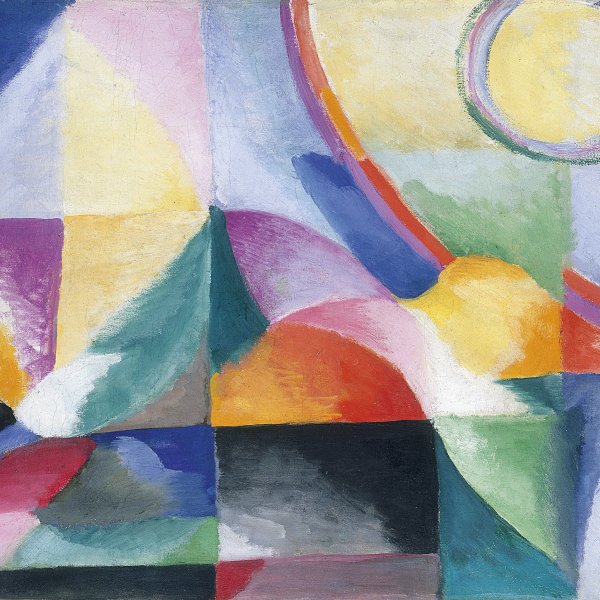
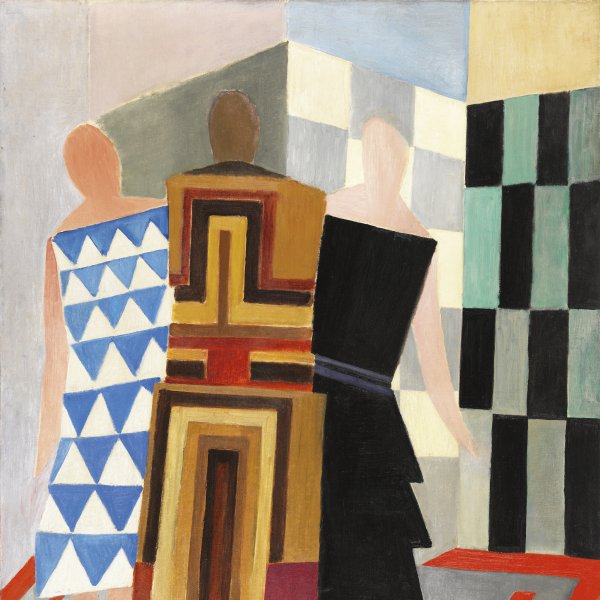
Sonia Delaunay, née Sara Élievna Stern, played a fundamental role in the development of Simultanism, a trend which she expressed both in painting and in the design of fashion, textiles and books, among others. Born in Ukraine, when she was a child she was entrusted to her maternal uncle in Saint Petersburg, from whom she received a cosmopolitan upbringing.
Through Max Liebermann, an acquaintance of her uncle’s, she came into contact with the German art world and went to live in Karlsruhe in 1904 to begin studying painting. Two years later she furthered her training at the Académie la Palette in Paris. During this period her works reflected her admiration for Van Gogh, Gauguin or the Fauvism of Matisse.
To avoid having to leave France, Sonia Delaunay entered into a marriage of convenience with the German dealer Wilhelm Uhde, who introduced her to avant-garde artists such as Pablo Picasso, Georges Braque and Robert Delaunay, whom she married in 1910 after divorcing Uhde. Thenceforward the artistic intercourse between them was constant. Like Robert, Sonia as interested in the colour theories of Michel-Eugène Chevreul and started on her non-figurative series of Simultaneous Contrasts in 1913. That year she collaborated in illustrating and designing the cover for Blaise Cendrars’ Prose on the Trans-Siberian Railway and of Little Jehanne of France. The eruption of the First World War took them by surprise when in the Iberian Peninsula, and Sonia spent the war years in Spain and Portugal. In 1917, following the triumph of the October Revolution, she no longer received an income and began to sell her own creations, first in Madrid, where she opened a shop with her own fashion and interior designs, and later in Paris, after she returned to the city in 1921. She was closely connected with the Dadaist and Surrealist groups of Paris of the 1920s and collaborated with them in producing theatre and film projects such as Le Somptier’s Le P’tit Parigot.
During the 1930s Sonia was in contact with groups of artists who advocated abstraction in art, such as Abstraction-Création and Cercle et Carré, and was one of the founding members of Réalités Nouvelles in 1939. After her husband died in 1941, she carried on working and collaborating in the promotion of abstract art. In 1964, after making a gift of her and her husband’s works, she became the first living woman to be honoured with an exhibition at the Musée du Louvre.