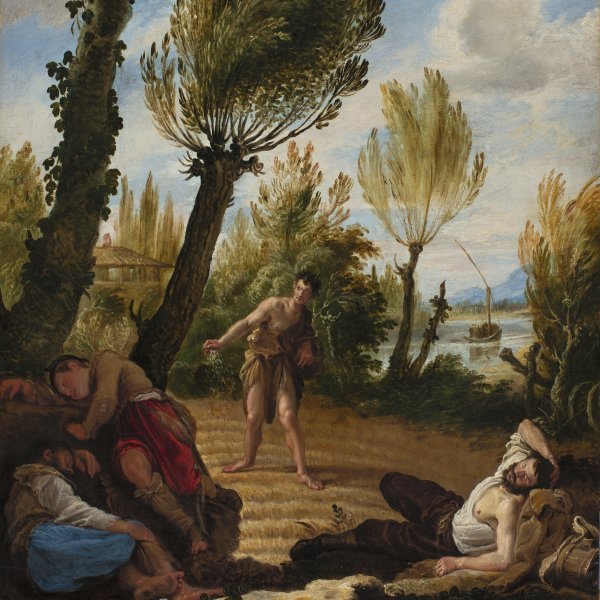
Domenico Fetti
Rome, 1589-Venice, 1623
Domenico Fetti trained in his native city of Rome, initially with his father, the painter Pietro Fetti, then in the studio of Andrea Commodi and finally with Lodovico Cigoli. Among his first works is a Portrait of Filippo Neri of 1610. His early works reveals an interest in the use of small formats, in northern European genre painting and in the work of Carlo Saraceni. By 1611 Fetti was receiving commissions from Ferdinando Gonzaga, at that date Cardinal of Rome, for whom he continued to work when the latter became Duke of Mantua two years later. In 1614 Fetti moved with his family to that city, where he soon developed his mature style. As superintendent of the ducal collection he became closely familiar with the works of the great painters, particularly Rubens and the 16th-century Venetian school.
Fetti was a versatile painter who experimented with different genres over the course of his career. He painted portraits, such as that of Francesco Andreini (Hermitage, St. Petersburg), allegorical works including Melancholy (Gallerie dell’Accademia, Venice), mythological scenes such as Hero and Leander (Kunsthistorisches Museum, Vienna), and religious compositions, including Episodes from the Life of Christ (Galleria Corsini, Florence). Fetti’s most important works were, however, the paintings that comprise his cycle on the Parables. These small-format works were executed between 1618 and 1621 for the Duke of Mantua and were extremely well received, widely copied and imitated.
In 1622 Fetti was involved in a violent fight and had to flee Mantua. He settled in Venice where he remained until his death the following spring. In Venice, Fetti enjoyed the protection of Giorgio Contarini degli Scrigni and Carlo Saraceni and his painting acquired a new lyricism, evident in late works such as The Flight into Egypt (Kunsthistorisches Museum, Vienna).
Fetti was a versatile painter who experimented with different genres over the course of his career. He painted portraits, such as that of Francesco Andreini (Hermitage, St. Petersburg), allegorical works including Melancholy (Gallerie dell’Accademia, Venice), mythological scenes such as Hero and Leander (Kunsthistorisches Museum, Vienna), and religious compositions, including Episodes from the Life of Christ (Galleria Corsini, Florence). Fetti’s most important works were, however, the paintings that comprise his cycle on the Parables. These small-format works were executed between 1618 and 1621 for the Duke of Mantua and were extremely well received, widely copied and imitated.
In 1622 Fetti was involved in a violent fight and had to flee Mantua. He settled in Venice where he remained until his death the following spring. In Venice, Fetti enjoyed the protection of Giorgio Contarini degli Scrigni and Carlo Saraceni and his painting acquired a new lyricism, evident in late works such as The Flight into Egypt (Kunsthistorisches Museum, Vienna).