Lucio Fontana
Rosario de Santa Fe, 1899-Comabbio, 1968
Born in Argentina to an Italian sculptor who returned to Italy with his family in 1905, the young Fontana spent his childhood in both countries. In 1928 he resumed his art studies — which he had abandoned in 1920 — at the Accademia di Brera in Milan. His master, Adolfo Wildt, instructed him in the solemn, monumental sculpture of the Novecento, which Fontana soon rejected in favour of abstraction. He joined Abstraction-Création in 1934, but dropped out of the association only a year later and produced a series of works in a figurative, Neo-Expressionist style that was emerging in the main Italian cities as a reaction to the Novecento.
When the Second World War erupted Fontana returned to Argentina and established the Academia Altamira. In 1946 he wrote the White Manifesto, in which he again advocated abstraction, questioned the two-dimensional vision of painting in the West and encouraged the new techniques that were made possible by scientific discoveries. This was his first step towards Spatialism, which he progressively defined in the five manifestos he wrote between 1947 and 1952 as a quest to transform matter into energy and invade space in a dynamic manner.
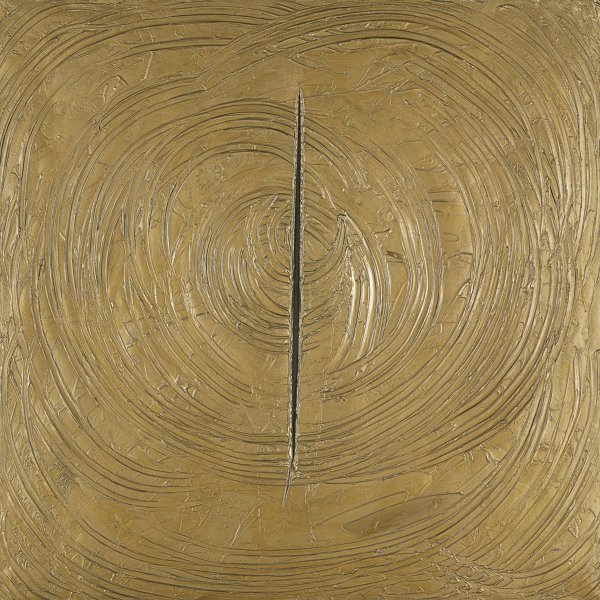
Lucio Fontana explored the concept of space and his interest in technological and scientific breakthroughs drove him to experiment with all kinds of media. As a painter with a grounding in sculpture, he strove to introduce the third dimension into his canvases by means of perforations and slashes, and used a broad variety of materials for his sculptures, from ceramic and metal to neon and UV light.
On returning to Milan in 1947, Fontana showed many of his experiments, often called Spatial Concepts. One of the most important, exhibited in 1949 at the Galleria del Naviglio in Milan, was Spatial Ambience with Black Light, his first temporary installation incorporating neon light. That year he started work on his series of Perforations, in which he made holes in the canvas to allow the space behind the painting to intrude into the work, and in 1958 began to produce the so-called Slash Pictures, in which monochrome surfaces focused the viewer’s attention on the support, which had been incised with a knife.
After returning to Italy following the Second World War, Fontana worked intensely with architects such as Luciano Baldessari in designing and decorating exhibition pavilions, in keeping with his wish to create a new aesthetic idiom in which all the arts could merge.
When the Second World War erupted Fontana returned to Argentina and established the Academia Altamira. In 1946 he wrote the White Manifesto, in which he again advocated abstraction, questioned the two-dimensional vision of painting in the West and encouraged the new techniques that were made possible by scientific discoveries. This was his first step towards Spatialism, which he progressively defined in the five manifestos he wrote between 1947 and 1952 as a quest to transform matter into energy and invade space in a dynamic manner.
Lucio Fontana explored the concept of space and his interest in technological and scientific breakthroughs drove him to experiment with all kinds of media. As a painter with a grounding in sculpture, he strove to introduce the third dimension into his canvases by means of perforations and slashes, and used a broad variety of materials for his sculptures, from ceramic and metal to neon and UV light.
On returning to Milan in 1947, Fontana showed many of his experiments, often called Spatial Concepts. One of the most important, exhibited in 1949 at the Galleria del Naviglio in Milan, was Spatial Ambience with Black Light, his first temporary installation incorporating neon light. That year he started work on his series of Perforations, in which he made holes in the canvas to allow the space behind the painting to intrude into the work, and in 1958 began to produce the so-called Slash Pictures, in which monochrome surfaces focused the viewer’s attention on the support, which had been incised with a knife.
After returning to Italy following the Second World War, Fontana worked intensely with architects such as Luciano Baldessari in designing and decorating exhibition pavilions, in keeping with his wish to create a new aesthetic idiom in which all the arts could merge.