Aert de Gelder
Dordrecht, 1645-1727
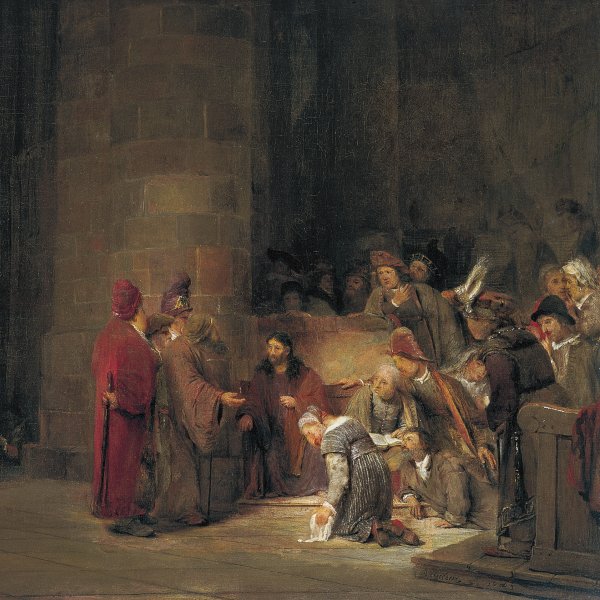
Aert de Gelder began his studies as a painter in the studio of Samuel van Hoogstraten in his native city of Dordrecht. Around 1661 he moved to Amsterdam to complete his training in Rembrandt’s studio. He was the last of Rembrandt’s pupils, remaining with him for two years, after which he returned to Dordrecht and lived there for the rest of his life. From his early years Aert de Gelder was considered to be Rembrandt’s best and most direct follower but he has also been seen as an eccentric figure as he was the only artist to continue to work in Rembrandt’s style until well into the 18th century. His works are clearly inspired by those of his master, for example the Ecce Homo (Staatliche Kunstsammlung, Dresden) of 1671, which is a variant on Rembrandt’s etching on that subject, or Abraham and the Angels (Boijmans- Van Beuningen Museum, Rotterdam), which was for many years considered to be by Rembrandt himself. Nonetheless, it is primarily in Aert de Gelder’s technique that Rembrandt’s influence is most evident and most long lasting. De Gelder’s brushstrokes are broad and heavily charged, with the pigment often applied with the finger or a spatula to achieve different textures. The artist also favoured effects achieved through scratching into the wet paint with the other end of the brush.
Aert de Gelder focused primarily on biblical scenes, of which his Scenes of the Passion, painted around 1715 are his most famous works. Like Rembrandt, he collected arms and armour, old shoes and costumes and curious objects, all of which he depicted in his paintings. De Gelder also painted portraits, which are notable for their naturalism and reveal little interest in the elegant Flemish style in vogue in late 17th-century Holland. One such example is Portrait of Dr Boerhaave and his Family (Rijksmuseum, Amsterdam). De Gelder’s most characteristic and original trait within his style was his use of colour, particularly from the start of the 18th century onwards, when he began to add early whites, yellows, blues, oranges, greens and violets to Rembrandt’s palette.
Aert de Gelder focused primarily on biblical scenes, of which his Scenes of the Passion, painted around 1715 are his most famous works. Like Rembrandt, he collected arms and armour, old shoes and costumes and curious objects, all of which he depicted in his paintings. De Gelder also painted portraits, which are notable for their naturalism and reveal little interest in the elegant Flemish style in vogue in late 17th-century Holland. One such example is Portrait of Dr Boerhaave and his Family (Rijksmuseum, Amsterdam). De Gelder’s most characteristic and original trait within his style was his use of colour, particularly from the start of the 18th century onwards, when he began to add early whites, yellows, blues, oranges, greens and violets to Rembrandt’s palette.