
Alberto Giacometti
Borgonovo, 1901-Chur, 1966
The paintings and, especially, the sculptures of the Swiss artist Alberto Giacometti were the plastic expression of the existentialist crisis that afflicted Western society after the end of the Second World War.
Giacometti grew up in a family of artists. His father, Giovanni, was a Neo-Impressionist painter and his godfather was Cuno Amiet. From 1919 to 1920 he studied painting at the École des Beaux-Arts and sculpture and drawing at the École des Arts et Métiers in Geneva. He travelled to Italy with his father in 1920 and was immensely impressed by Giotto and Tintoretto, Egyptian and African art, and the work of Alexander Archipenko and Paul Cézanne that he had the chance to see at the Venice Biennale. Giacometti moved to Paris in 1922 and in 1927, the year his brother Diego joined him to become his assistant, he began to work in a studio on the rue Hipolyte-Maindron in Montparnasse. In 1929 the Galerie Jeanne Bucher showed two sculptures from his series Plaques, which powerfully drew the attention of the Paris art scene, particularly the Surrealist circle, with whom he was associated until 1934. During this period Giacometti experimented with all kinds of materials and became the most innovative of all the Surrealist sculptors.
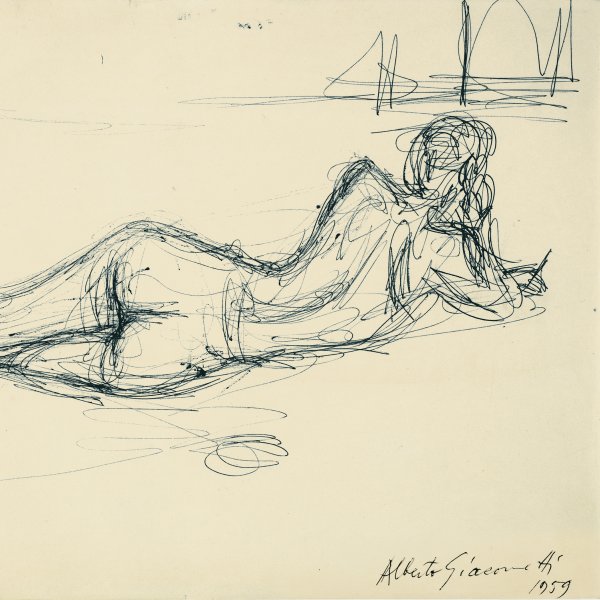
In 1935 he experienced a creative crisis lasting practically a decade, during which he went back to working with models, whom he subjected to lengthy sittings. This method, which he had abandoned in his Surrealist period, resulted in sculptures that were reduced to their minimum expression and paved the way for his entire subsequent output. In 1945, after the end of the Second World War, his long, thin figures were perceived as a fitting metaphor for man emerging from the aftermath of war, according to the interpretation of Jean-Paul Sartre, who was a friend of Giacometti since they met during the French writer’s exile in Geneva in 1943. In addition, following a twenty-year break, Giacometti went back to painting and drawing regularly, employing a sketchy style to isolate the figures.
The Pierre Matisse Gallery in New York first showed his work in 1948, and the Galerie Maeght in Paris in 1951. These exhibitions were followed by a series of retrospectives and Giacometti was awarded the Grand Prix National des Arts by the French Government in 1965.
Giacometti grew up in a family of artists. His father, Giovanni, was a Neo-Impressionist painter and his godfather was Cuno Amiet. From 1919 to 1920 he studied painting at the École des Beaux-Arts and sculpture and drawing at the École des Arts et Métiers in Geneva. He travelled to Italy with his father in 1920 and was immensely impressed by Giotto and Tintoretto, Egyptian and African art, and the work of Alexander Archipenko and Paul Cézanne that he had the chance to see at the Venice Biennale. Giacometti moved to Paris in 1922 and in 1927, the year his brother Diego joined him to become his assistant, he began to work in a studio on the rue Hipolyte-Maindron in Montparnasse. In 1929 the Galerie Jeanne Bucher showed two sculptures from his series Plaques, which powerfully drew the attention of the Paris art scene, particularly the Surrealist circle, with whom he was associated until 1934. During this period Giacometti experimented with all kinds of materials and became the most innovative of all the Surrealist sculptors.
In 1935 he experienced a creative crisis lasting practically a decade, during which he went back to working with models, whom he subjected to lengthy sittings. This method, which he had abandoned in his Surrealist period, resulted in sculptures that were reduced to their minimum expression and paved the way for his entire subsequent output. In 1945, after the end of the Second World War, his long, thin figures were perceived as a fitting metaphor for man emerging from the aftermath of war, according to the interpretation of Jean-Paul Sartre, who was a friend of Giacometti since they met during the French writer’s exile in Geneva in 1943. In addition, following a twenty-year break, Giacometti went back to painting and drawing regularly, employing a sketchy style to isolate the figures.
The Pierre Matisse Gallery in New York first showed his work in 1948, and the Galerie Maeght in Paris in 1951. These exhibitions were followed by a series of retrospectives and Giacometti was awarded the Grand Prix National des Arts by the French Government in 1965.
![Portrait of a Woman [Rita] (?)](/sites/default/files/styles/square_large/public/imagen/obras/1982.16_retrato-mujer-rita.jpg?h=a42a5fac)