Arshile Gorky
Born in Armenia, Arshile Gorky became one of the pioneers of Abstract Expressionism, a movement that emerged in New York after the Second World War. His real name was Vosdanig Adoian, but in the early 1920s he adopted the pseudonym by which he is known with the design of passing for a nephew of the Russian writer Maksim Gorky.
Gorky’s childhood and youth were marked by Turkey’s invasion of Armenia during the First World War, as a result of which his father was forced to seek exile in the United States and he and his mother and sister had to flee from the Turkish troops on foot, leading to his mother’s death. He arrived in New York in 1920 and studied design in Providence and Boston. In 1925 he enrolled at the Grand Central Art School, where he soon began to teach. From the outset his works were centred on his own experiences and executed in a style that was initially Impressionist and later, during his New York period, closer to synthetic Cubism. Around this time the Works Progress Administration, which had established an aid scheme for artists during the Great Depression, commissioned various mural paintings from him.
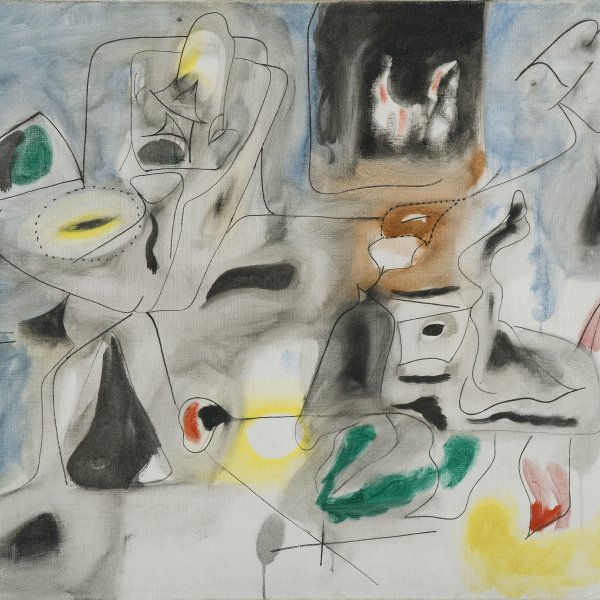
Reading Julien Levy’s Surrealism in 1936 brought Gorky into contact with the movement and inspired him to paint biomorphic figures recalling those of Joan Miró and André Masson. When many of the Surrealist artists took up residence in New York in the early 1940s, Gorky befriended Roberto Matta and André Breton. Unlike the Surrealists, Gorky did not take his themes from the subconscious or the dream world; rather, his source of inspiration continued to be experiences in his native country.
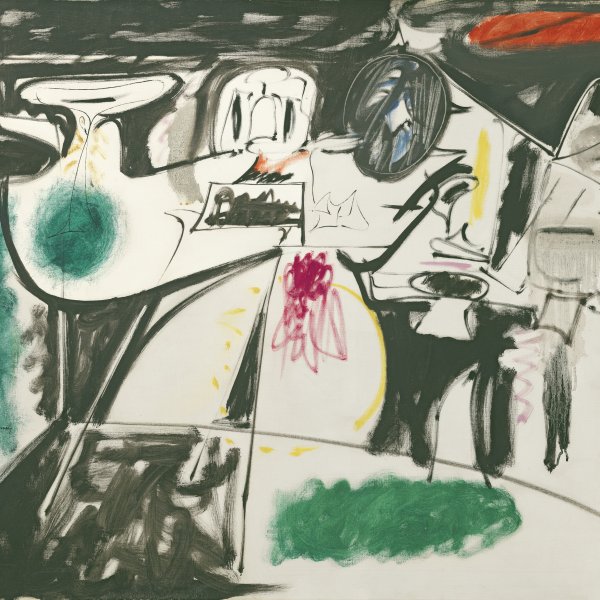
Around 1946 Gorky’s works, which had been populated with distorted, menacing figures since the Cubist period, began to convey his own angst even more intensely. Although by then his work had earned a certain amount of recognition, he failed to achieve financial stability. On top of this, his studio was gutted by fire, he was diagnosed with throat cancer, he split up with his second wife and his painting hand was paralysed in a car accident. He committed suicide in 1948.