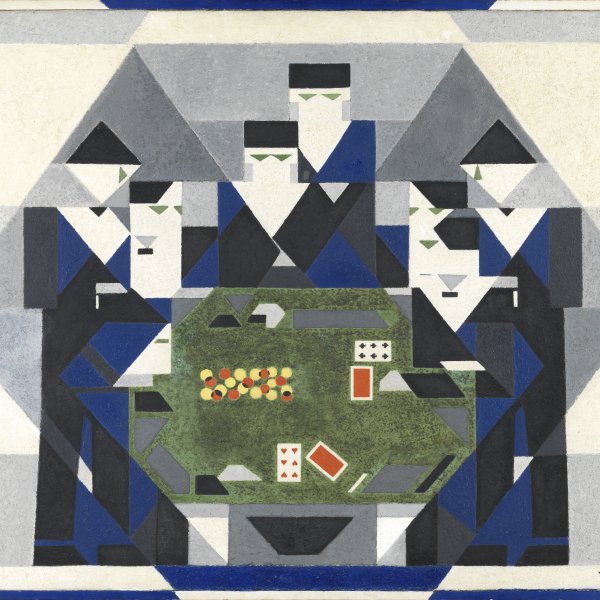
Vilmos Huszár
Budapest, 1884-Hierden, 1960
The Hungarian-born Vilmos Huszár, whose surname was originally Herz, spent most of his life in the Netherlands, where he frequented different avant-garde groups and espoused the aesthetic and artistic principles of Neo-Plasticism.
Huszár studied at the Budapest Academy of Decorative Arts and moved to Munich to further his studies in 1904. He settled in The Hague in 1906 and produced works that reflected his great admiration for Vincent van Gogh. During these years, in which he mainly painted portraits of the city’s high society and designed his first stained-glass windows, he came into contact with avant-garde artists of London and Paris. The influence of Cubism and Futurism gradually pervaded his oeuvre.
In 1916 Vilmos Huszár met Theo van Doesburg, with whom he cofounded the review De Stijl in 1917. Huszár was responsible for the cover design, and the numerous articles he published in the magazine contributed to defining Neo-Plasticism. During this period he produced non-figurative works and collaborated on interior design projects, such as for the home of the industrialist Bruynzeel with Piet Klaarhamer in 1918, and in designing furniture with Piet Zwart from 1920 to 1921.
In the mid-1920s Huszár met Kurt Schwitters, El Lissitzky and some of the Hungarian avant-garde painters. During these years he also worked in industrial and commercial graphic design until the outbreak of the Second World War, when he moved to a small Dutch town called Hierden where he felt safer about being a Jew. During the following years he depicted the surrounding landscape in a naturalistic style and from 1955 until his death he focused on finding a pure non-objective language.
Huszár studied at the Budapest Academy of Decorative Arts and moved to Munich to further his studies in 1904. He settled in The Hague in 1906 and produced works that reflected his great admiration for Vincent van Gogh. During these years, in which he mainly painted portraits of the city’s high society and designed his first stained-glass windows, he came into contact with avant-garde artists of London and Paris. The influence of Cubism and Futurism gradually pervaded his oeuvre.
In 1916 Vilmos Huszár met Theo van Doesburg, with whom he cofounded the review De Stijl in 1917. Huszár was responsible for the cover design, and the numerous articles he published in the magazine contributed to defining Neo-Plasticism. During this period he produced non-figurative works and collaborated on interior design projects, such as for the home of the industrialist Bruynzeel with Piet Klaarhamer in 1918, and in designing furniture with Piet Zwart from 1920 to 1921.
In the mid-1920s Huszár met Kurt Schwitters, El Lissitzky and some of the Hungarian avant-garde painters. During these years he also worked in industrial and commercial graphic design until the outbreak of the Second World War, when he moved to a small Dutch town called Hierden where he felt safer about being a Jew. During the following years he depicted the surrounding landscape in a naturalistic style and from 1955 until his death he focused on finding a pure non-objective language.