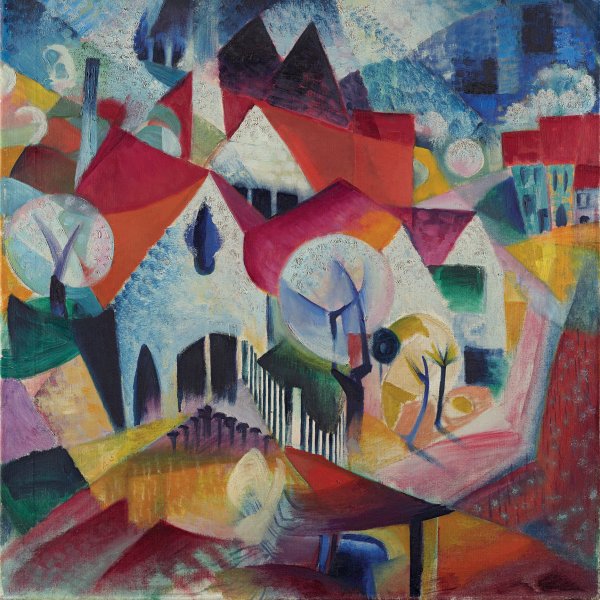
Johannes Itten
Süddern-Linden, 1888-Zurich, 1967
Johannes Itten was notable for both his artistic output and his work as an educator and theoretician. The Swiss-born artist spent much of his life in Germany, where he was connected with the artistic avant-garde and collaborated intensely as a lecturer at the Bauhaus.
After training as a teacher, Itten decided to become a painter in 1909. He studied at the Geneva École des Beaux-Arts and completed his instruction under Adolf Hölzel in Stuttgart in 1913. Under the influence of his master, a pioneer of abstract art, Itten began to experiment with colours, the interplay of contrasts and collage. Initially close to Expressionism and linked to figurative art, his work shifted towards an interest in abstract expression which first materialised in his painting in 1916. That year he moved to Vienna, where he established an art school and took an interest in the new methods of art teaching. He came into contact with musicians such as Alban Berg and Arnold Schönberg, who fostered his interest in the analogies between music and painting.
In 1919 Itten began to work at the Bauhaus, where he taught the preliminary course that was compulsory for all students. He became one of the most renowned and charismatic lecturers, and over time this caused a split among the school. His growing attachment to a current of thought called Mazdaznan, based on the wisdom of Zoroaster, eventually drove him to leave the Bauhaus in 1923 and he went to live in a community of followers of the sect in Herrliberg. He left the community in 1926 and settled in Berlin, where he established his own school of painting, graphic art, photography and architecture. Thenceforward he devoted more time to teaching and his work as an artist was relegated to second place. He taught textile design at Krefeld and, when the National Socialists came into power, he returned to Switzerland where he continued his pedagogical work. Towards the end of his life he took up painting again with renewed interest and saw the publication of his most famous written work, Kunst der Farbe (The Art of Colour, 1961), and his course at the Bauhaus, Mein Vorkurs am Bauhaus. Gestaltungs und Formenlehre (1963).
After training as a teacher, Itten decided to become a painter in 1909. He studied at the Geneva École des Beaux-Arts and completed his instruction under Adolf Hölzel in Stuttgart in 1913. Under the influence of his master, a pioneer of abstract art, Itten began to experiment with colours, the interplay of contrasts and collage. Initially close to Expressionism and linked to figurative art, his work shifted towards an interest in abstract expression which first materialised in his painting in 1916. That year he moved to Vienna, where he established an art school and took an interest in the new methods of art teaching. He came into contact with musicians such as Alban Berg and Arnold Schönberg, who fostered his interest in the analogies between music and painting.
In 1919 Itten began to work at the Bauhaus, where he taught the preliminary course that was compulsory for all students. He became one of the most renowned and charismatic lecturers, and over time this caused a split among the school. His growing attachment to a current of thought called Mazdaznan, based on the wisdom of Zoroaster, eventually drove him to leave the Bauhaus in 1923 and he went to live in a community of followers of the sect in Herrliberg. He left the community in 1926 and settled in Berlin, where he established his own school of painting, graphic art, photography and architecture. Thenceforward he devoted more time to teaching and his work as an artist was relegated to second place. He taught textile design at Krefeld and, when the National Socialists came into power, he returned to Switzerland where he continued his pedagogical work. Towards the end of his life he took up painting again with renewed interest and saw the publication of his most famous written work, Kunst der Farbe (The Art of Colour, 1961), and his course at the Bauhaus, Mein Vorkurs am Bauhaus. Gestaltungs und Formenlehre (1963).