Joan Miró
Barcelona, 1893-Palma de Mallorca, 1983
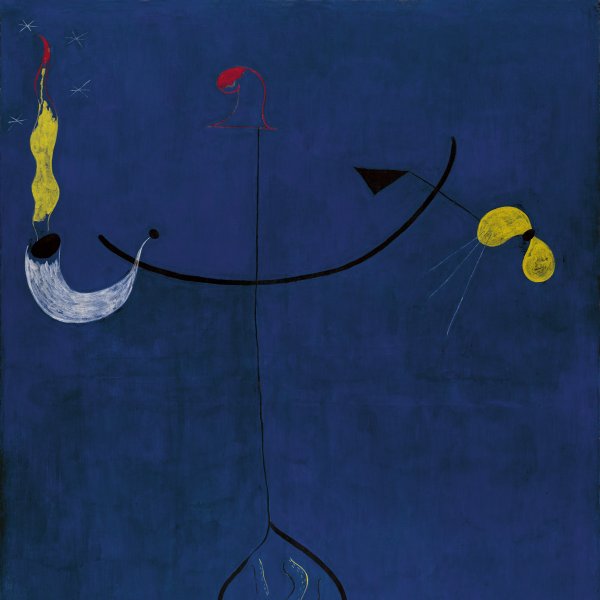
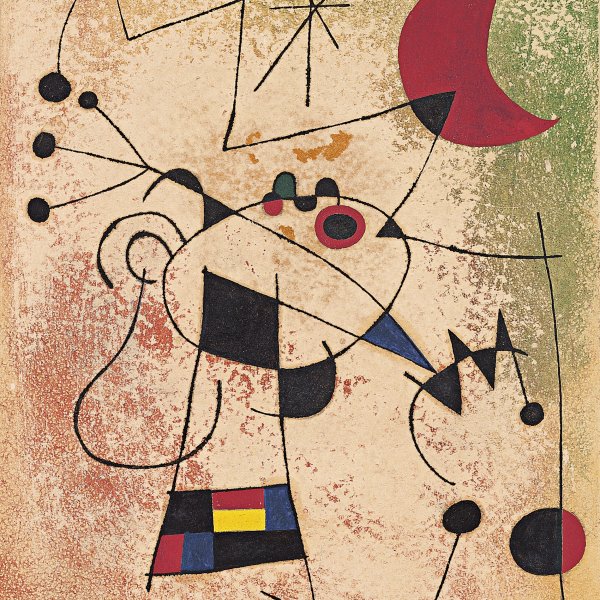
Joan Miró was a leading figure in twentieth-century art. He developed a personal style close to Surrealism that made him a highly influential artist for both his contemporaries and generations to come. He trained at the Llotja in Barcelona and later at the Academia de Francesc Galí, which was more modern in outlook. At the school and the Cercle Artistic de Sant Lluc he met some of his great friends, the critic Sebastià Gasch, the poet J.V. Foix, Josep Llorens Artigas and Joan Prats. From an early age he was in contact with Barcelona’s most avant-garde scene, then in full swing. At the end of 1920 Miró made his first trip to Paris, where he met Pablo Picasso. Throughout the decade he alternated his winters in Paris with long stays at the country house his family owned in Montroig, Tarragona. These would be the crucial years in his artistic career, in which he discovered his personal language. In the French capital he struck up a friendship with André
Masson, the leader of the so-called “rue Blomet group, ” the future core of the Surrealist group. From this point onwards his sensibility came close to that of the Surrealist movement, many of whose theoretical ideas he shared, although he never fully belonged to the group and gave priority to his individual creative freedom.
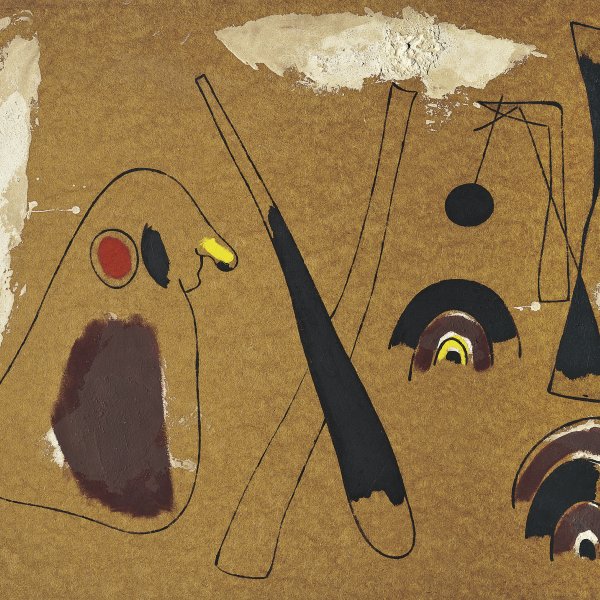
In the 1930s he became established as one of the most prominent figures on the international art scene and as one of the key twentieth-century artists. It was precisely then that Miró, a born non-conformist, entered a phase that he called “the assassination of painting, ” in which he voluntarily gave up painting, experimented with other media such as collage and drawings on differently textured papers and made “objects” from elements found in nature, which were his first forays into the world of sculpture. Although he returned to painting soon afterwards, he never abandoned his desire to experiment with all kinds of materials and media: ceramics, bronze, stone, graphic work and, from 1970, even tapestry.
After the Spanish civil war and the Second World War years, during which he was forced to change residence constantly, in 1956 he settled permanently in Palma de Mallorca, where his friend Josep Lluís Sert designed a large studio for him.
Masson, the leader of the so-called “rue Blomet group, ” the future core of the Surrealist group. From this point onwards his sensibility came close to that of the Surrealist movement, many of whose theoretical ideas he shared, although he never fully belonged to the group and gave priority to his individual creative freedom.
In the 1930s he became established as one of the most prominent figures on the international art scene and as one of the key twentieth-century artists. It was precisely then that Miró, a born non-conformist, entered a phase that he called “the assassination of painting, ” in which he voluntarily gave up painting, experimented with other media such as collage and drawings on differently textured papers and made “objects” from elements found in nature, which were his first forays into the world of sculpture. Although he returned to painting soon afterwards, he never abandoned his desire to experiment with all kinds of materials and media: ceramics, bronze, stone, graphic work and, from 1970, even tapestry.
After the Spanish civil war and the Second World War years, during which he was forced to change residence constantly, in 1956 he settled permanently in Palma de Mallorca, where his friend Josep Lluís Sert designed a large studio for him.