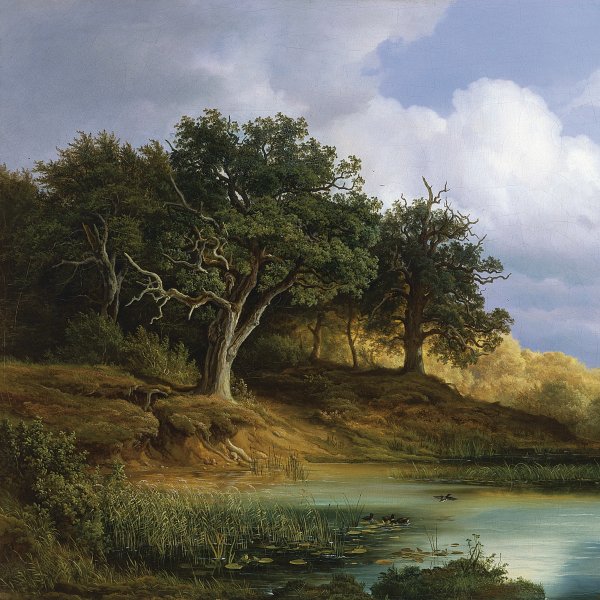
Christian E. B. Morgenstern
Hamburg, 1805-Munich, 1867
Christian Ernst Bernhard Morgenstern was the son of a miniaturist and began his training in his native city, first with the Suhr brothers and later with the landscape painter Siegfried Bendixen. Between 1827 and 1828 he completed his training at the Fine Arts Academy in Copenhagen, during which time he travelled around Norway and Sweden drawing the landscape. On the advice of his mentor, Baron Von Rumohr, he decided to move to Munich, where he settled permanently in 1829.
Morgenstern travelled around Bavaria, executing landscapes and studying the topography in detail. Many of these trips and excursions were made in the company of his friends the painters Daniel Fohr and Heinrich Crola. His works of this period reveal the influence of 17th-century Dutch painting, particularly that of Jacob van Ruisdael, and that of the landscape painters of Copenhagen and Norway and the work of the group of realistic painters in Munich, particularly Johann Georg von Dillis. Morgenstern was one of the first German painters to execute watercolours outdoors, preferring isolated, desolate scenes and landscapes with changing atmospheric conditions flooded with dawn or evening light, or with mist and storms.
Over the following years his landscapes evolved into panoramic views in which he omitted foreground details, for example Dawn in the Ammer Valley near Polling of 1853 (Staatliche Kunsthalle, Karlsruhe). Morgenstern’s interpretation of nature became more subjective and his works express feelings of solitude, the spirituality of nature and the insignificance of man, all of which brings him close to the Romanticism of Caspar David Friedrich.
Morgenstern travelled around Bavaria, executing landscapes and studying the topography in detail. Many of these trips and excursions were made in the company of his friends the painters Daniel Fohr and Heinrich Crola. His works of this period reveal the influence of 17th-century Dutch painting, particularly that of Jacob van Ruisdael, and that of the landscape painters of Copenhagen and Norway and the work of the group of realistic painters in Munich, particularly Johann Georg von Dillis. Morgenstern was one of the first German painters to execute watercolours outdoors, preferring isolated, desolate scenes and landscapes with changing atmospheric conditions flooded with dawn or evening light, or with mist and storms.
Over the following years his landscapes evolved into panoramic views in which he omitted foreground details, for example Dawn in the Ammer Valley near Polling of 1853 (Staatliche Kunsthalle, Karlsruhe). Morgenstern’s interpretation of nature became more subjective and his works express feelings of solitude, the spirituality of nature and the insignificance of man, all of which brings him close to the Romanticism of Caspar David Friedrich.