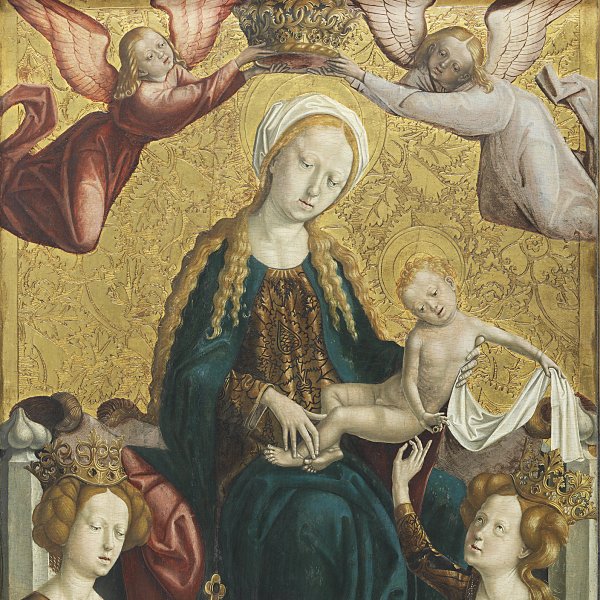
Michael Pacher (follower of)
Pacher was a painter and sculptor whose date and place of birth are not known with certainty, although he must have been born around 1430–35. He may have trained with local artists and is recorded from 1467 onwards as a master in a workshop in the city of Bruneck in the Tyrol (now Brunico, Italy). A document of 1507 states that by around 1462 Pacher was already working as an independent master with a large workshop with numerous assistants, including his son Hans. He also executed sculptures for the altarpieces on which he worked. Pacher’s style combines dramatically expressive figures with monumental forms in a way characteristic of German artists such as Hans Multscher and Konrad Witz. In addition, his work incorporates more classical elements that reflect his knowledge of Paduan art, particularly that of Mantegna, and a use of light that recalls the work of Filippo Lippi.
Pacher’s first known work is an altarpiece of 1462–63, executed for the church of San Lorenzo in Pusteria (near Bruneck). Various fragments from this altarpiece have survived, depicting the life of the Virgin and of Saint Lawrence (Österreichisches Galerie Belvedere, Vienna, and Alte Pinakothek, Munich). Around 1475 Pacher’s style evolved and changed and his figures become extremely individualised with an interest in the figures’ interior characters. Among his most important works are the altarpiece for the church at Gries of 1471–74, and the Saint Wolfgang Altarpiece for the parish church of that name. The latter was his most important commission, and the central scene of The Coronation of the Virgin with Saints Wolfgang and Benedict as well as the panel of The Attempted stoning of Christ are clear examples of this artist’s talents and artistic maturity. Pacher died in Salzburg between 7 July and 24 August 1498.