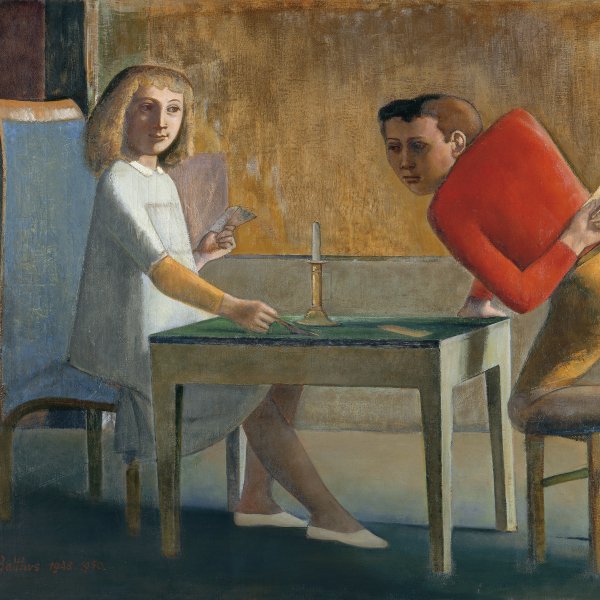
Balthus
Son of the art historian and painter Erich Klossowski, Balthus grew up in an intellectual and artistic environment in Paris. During the First World War he and his family took refuge in Berlin, and after his parents split up, he moved to Switzerland, where his father’s place was taken by Rainer Maria Rilke, a friend of his mother’s. Until his death in 1926, the poet was not only a second father to Balthus but also his main mentor. In 1920 Rilke published a collection of watercolours by Balthus in the book Mitsou: quarante images par Balthusz, at which point what had previously been his family nickname became his artistic name. Encouraged by André Gide, Balthus returned to Paris in 1924 to devote himself to painting. Although he rejected the teachings of any other painter, the family friend Pierre Bonnard guided him at the start of his career, as a result of which his style was initially Post-Impressionist. However, what really interested him was studying the Old Masters such as Poussin, Masaccio and Piero della Francesca, whose works he copied at the Louvre.
Balthus was already firmly established as an artist by the end of the 1940s. Between the 1950s and 1960s he moved to the Château de Chassy in Morvan and for a time concentrated chiefly on landscape. In 1961 André Malraux appointed him director of the Académie de France at the Villa Medici in Rome. In Italy he returned to representing the human figure, using a technique that recalls Renaissance frescoes. After leaving his post at the Académie in 1978, he divided his time between Italy and Switzerland.
Balthus developed a figurative style that defies any label. His personal pictorial language of robust forms and heavily defined outlines combines the procedures of the Old Masters with certain aspects of Surrealism.