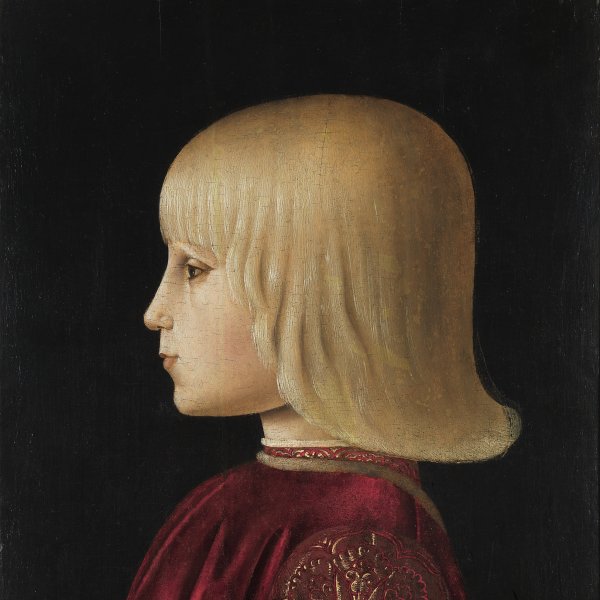
Piero della Francesca
Piero della Francesca is one of the most highly appreciated artists of the 15th century. Piero di Benedetto dei Franceschi, known as Piero della Francesca, was born in Borgo San Sepolcro in Tuscany. Although he primarily focused on painting, Piero was also active as a writer and art theoretician. According to tradition he was the teacher of Luca Signorelli and during his lifetime enjoyed the favour of prestigious patrons including some of the most powerful individuals of his day such as the Duke of Urbino, the d’Este family in Ferrara, Sigismondo Malatesta of Rimini and Pope Nicholas V. Piero may have trained in his native city with Antonio d’Anghiari and his style reveals an interest in geometry and the new discoveries on perspective applied to painting. Influenced by the theories of Alberti and by the work of Uccello and Domenico Veneziano -with whom he collaborated in the church of Sant’Egidio in Florence in around 1439 - Piero’s work is characterised by its refined, monumental character, particularly in his mature period. His figures reflect the style of Donatello’s sculpture and the work of Fra Angelico.
While a large number of Piero’s works have not survived to the present day, his life and career have been substantially reconstructed. Dating from his early period is The Baptism of Christ (National Gallery, London) of the early 1440s, and the Misericordia Polyptych (Pinacoteca, Sansepolcro), commissioned in 1445 but completed after 1460. Piero’s interest in the effects of light is already evident in these works. Among his works for various Italian courts are the frescoes in the Tempio Malatestiano in Rimini, notably the one depicting Sigismondo Malatesta venerating his patron saint. During his mature period Piero executed the project that is considered his masterpiece and a key reference point in the history of painting: the cycle of frescoes of The Legend of the True Cross in the church of San Francesco in Arezzo. They reveal the three most important aspects of Piero’s style: interest in mathematical perspective, naturalism, and skilful handling of light. Among the artist’s most celebrated paintings are The Flagellation (Galleria Nazionale, Urbino), and the Double Portrait of Federico da Montefeltro and his Wife Battista Sforza (Galleria degli Uffizi, Florence), whose landscape background is considered one of the finest of the entire 15th century.
Towards the end of his life Piero lost his sight and died on 12 October 1492.