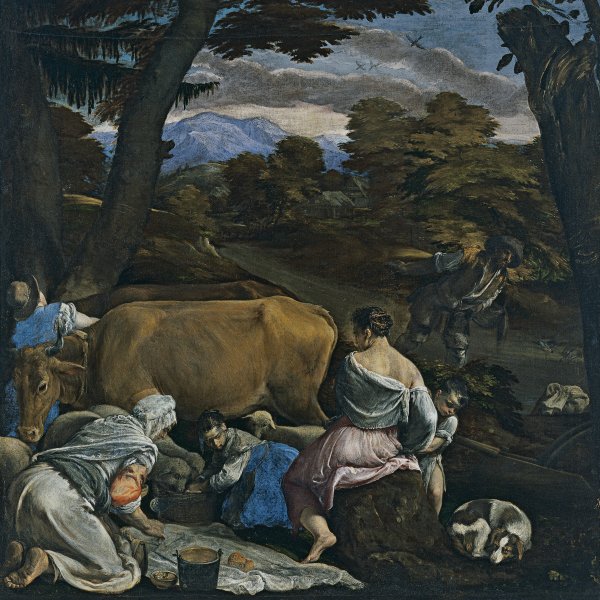
Jacopo Bassano (Jacopo da Ponte)
Jacopo Bassano or Jacopo da Ponte was the most important member of a family of painters and the first to adopt the name of his native city as his surname. Bassano first received lessons from his father, Francesco da Ponte the Elder, then continued his studies in the Venetian workshop of Bonifazio de’Pitati during the first half of the 1530s. Around 1540 he moved to Bassano where he lived and worked for the rest of his career and where he ran his father’s workshop with great efficiency, becoming one of the most influential figures in the art world of the Veneto around the mid-century. Bassano’s first works date from a year before his arrival in Bassano and include a Flight into Egypt (Museo Civico, Bassano) in which the influence of Bonifazio and Titian is evident. His canvases also look to the work of Pordenone, particularly between 1535 and the early 1540s, while between 1543 and 1560 they reveal an interest in Mannerism. For the composition of some of his paintings Bassano made use of prints after works by the great masters of his day, particularly Dürer, Raphael and Parmigianino although he was primarily interested in the innovations to be seen in contemporary Venetian art. Around 1560 he focused more actively on pastoral scenes with broad landscapes of a type that became increasingly popular and sought after. During that decade the influence of Tintoretto becomes more pronounced in the manner of applying the paint, the chromatic contrasts and the effects of light.
Bassano’s success was largely based on his way of interpreting his pastoral and religious compositions and he presented the latter in the manner of genre scenes. His sons Francesco, Leandro, Giambattista and Gerolamo, along with a series of imitators, all repeated his models and compositions. All Bassano’s biographers describe him as a modest man who lived in a simple manner in his small city, turning down the numerous invitations that he received to work for foreign courts. His work is well represented in the Museo Civico in Bassano and in the Museo Nacional del Prado, Madrid.