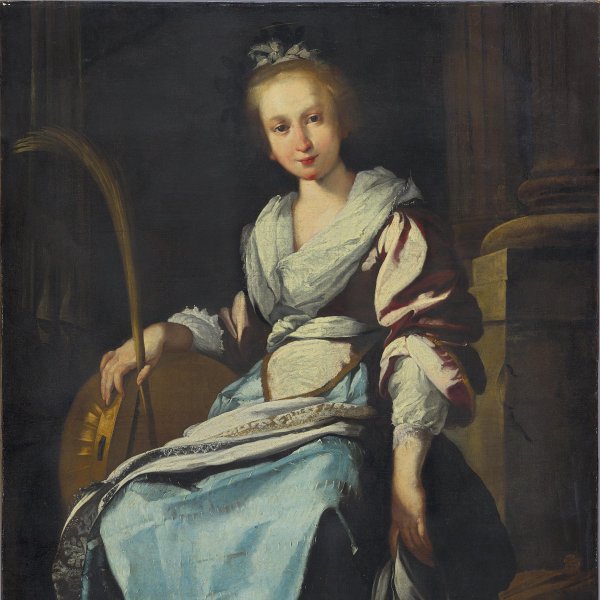
Bernardo Strozzi (workshop of)
Strozzi first trained in his native city, initially with the painter and antiquarian Cesare Corte, known as Soprani, and later with the Sienese painter Pietro Sorri, who was active in Genoa during the last years of the century. In 1598 Strozzi entered the Capuchin Order in the monastery of San Barnaba in Genoa. On the death of his father in 1610 Strozzi obtained permission to leave the monastery in order to support his family as a painter. The chronology of his oeuvre is difficult to establish as many of his works are unsigned. His early paintings reveal the influence of Barocci and the Sienese masters, particularly Francesco Vanni, as well as that of the Lombard Mannerist painters. Notable works from his early period include The Pietà (Museo dell’Accademia Linguistica di Belle Arti, Genoa), and Saint Catherine of Alexandria (Wadsworth Atheneum, Hartford). Around 1620 Strozzi adopted a much more naturalistic style influenced by Caravaggio and his followers and the Mannerist elements in his work gradually disappeared. In the 1620s his style was also influenced by Rubens and the Flemish artists living in Genoa. Also notable from this decade are his series of frescoes, of which few have survived, while it was during these years that he produced his most famous and celebrated compositions such as Jacob and Esau (Palazzo Bianco, Genoa) and The Supper at Emmaus (Musée de Grenoble).
Strozzi’s mother died and his sister married around 1630. Freed from his family responsibilities, he was recalled by the Capuchins to re-enter the monastery but he fled to Venice where he remained until his death. Among Strozzi’s early works from this final phase of his career are the Portrait of Cardinal Federico Correr (Museo Correr, Venice), and other portraits of members of the leading aristocratic families of the city, suggesting that Strozzi achieved considerable fame and prestige in Venice. His interest in Venetian painting became more pronounced following his move to the city and his palette became lighter under the influence of Veronese.