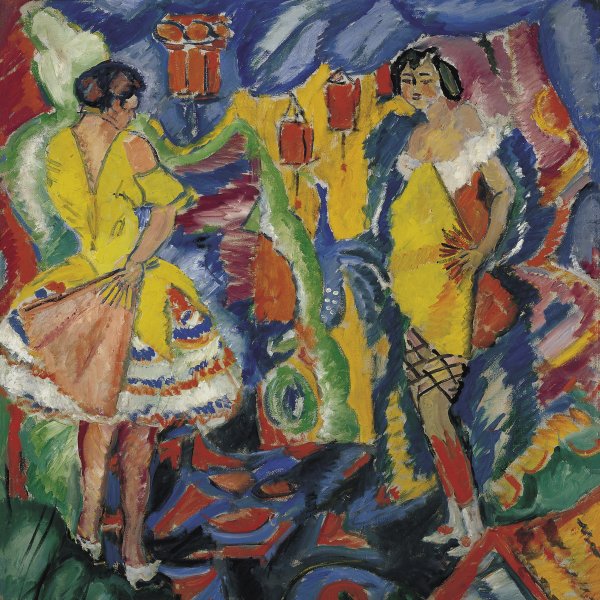
Georg Tappert
Georg Tappert was born in Berlin in 1880, the same year as Ernst Ludwig Kirchner (1880-1938) and Franz Marc (1880-1916), the two leading figures in the German Expressionist groups, Brücke and Der Blaue Reiter. Tappert did not join either of these movements, but he became friends with most of the artists involved. He pursued artistic ends closely aligned to theirs, took part in many of their exhibitions, and shared their fate in seeing his work banned by the Nazi regime.
Tappert began his working life as a tailor before 1900 when, at the age of twenty, and on the recommendation of Max Liebermann (1847-1935), he entered the Karlsruhe Akademie, a school then well known for promoting landscape painting. After devoting himself to a number of different enterprises, he joined the artists' colony of Worpswede, near Bremen, in 1906. There, he befriended Heinrich Bogeler (1872-1942) and was to some extent influenced by Paula Modersohn-Becker(1876-1907. At Worpswede Tappert founded a school of painting that included Wilhelm Morgner (1891-1907) among its students. Long after the latter's death, Tappert would generously continue to champion the young painter's ardent, intensely expressive work. Towards the end of 1909, he returned to his native city, Berlin. Here, in the years preceding World War I, his artistic career reached a high point. When the Berlin Secession refused his work, like that of most of the artists of his generation, Tappert founded the Neue Secession. By 1911-the year he painted Varieté-the Neue Secession's spectacular exhibitions were the first to include works by artists belonging to both Brücke and Der Blaue Reiter alongside works by French, Russian and Czech artists. In 1911, Tappert also promoted shows without juries in Berlin, following the example of the Salon des Indépendants in Paris, and he wrote for the socially critical publication Die Aktion. His submission of four works to the Sonderbund in Cologne in 1912 signalled a high point in his production, which mostly consisted of figures and nudes. In 1918, just after the war, he took part in the revolutionary Novembergruppe, returning to teaching soon afterwards. Tappert's devotion to and enthusiasm for this activity was such that he began to neglect his own artistic production. When the National Socialists came to power in 1933, Tappert was among the first teachers to be fired. He was briefly reinstated before being definitively dismissed in 1937. He continued to paint, especially landscapes, but his artistic inspiration appears to have waned to some extent. It would never revive, even in 1945 when, at the age of sixty-five, he was entrusted with the reorganisation of the Hochschule für Bildende Künste in Berlin with Karl Hofer (1878-1955). Because he did not exhibit any of his work up to his death in 1957, Tappert's name was ignored by critics for many years, even by those who had already taken a renewed interest in German Expressionism. The rediscovery of his work, which had survived the Second World War almost intact, also occurred rather late. The first monograph on Tappert appeared in 1980 to accompany the catalogue raisonné of his works, while the catalogue of his prints was not published until 1996. Since 1993, the artist's bequest, the Georg Tappert Foundation, has added to the Schleswig-Holsteinisches Landesmuseum's considerable collection of Expressionist art.
Gerhard Wietek