Alexander Vesnin
Yurevets, 1883-Moscow, 1959
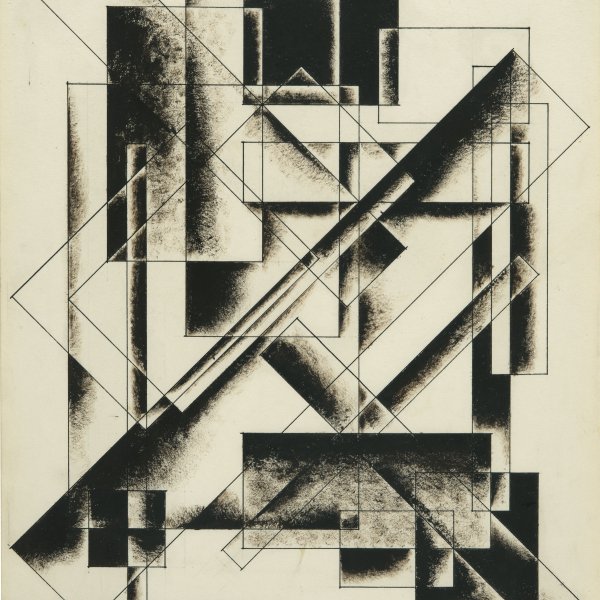
Alexander Vesnin was a foremost representative of Russian Constructivism who combined his activity as an architect with painting throughout his lifetime. He studied engineering in Moscow and Saint Petersburg like his two older brothers, Leonid and Viktor, with whom he worked on most of his architectural projects. Vesnin also attended the classes of the Impressionist painter Konstantin Yuon and in 1913–14 experimented with Cubism in Vladimir Tatlin’s workshop known as The Tower. There he met Liubov Popova and Nadeshda Udaltsova, among other artists.
In 1918 Vesnin was involved in the decoration of Moscow’s Red Square for the May the First celebrations and around 1920 he began to work as a stage designer. One of his most important sets was for Gilbert Keith Chesterton’s The Man who was Thursday, in 1923. From 1921 to 1924 he taught at the Higher State Art-Technical Studios (Vkhutemas), where he again worked with Popova. In parallel with these activities he collaborated in the Institute of Artistic Culture (Inkhuk), where he met other painters such as Alexander Rodchenko. Together with Rodchenko, Popova, Varvara Stepanova and Alexandra Ekster, he took part in the 5 x 5 = 25 exhibition in 1921.
Vesnin was first attracted by Suprematism at the end of the 1910s, but gradually espoused the Constructivist principles which advocated an art that was bound to its constituent elements and to the new technological society that emerged after the Soviet Revolution. He attempted to put these ideas into practice in some of his projects, such as the design for the Moscow Palace of Labour (not built), which he worked on with his brothers in 1922–23, and the newspaper Pravda building in Leningrad. In 1925 he and Moisey Ginzburg founded the OSA (Union of Contemporary Architects) and the magazine they began to publish became the vehicle for the dissemination of their ideas.
When, around 1930, the authorities began to demand a return to historicism, Alexander and Viktor Vesnin (Leonid died in 1933) voiced their disagreement. After the Second World War the shortage of commissions spurred Alexander to concentrate chiefly on painting and drawing in a figurative style.
In 1918 Vesnin was involved in the decoration of Moscow’s Red Square for the May the First celebrations and around 1920 he began to work as a stage designer. One of his most important sets was for Gilbert Keith Chesterton’s The Man who was Thursday, in 1923. From 1921 to 1924 he taught at the Higher State Art-Technical Studios (Vkhutemas), where he again worked with Popova. In parallel with these activities he collaborated in the Institute of Artistic Culture (Inkhuk), where he met other painters such as Alexander Rodchenko. Together with Rodchenko, Popova, Varvara Stepanova and Alexandra Ekster, he took part in the 5 x 5 = 25 exhibition in 1921.
Vesnin was first attracted by Suprematism at the end of the 1910s, but gradually espoused the Constructivist principles which advocated an art that was bound to its constituent elements and to the new technological society that emerged after the Soviet Revolution. He attempted to put these ideas into practice in some of his projects, such as the design for the Moscow Palace of Labour (not built), which he worked on with his brothers in 1922–23, and the newspaper Pravda building in Leningrad. In 1925 he and Moisey Ginzburg founded the OSA (Union of Contemporary Architects) and the magazine they began to publish became the vehicle for the dissemination of their ideas.
When, around 1930, the authorities began to demand a return to historicism, Alexander and Viktor Vesnin (Leonid died in 1933) voiced their disagreement. After the Second World War the shortage of commissions spurred Alexander to concentrate chiefly on painting and drawing in a figurative style.