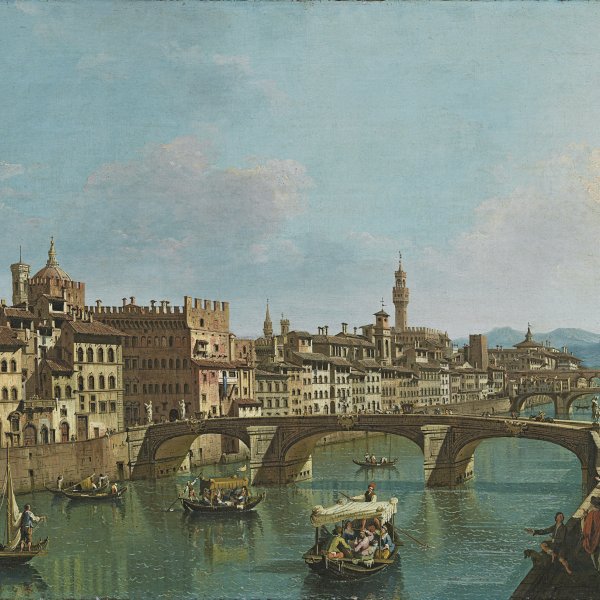
Giuseppe Zocchi
The son of a sand-digger from Fiesole, Zocchi was not born in 1711, as has been often stated, but rather in 1716-1717, as can be readily deduced from the frontispiece of his Views of Villas printed in Florence in 1744 with an inscription under the artist's self-portrait in which he states that he is 27 years old. If we can trust the short life of the painter written by Francesco Maria Niccolò Gabburri, we learn that Zocchi was apprenticed to that important figure of the Florentine Baroque, Ranieri del Pace. On the latter's death (in 1738), it was Gabburri who offered his support, as did the wealthy Marchese Andrea Gerini. Zocchi very probably studied perspective, which he enriched with trips to Rome, Bologna and to the North of Italy. He was awarded the prize for young students in the painting class at the Accademia in 1737, and in 1741 was admitted to the first year.
Between 1739 and 1741, he must also have travelled to Venice, where he was Joseph Wagner's student and where he learned the art of engraving. Gabburri had encouraged him in this field by having him draw the paintings of various artists in the churches in Florence to be used as basis for engravings. It must be emphasised, however, that although Zocchi is primarily known in the modern age as a draughtsman and view painter, he was in his own time pre-eminently a figure painter, even in his architectural and landscape works. Proof of this lies in Gabburri's own words, when he mentions how Zocchi would pass from landscape painting "after having painted figures in oil, and architecture a fresco and in tempera."
In addition to his wonderful canvas of The Triumph of David, 1739 (private collection), which evokes Pannini, and his pair of Ruins with Figures, both signed and dated 1746 and 1747 (Great Britain, private collection), it is worth recalling his scenes of conversations (Venice, Museo Correr; Florence, private collection), his frescoes for Gabriello Riccardi (before 1740), as well as his mural paintings for the Palazzo dell'Arcivescovado in Pisa (Stories from the Bible, 1751), and those in the Florentine Rinuccini (1756-1766), Gerini (post-1759), and Serristori palaces. In the early 1740s, Zocchi was the guest of the Marchesse Gerini, "employed in painting in oils various views of the city of Florence, inserting in them an infinite number of well-placed and perfectly drawn figures in the style of the celebrated Canaletto, though perhaps even softer than those in their colours."
This praise is not excessive if we bear in mind the quality of his seven surviving views-View from outside the Gate of San Niccolò and Piazza della Signoria with Marco Grassi in New York; The Arno River at Santa Trinità Bridge (Madrid, Carmen Thyssen-Bornemisza Collection); The Bridge at Santa Trinità and the Church of Santa Trinità and Piazza San Firenze, now in a private collection, with Christie's, London, 10 July 1981; Capriccio with the Ponte Vecchio (private collection); and Piazza Santissima Annunziata (location unknown). The artist had previously painted a day-time and a night-time Festivity in the Piazza del Campo in Siena, held for the arrival of the Grand Dukes of Tuscany in 1739 (today with the Monte dei Paschi bank, Siena) and a Regatta in Venice in 1740 (London, Sotheby's, 19 July 1961, lot 159).
Zocchi's most famous work is his two-fold series of engravings published in 1744, promoted and paid for by the Marchese Gerini, entitled Selection of XXIV Views of the principal Districts, Squares, Churches, and Palaces of the City of Florence and of Views of Villas and of Places in Tuscany, made after Zocchi's own drawings. The complete set of drawings (probably the set owned by Zocchi's patron, Gerini) consisting of seventy-seven sheets, is now in the Pierpont Morgan Library in New York.
From 1750 onward, Zocchi worked with the "Galleria dei lavori di pietre dure", where he was actually salaried as the official engraver to the workshop from 1754 until his death (from the plague, on 22 June 1767), supplying drawings and models, mostly for the workshop's principal commissioner, the Emperor Francis Stephen of Habsburg Lorraine (Vienna, Hofburg, Pietradurazimmer; Florence, Museo dell'Opificio delle Pietre Dure).
Roberto Contini