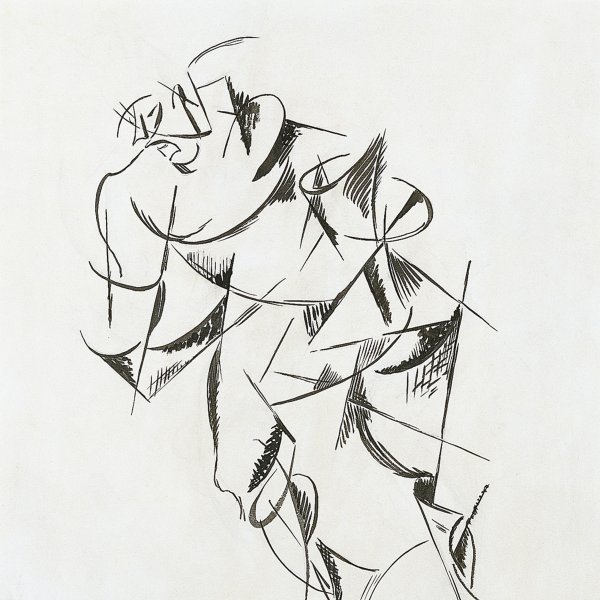
Umberto Boccioni
Umberto Boccioni played a crucial role in disseminating the Italian Futurist movement in the visual arts, through both his works and his theoretic writings. He grew up in various Italian cities and expressed his fondness for literature in a novel that was not published. In 1900 he settled in Rome, where he met Gino Severini, with whom he began to frequent the studio of Giacomo Balla. Under Balla’s guidance, they learned the Divisionist technique and the use of complementary colours. In 1906 he travelled to Paris, and from there to Russia.
At the end of 1909 Boccioni met the poet Filippo Tommaso Marinetti, who had just proclaimed the birth of literary Futurism.Months later, in 1910, Boccioni published the Manifesto dei pittori futuristi, followed by La pittura futurista–Manifesto tecnico, which he signed together with Carlo Carrà, Luigi Russolo, Gino Severini and Giacomo Balla. The manifesto criticised old art and laid the foundations for a new art in keeping with the dynamism of the contemporary age. Their first group exhibition was held in Milan in 1911. In 1912 Boccioni began to experiment with sculpture and published a manifesto entitled La scultura futurista in defence of dynamism and the simultaneity of forms. His knowledge of the Cubist theories is evident in both his sculptures and the rest of his works.
Around 1913 Boccioni became increasingly involved in political issues and his interest in artistic creation waned as he became interested in the idea of combining nationalism and technology. In 1914 he took part in the demonstrations to demand that Italy join in the First World War and he and Marinetti were imprisoned for burning an Austrian flag. However, shortly after the outbreak of war, he changed his mind about its supposed advantages, which caused a rift with many of his friends. He died on the battle front after falling from a horse.