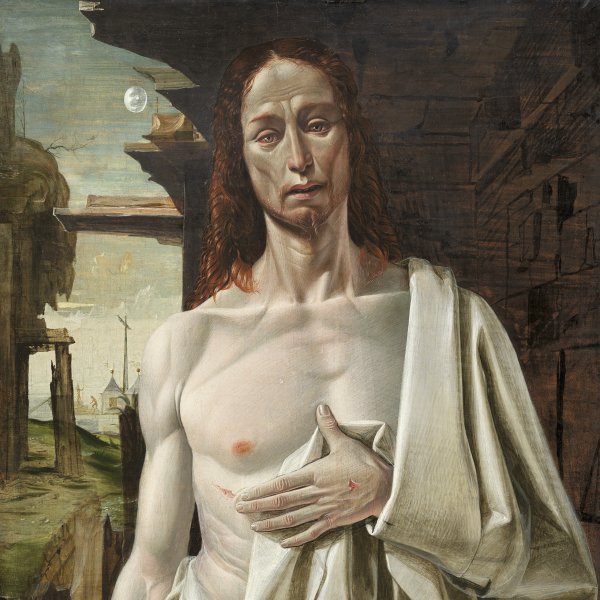
Bramantino (Bartolomeo Suardi)
An Italian painter and architect, Bramantino first trained as a goldsmith but later devoted his activities to painting. His work reveals the influence of painters such as Butinone and Zenale, but most important to his early formation was his early familiarity with Bramante, who profoundly influenced his style. Bramantino’s first works date from around 1490 and there are no indications that he was active as an artist prior to this date. Compositions from this period include The Risen Christ (Museo Thyssen- Bornemisza, Madrid), The Virgin and Child (Museum of Fine Arts, Boston), and The Adoration of the Magi (National Gallery, London). These early works use a dramatic type of lighting that helps to construct the forms with their graphic, linear and highly precise line. In 1508 the artist was working in Rome on some now lost frescoes for one of the rooms in the Vatican, commissioned by Pope Julius II. The following year he was again in Milan and undertook a series of commissions. In 1525 Bramantino was appointed architect and painter to Francesco Maria Sforza, Duke of Milan. At this period the artist primarily produced religious compositions. Among them were a Crucifixion (Pinacoteca di Brera, Milan), and a Virgin and Child with Saints (Palazzo Pitti, Florence). Bramantino’s surviving projects as an architect include the Trivulzio funerary chapel in San Nazaro Maggiore in Milan, designed in 1512.
Bramantino’s style was complex and eclectic and he is considered one of the most important painters of his day, but his influence on artists of his circle was minimal. Throughout his career Bramantino revealed a great interest in the technical aspects of architecture and perspective, writing a treatise on the latter of which some chapters have survived as they were incorporated by Giovanni Paolo Lomazzo into his Trattato dell’arte della pittura, scultura e architettura of 1585.