The Nativity
Born in Wesel or Cologne, Bruyn primarily focused on religious painting throughout his career. There is no documentary evidence that provides information on his training but from the outset Bruyn’s style indicates a close knowledge of both Netherlandish painting and of the work of the northern Italianate painters such as Maerten van Heemskerck and Jan van Scorel.
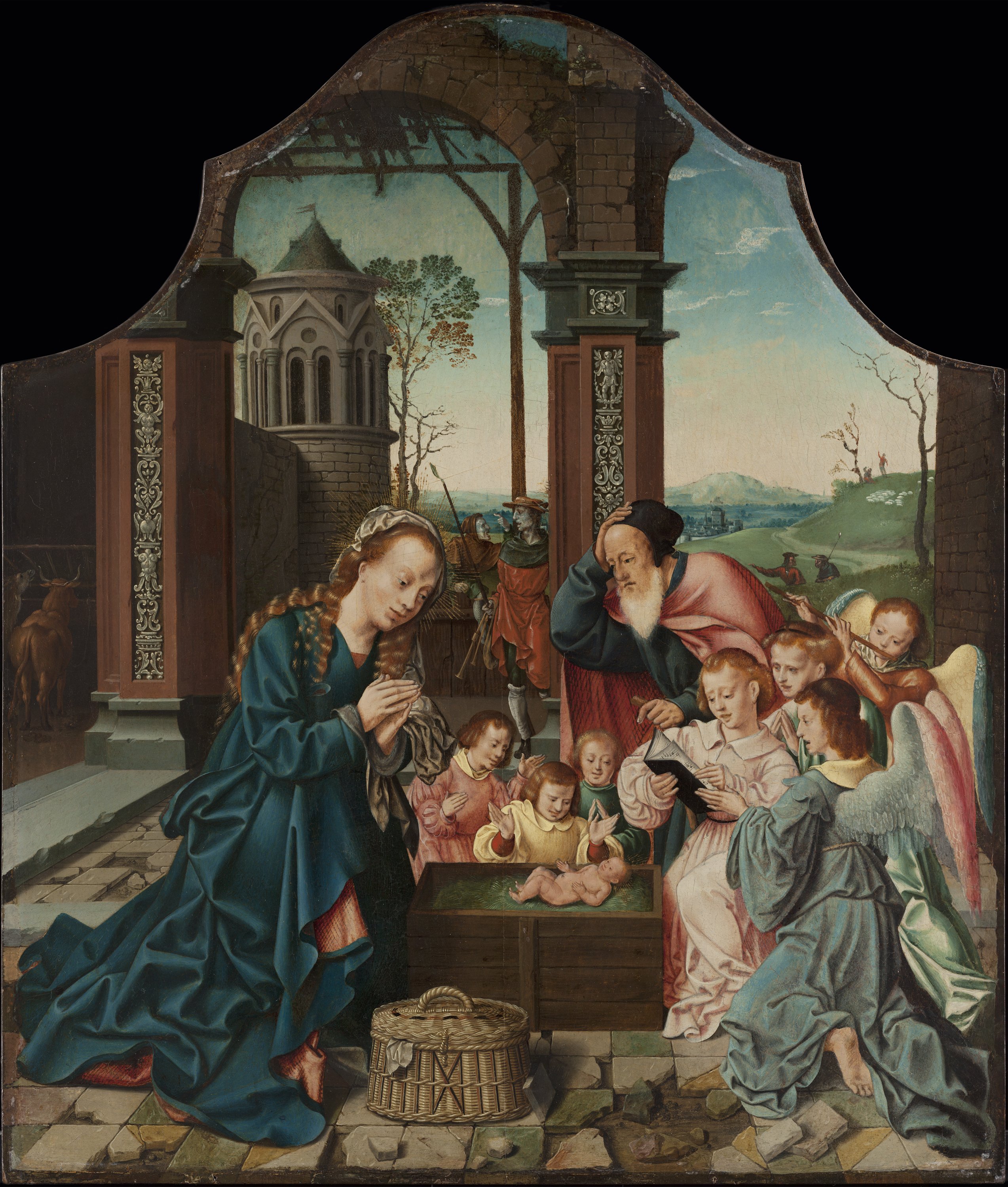
The style of the present panel suggests the influence of Joos van Cleve, as well as the stylistic and iconographic influence of 15th-century artists. It can be dated to around 1520. The episode of the Adoration is located in a Renaissance architectural setting with ruins. In the centre is the principal motif of the Infant Christ, around whom is grouped the key episode in the composition. Saint Joseph occupies a secondary position, raising his hand to take off his cap in a gesture of respect while the angels sing and play instruments around the central group. The background is presented as a landscape with gentle hills, a tower and the episode of the Annunciation to the Shepherds. Bruyn’s painting has been compared to two others by his hand depicting the same subject. One is a panel for the high altar of Essen cathedral and the other is the principal scene of a panel of a triptych now in the Kisters Collection.
MGA
Bruyn is documented in Cologne in 1515. Two years later he began to play an active role on the City Council. He occupied various posts and was intermittently involved with its activities throughout his life. Among his first commissions was a panel of The Coronation of the Virgin, while in the 1520s he painted the altarpiece for the high altar of Essen cathedral.
The present panel of The Nativityhas been dated to around 1520. Its composition and the figure types reveal elements characteristic of Netherlandish painting that Bruyn skilfully blends with his own style. The principal motif in the scene is the Christ Child who occupies the centre of the panel. Arranged in a semicircle around this smiling baby who looks at his mother is the core group within the composition. In contrast, Saint Joseph occupies a secondary position, as is traditional in this iconography, raising his hand to remove his hat in a sign of respect. The angels are arranged in two groups, one of four figures on the right and the other of three, presented frontally behind the manger. The angels play and sing while the three nearest the manger amuse the Christ Child.
One of the most successful elements in the composition is the space in which the main episode takes place, as well as the backdrop and setting. Here Bruyn displays all his abilities in the soft landscape created with a limited but carefully thought-out colour range. It includes the episode of the Annunciation to the Shepherds on a low hill on the right and a series of small figures that hurry to arrive at the place where the Christ Child has been born. To increase the sense of space in the panel Bruyn used a Mannerist device that he had already deployed in other compositions in the form of the shepherd in the middle ground who advances towards the central group and whose figure acts as a linking element to reinforce the connections between the most distant planes and the nearer ones.
The painting has been compared with two more panels by Bruyn on the same subject: one in the Essen altarpiece in which he again included the pilasters that frame the dilapidated arch but with more ornamental details, and the principal scene in the triptych in the Kisters collection in which he organised a more complex distribution of the groups surrounding the manger. To judge from its size the present panel might have been the central panel in a triptych, but it could also be an individual composition. It entered the Thyssen-Bornemisza collection before 1930 and on the death of Baron Hans Thyssen-Bornemisza was inherited by his daughter Margit, Countess of Batthyány. It was acquired by Baron Hans Heinrich Thyssen-Bornemisza for the Collection in 1972.
Mar Borobia