Cassone
ca. 1560
Walnut and gilding.
55.5 x 175.5 x 62 cm
Carmen Thyssen Collection
Inv. no.
K 522
(CTB.DEC0329
)
Room 6
Level 2
Permanent Collection
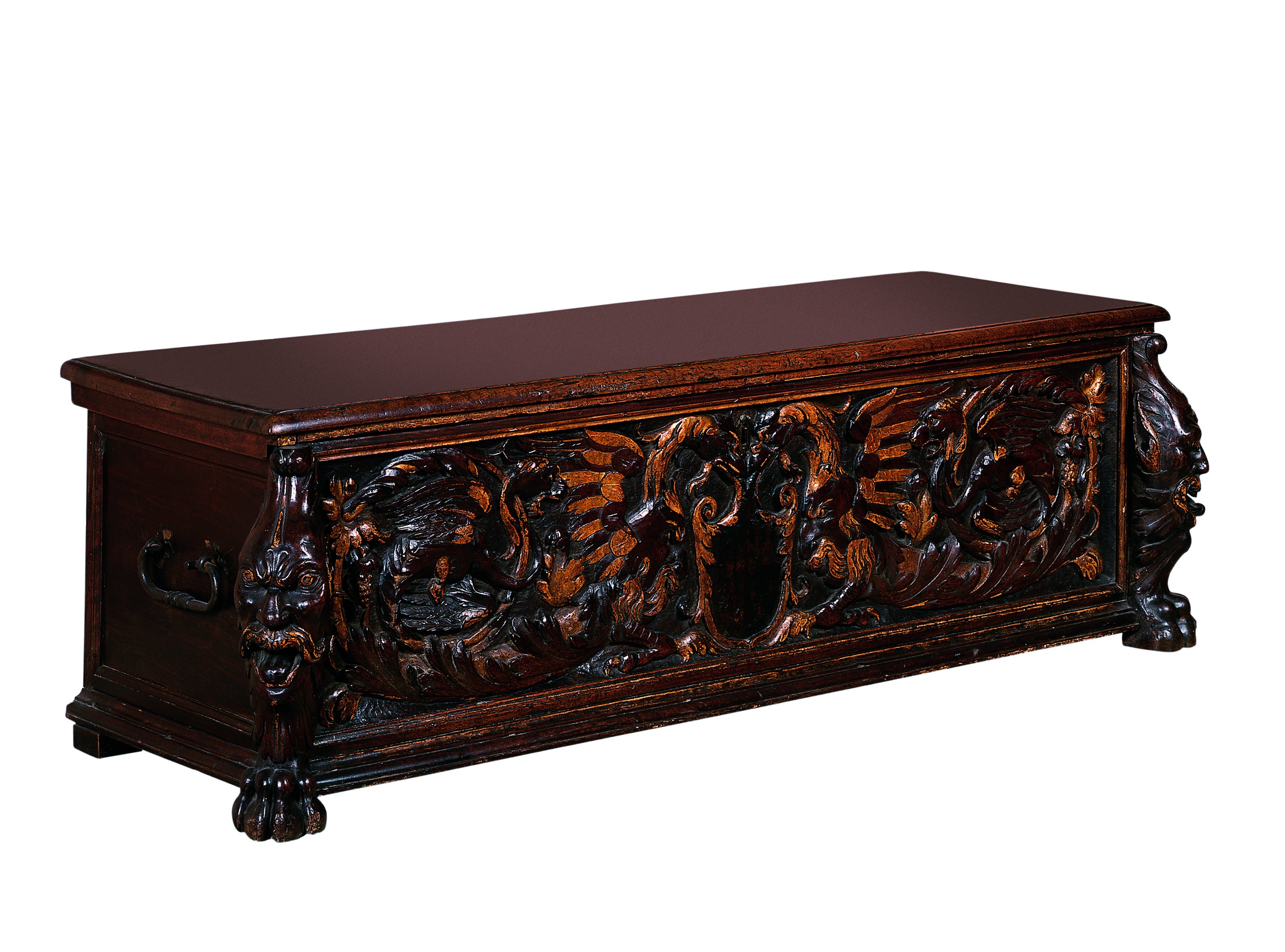
Apparently, this is a Venetian chest of the second half of the 16th century or beginning of the 17th, with the characteristic decoration of imaginary animals-winged dragons-inscribed within scrolls in mezzo rilievo, organised around an illegible quartered shield, and skewed grotesque masks on both edges of the front panel.
However, there are a number of inconsistencies in the way it is built, which suggest that it may be a historicised piece, combining old and modern elements. The bottom panel has been cut with a mechanical saw, a fact which can be observed particularly in its underside but not in the top surface, which is the only one visible when the chest is opened, and which has been smoothed off expressly. The bottom edge of the front panel, which can only be seen by turning the chest upside down, has been cut following the same procedure. The front, back and side panels have mitre joints, rather than being assembled with straight cuts, as was habitual in the 16th century. These joints are reinforced with angle irons, this also being a much more modern practice. The dovetail joints of the corners, visible from the back, show the regular and parallel marks of a mechanical cut, and the marks left by the gauge used to establish its size are also too obvious. The back panel has been planed quite roughly on the outside, rather than presenting a natural hand cut, which may suggest an intentional treatment to make it seem antique. The front panel has a lath at the top made with a piece of salvaged old wood gnawed by woodworm, showing the open cavities due to the fact that the surface was planed before being used for this chest. The wood finishing of the base seems to have been intentionally homogenised, and is made up of a thick coat of intense brown pigments, which could hide panels of different types of wood.
The walnut wood of the lid is older, and shows a natural aging produced by use and the effect of light; however, in the central front area it is possible to recognise the outline of an old keyhole, which has been sealed up with a graft; this is clearly an old door recycled as the top of a chest, probably before the construction of this piece. In fact, the mouldings of the edges show an unintentional wear and tear which can be obtained only with time, and the protecting lath has been fixed with old nails. If to these observations we add that the hinges are also old, as are the clinch nails-but not the corresponding nails in the back panel, which are more modern-we can assume that this part used to be a door, transformed at an unspecified date into the lid of a chest whose other parts were later lost, and was then reused for this chest, completing it with more recent pieces of wood. The back edge of this panel has been scraped, perhaps with the aim of disguising the cut with which the width of the panel had been reduced in order to give it the correct dimensions. On the inside is the inscription ".1601./VENA", in ink, which refers to the year and place -Venice- when and where it was made. It is not possible to determine if it belonged to the older piece from which we suppose the lid came, or whether it was added later, although the writing is excessively careless for a piece of such quality.
In addition, the metalwork does not conform to the norm: both the keyhole plate and the escutcheons of the side handles are made of tin, and not iron, as would be expected; the handles are made of iron, but it is clear that their manufacture is not old, and that they have been antiqued expressly.
Sofía Rodríguez Bernis
However, there are a number of inconsistencies in the way it is built, which suggest that it may be a historicised piece, combining old and modern elements. The bottom panel has been cut with a mechanical saw, a fact which can be observed particularly in its underside but not in the top surface, which is the only one visible when the chest is opened, and which has been smoothed off expressly. The bottom edge of the front panel, which can only be seen by turning the chest upside down, has been cut following the same procedure. The front, back and side panels have mitre joints, rather than being assembled with straight cuts, as was habitual in the 16th century. These joints are reinforced with angle irons, this also being a much more modern practice. The dovetail joints of the corners, visible from the back, show the regular and parallel marks of a mechanical cut, and the marks left by the gauge used to establish its size are also too obvious. The back panel has been planed quite roughly on the outside, rather than presenting a natural hand cut, which may suggest an intentional treatment to make it seem antique. The front panel has a lath at the top made with a piece of salvaged old wood gnawed by woodworm, showing the open cavities due to the fact that the surface was planed before being used for this chest. The wood finishing of the base seems to have been intentionally homogenised, and is made up of a thick coat of intense brown pigments, which could hide panels of different types of wood.
The walnut wood of the lid is older, and shows a natural aging produced by use and the effect of light; however, in the central front area it is possible to recognise the outline of an old keyhole, which has been sealed up with a graft; this is clearly an old door recycled as the top of a chest, probably before the construction of this piece. In fact, the mouldings of the edges show an unintentional wear and tear which can be obtained only with time, and the protecting lath has been fixed with old nails. If to these observations we add that the hinges are also old, as are the clinch nails-but not the corresponding nails in the back panel, which are more modern-we can assume that this part used to be a door, transformed at an unspecified date into the lid of a chest whose other parts were later lost, and was then reused for this chest, completing it with more recent pieces of wood. The back edge of this panel has been scraped, perhaps with the aim of disguising the cut with which the width of the panel had been reduced in order to give it the correct dimensions. On the inside is the inscription ".1601./VENA", in ink, which refers to the year and place -Venice- when and where it was made. It is not possible to determine if it belonged to the older piece from which we suppose the lid came, or whether it was added later, although the writing is excessively careless for a piece of such quality.
In addition, the metalwork does not conform to the norm: both the keyhole plate and the escutcheons of the side handles are made of tin, and not iron, as would be expected; the handles are made of iron, but it is clear that their manufacture is not old, and that they have been antiqued expressly.
Sofía Rodríguez Bernis