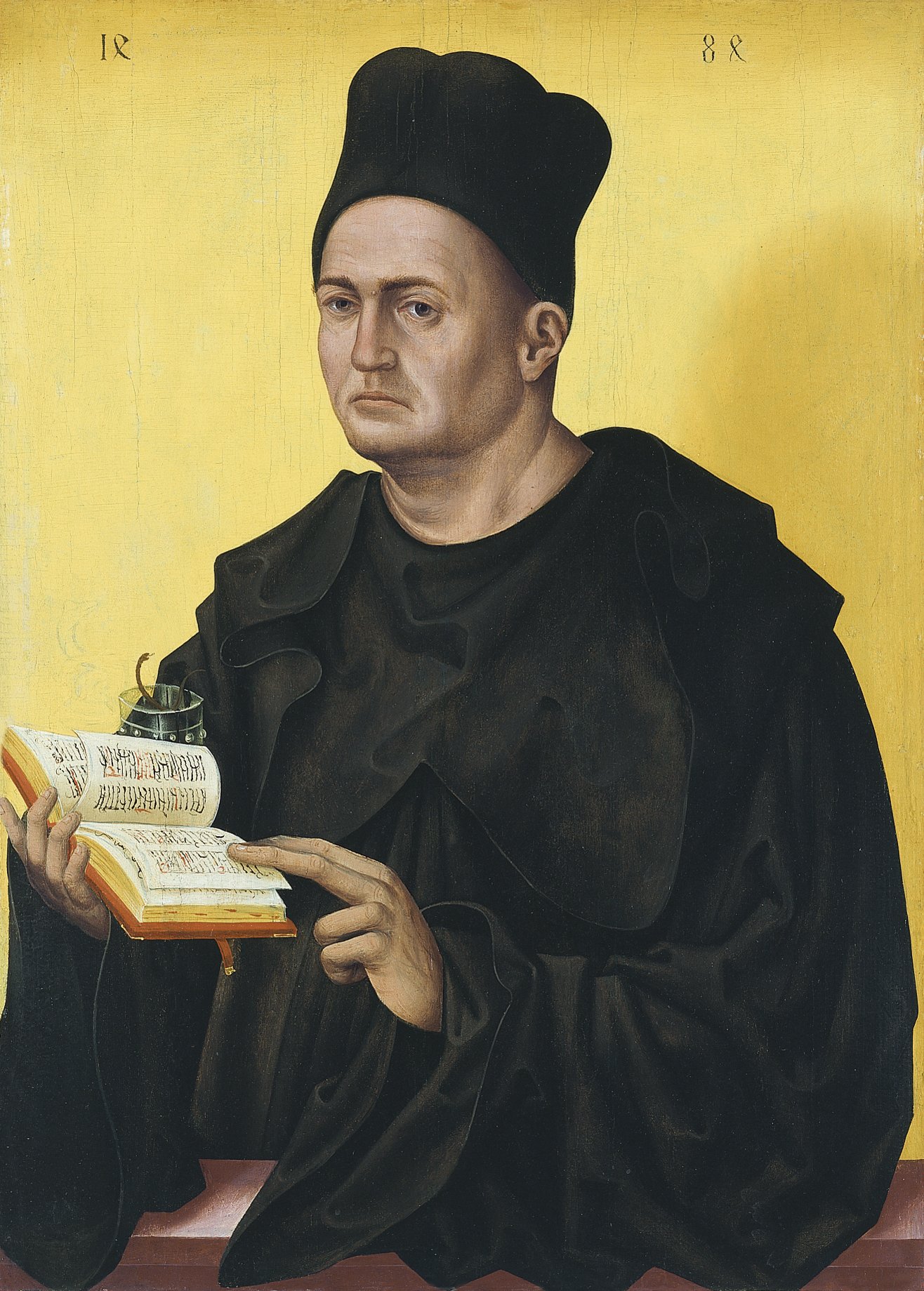
Portrait of a Benedictine Abbot
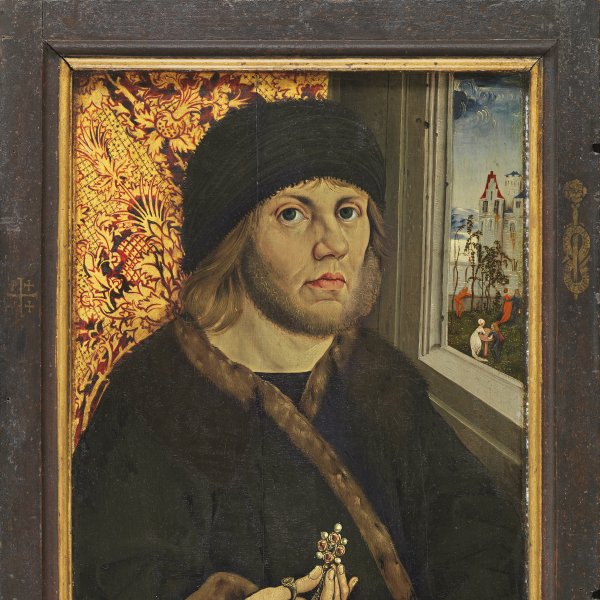
Jan Polack was a German painter of the late 14th and early 15th centuries who worked in Munich and was noted for his portraits and religious compositions. His style has echoes of late Gothic painting from southern Poland and Bavaria and he settled in the latter area. In particular, he was influenced by the Master of the Tegernsee Passion. This panel, which depicts a Benedictine abbot, is a good example of Polack’s work in the field of portraiture. The sitter is presented against a striking yellow background that contrasts with his black habit. His features are highly individualised, suggesting that this is not a depiction of Saint Benedict, the Order’s founder, but rather a portrait of a particular abbot. Christian Salm suggested that the sitter might be Christoph Schleichere, abbot of the monastery of Weihenstephen where Polack worked for six years. The abbot is depicted holding a book with the rules of his community and a chalice from which a snake emerges.
NR
This panel is a good example of Polak’s skills as a portraitist. Silhouetted against a yellow background, the monk bears the attributes of Saint Benedict, founder of the Order of that name. The face is precisely defined with individualised and realistic features such as the wart at the top of the nose and the very short hair. These characteristics have led art historians to suggest that the painting is a portrait rather than a depiction of Saint Benedict. The monk, located in front of a barely visible ledge that is half-hidden by the folds of his voluminous habit, holds the symbols of that saint: a book with the rules of the Order and a chalice with a serpent. The latter is a common attribute of Saint John the Evangelist but in the case of Saint Benedict refers to the time that he spent in the monastery at Vicovaro: there, various monks attempted to kill him but the poison in the cup turned into a snake that fled and the cup broke when Benedict made the sign of the cross over it.
At the time of the painting’s inclusion in the Royal Academy exhibition in London, David Ekserdjian drew attention to two unusual aspects of the work: the fact that monks were very rarely depicted at this date with the attributes of particular saints; and the striking colour that Polak selected for the background.
Salm suggested that the sitter might be Christoph Schleichere, abbot of the monastery at Weihenstephen where Polak worked between 1483 and 1489. The present panel has significant underdrawing, some of which is visible to the naked eye, for example under the small snake in the chalice, which was originally larger and located further to the left. In fact, this panel was originally destined to be a depiction of the Virgin and Child, as the under-drawing revealed by infra-red reflectography has indicated. The image of the Virgin was positioned in the opposite direction to that of the monk and the lower area of her drapery is clearly visible, with the folds and shadows precisely drawn. The upper part of the Virgin is not visible under infra-red as the paint layers of the monk’s habit are too dense.
Mar Borobia