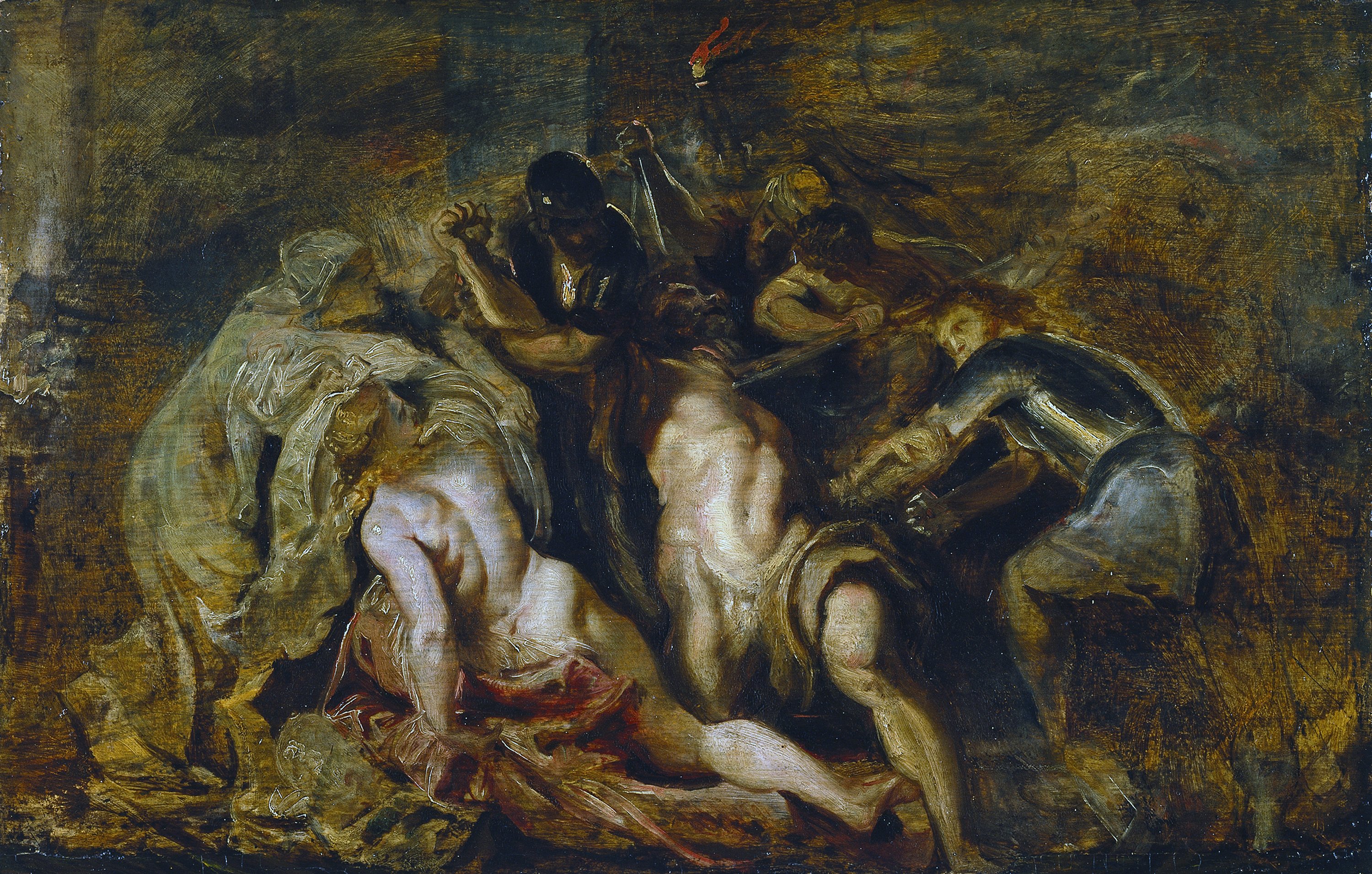
The Blinding of Samson
Rubens depicts an episode from the life of Samson recounted in the Old Testament. According to this account, the Philistines entrusted Delilah with seducing Samson in order to discover the secret of his great strength and thus capture him. After Samson foiled her attempts several times, Delilah, who was paid for her work, succeeded in gaining his confidence and he confided his secret to her. He fell asleep in her lap and she called a man to cut off the seven locks of his hair in which his powers of strength lay. Once deprived of his might, Delilah summoned the Philistines who captured him, put out his eyes and took him to Gaza.
Rubens here chooses the most dramatic and violent moment of the story, when the Philistines, represented by four figures, hurl themselves on Samson to take him prisoner. The artist constructs a compact group in which Samson stands out through his central location and his contorted pose, defending himself and trying to escape from his captors. One of the Philistines holds a lance to his chest, while another has a flaming torch which provides the only touch of scarlet in the painting, and another brandishes a dagger above his eyes in a threatening gesture. Delilah is to be seen on the left, her naked body partly covered by red draperies, in an exaggeratedly foreshortened pose and accompanied by an old woman who is probably her servant.
This monochrome oil sketch, created from tones of brown and grey and painted in a loose, rapid technique, belonged to Robert von Hirsch, in whose collection it was to be found in 1925. It was auctioned in London in 1978 and was acquired that year for the Thyssen-Bornemisza collection. When in the Von Hirsch collection the panel was thought to be by Van Dyck. It was attributed to Rubens by Glück and Burchard in letters of 1928 and 1929.
Rubens depicted this subject on other occasions, for example in the oil sketch in the Cincinnati Art Museum entitled Samson asleep on Delilah’s Lap, and in The Capture of Samson in the Art Institute of Chicago. The present painting can be compared to the Chicago panel, particularly with regard to the group of Philistines who enter Delilah’s room to capture Samson, and in the position of Samson’s legs and the figure of the old servant.
The present sketch has echoes of classical art, in particular the Laocoön group, which Rubens sketched from several viewpoints when he was in Rome. Delilah’s pose is derived from a composition by Perino del Vaga of Jupiter and Callisto. Her contorted pose was used again by Rubens in other oil sketches, such as The Miraculous Draught of Fishes in the Wallraf-Richartz Museum, Cologne, in which it is deployed for one of the fishermen.
The Musée du Louvre has a drawing of this composition, which is not, however, unanimously attributed to Rubens.
Mar Borobia