Portrait of David Lyon
Thomas Lawrence was the greatest English portraitist of the 19th century and an artist whose work forms a connecting link between 18th-century trends, which he absorbed and applied, and the new aesthetic of the 19th century. Lawrence had a natural ability for painting that became evident at an early age and is to be seen in various chalk drawings executed while still young. In Bath, to where his family had moved in 1780, he began to produce pastel portraits while starting to work in oil and to study the works of the Old Masters to be found in local collections. Lawrence moved to London in 1787, spent a brief period at the Royal Academy Schools and began to exhibit that year. The dynamic force of his works aroused considerable surprise in artistic circles. The caution with which critics initially reacted soon turned to admiration when he presented his first full-length portrait, of Lady Cremorne, in 1789. This would function as a recommendation to Queen Charlotte, who commissioned her own portrait from the artist, completed in 1790 when he was twenty-one. Lawrence became the most celebrated portraitist of the day, patronised by the English monarchs, and soon achieved fame and numerous commissions. The following year he was elected an Academician and became a full member in 1794. His paintings look to the grand manner developed by Reynolds but they also convey a sense of intimate connection with the sitter, which Lawrence was so brilliantly able to convey. Among his most notable qualities was the type of idealisation devoid of overt flattery with which he portrayed his clients, which was fundamental to his notion of painting, as well as his skill at depicting the textures of materials.
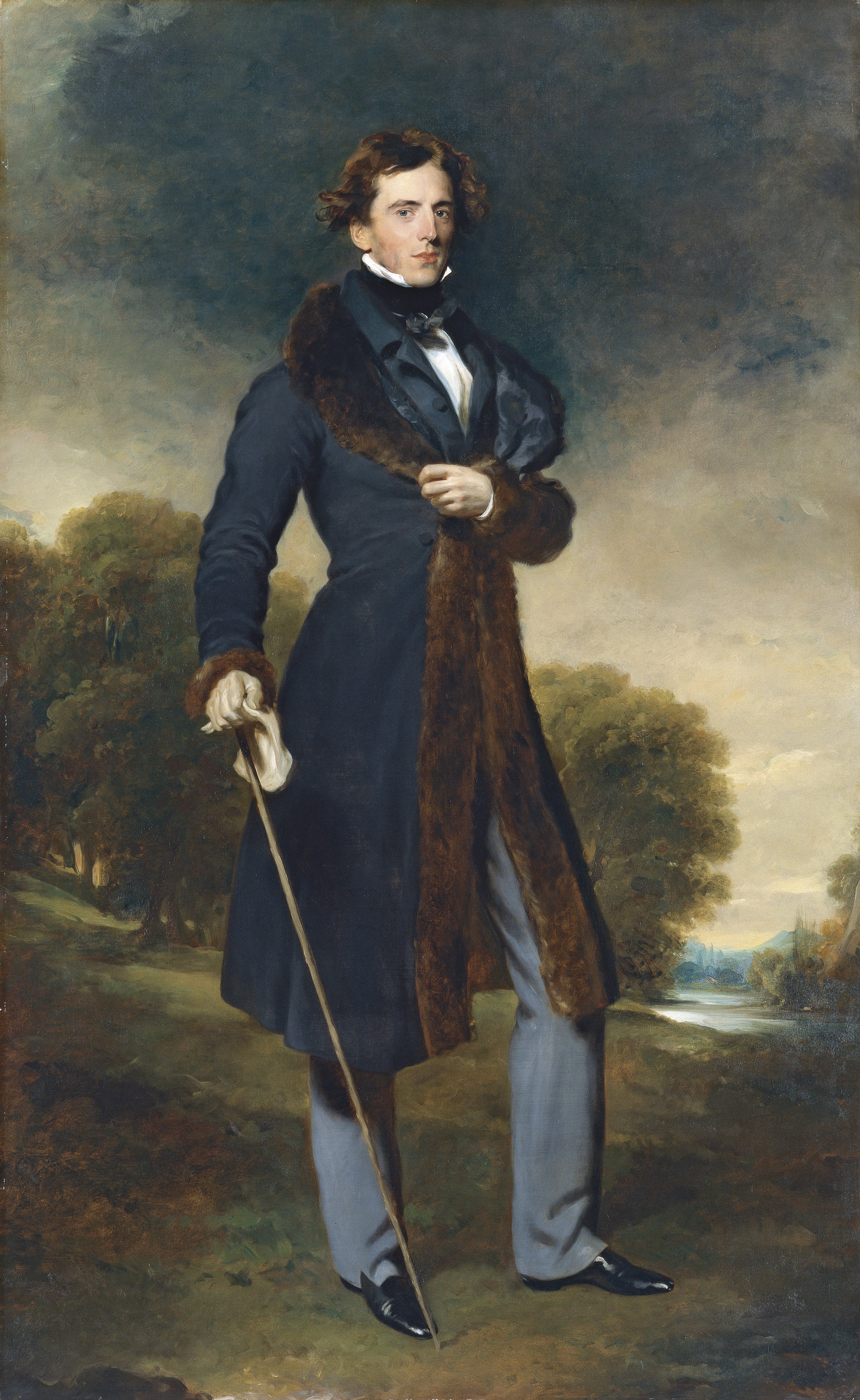
The present canvas was in the collection of Miss Carnegy-Arbuthnott and was auctioned at Christie’s in 1980. It entered the Thyssen-Bornemisza collection one year later and was displayed at the residence of the Baron and Baroness at Daylesford House in the UK. Portrait of David Lyon is a mature work by Lawrence, executed in his last phase during which time the artist produced works of exceptional quality and handling. Lawrence was paid for the painting in 1828, which would seem to have cost the sitter the high sum of 700 guineas. The artist had painted a portrait of the sitter’s father, also called David Lyon, ten years earlier in an unfinished bust-length work.
Lawrence locates his sitter in a spacious, tranquil landscape setting, imbuing the image with a characteristic air of distinction and elegance conveyed through the young man’s clothing and pose. The figure is elegant and attractive despite the simple, natural pose. The head has a sense of presence emphasised by the expression, the lively eyes and penetrating gaze. David Lyon is given a Romantic air through his long hair, stirred by the breeze, and his sideburns. In his final phase Lawrence abandoned the technical bravura of his early works and here renders the surface of the shoes and cloth of the coat with its fur trim in a relatively simple manner, both areas being painted with great skill but without an excessive degree of finish.
Mar Borobia