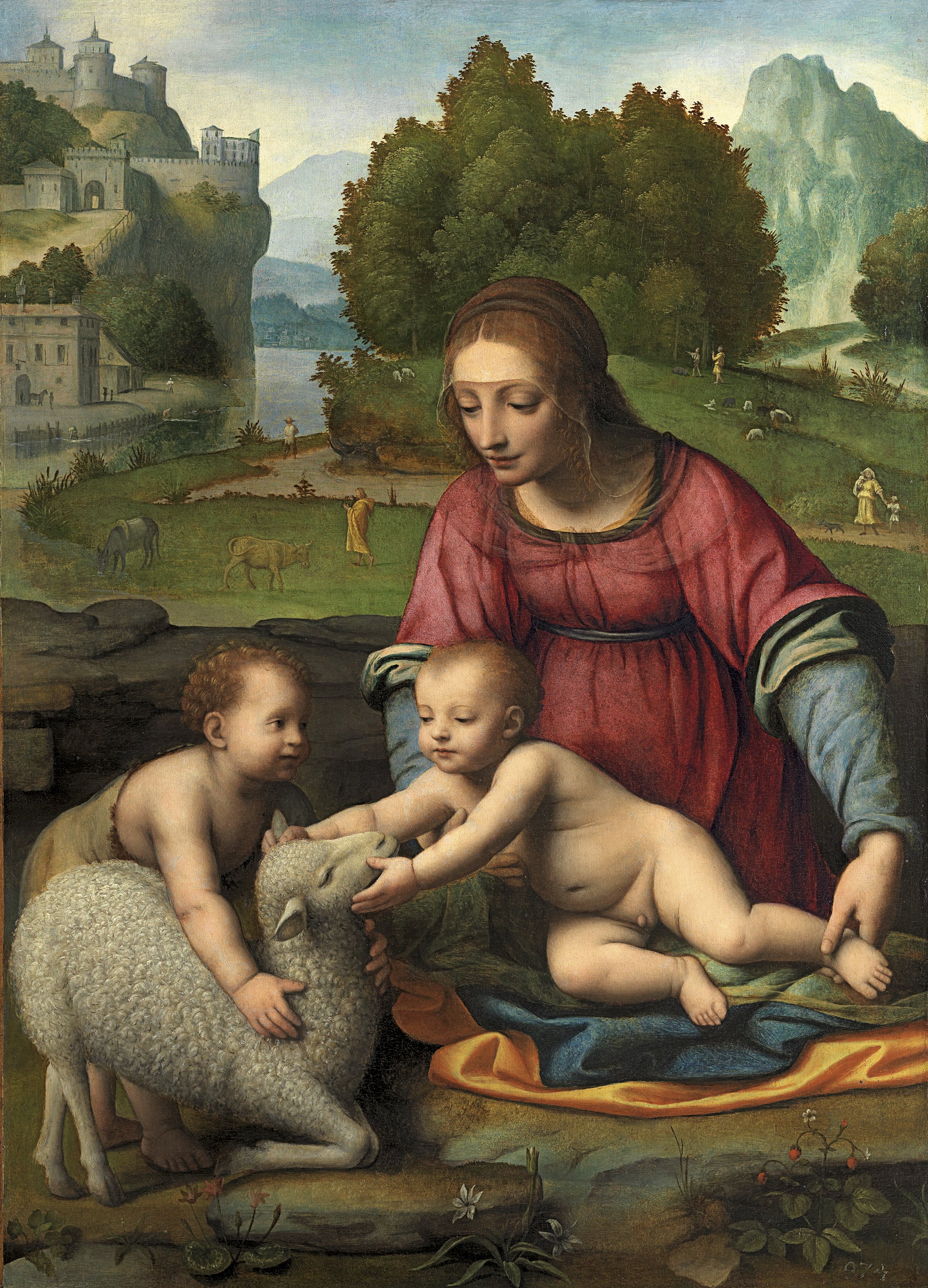
Virgin and Child with the Infant Saint John the Baptist
1523 - 1525
Oil on canvas.
86 x 60 cm
Museo Nacional Thyssen-Bornemisza, Madrid
Inv. no.
232
(1977.108
)
Room 7
Level 2
Permanent Collection
Bernardino Luini was highly appreciated among 19th-century collectors for his compositions and the elegance of his style. Luini was both a painter of frescoes and of easel-format paintings. Little information is known regarding his life and many works previously attributed to him have been rejected in recent times, reducing his extensive oeuvre. Luini is mentioned as one of Leonardo’s followers and is said to have worked in the studio of a minor painter in Milan in the late 15th and early 16th centuries. Luini had a profound knowledge of Leonardo’s work, applying the latter’s precepts in his own paintings, particularly with regard to composition and technique, for which he borrowed Leonardo’s soft, diffused outlines. He also studied Raphael’s Roman output and Venetian painting. Among his early works from the second decade of the 16th century is the polyptych for the parish church of Maggianico in Como, as well as various frescoes for the abbey of Chiaravalle.
The Virgin and Child with the Infant Saint John the Baptist was in the Paris collection of Baron Edouard de Rothschild where it is documented in 1880, subsequently passing to the Baron’s descendents. The canvas entered the Thyssen-Bornemisza collection in 1977 from the UK art market. It may have belonged at one point to Cardinal Fesch, Bishop of Lyons, whose collection was auctioned in Rome in 1845. The canvas appears in the catalogue of that sale correctly attributed and with a detailed description that seems to correspond to the present painting. The catalogue also refers to the harmony of the colouring, the soft brushstroke, the beauty of the Virgin and the pleasing overall effect of the composition.
The central group in Luini’s canvas is inspired by models developed by Leonardo. The central group is located on a small raised area above a meadow, separated from the landscape behind by a low stone wall that also functions to emphasise the foreground and create a sense of space. The kneeling Virgin has an idealised face of the type seen in Leonardo’s Virgin of the Rocks. She delicately supports the infant Christ around the chest and by one of his feet. He leans towards the lamb, which kneels before him and which is also caressed by the infant Saint John the Baptist who looks fixedly at the Christ Child. This pleasing, gentle composition is completed by a background view that features elements based on the landscape of north Italy near Lake Como. In the meadow on the left Luini depicted an ox and a grazing mule next to a man who may be Saint Joseph. The artist achieved fine colour combinations through the contrast of large areas of colour such as Mary’s red tunic and the intense green of the vegetation.
There is another version of this composition with slight variations in the Indiana Museum of Art, dated 1520.
Mar Borobia
The Virgin and Child with the Infant Saint John the Baptist was in the Paris collection of Baron Edouard de Rothschild where it is documented in 1880, subsequently passing to the Baron’s descendents. The canvas entered the Thyssen-Bornemisza collection in 1977 from the UK art market. It may have belonged at one point to Cardinal Fesch, Bishop of Lyons, whose collection was auctioned in Rome in 1845. The canvas appears in the catalogue of that sale correctly attributed and with a detailed description that seems to correspond to the present painting. The catalogue also refers to the harmony of the colouring, the soft brushstroke, the beauty of the Virgin and the pleasing overall effect of the composition.
The central group in Luini’s canvas is inspired by models developed by Leonardo. The central group is located on a small raised area above a meadow, separated from the landscape behind by a low stone wall that also functions to emphasise the foreground and create a sense of space. The kneeling Virgin has an idealised face of the type seen in Leonardo’s Virgin of the Rocks. She delicately supports the infant Christ around the chest and by one of his feet. He leans towards the lamb, which kneels before him and which is also caressed by the infant Saint John the Baptist who looks fixedly at the Christ Child. This pleasing, gentle composition is completed by a background view that features elements based on the landscape of north Italy near Lake Como. In the meadow on the left Luini depicted an ox and a grazing mule next to a man who may be Saint Joseph. The artist achieved fine colour combinations through the contrast of large areas of colour such as Mary’s red tunic and the intense green of the vegetation.
There is another version of this composition with slight variations in the Indiana Museum of Art, dated 1520.
Mar Borobia