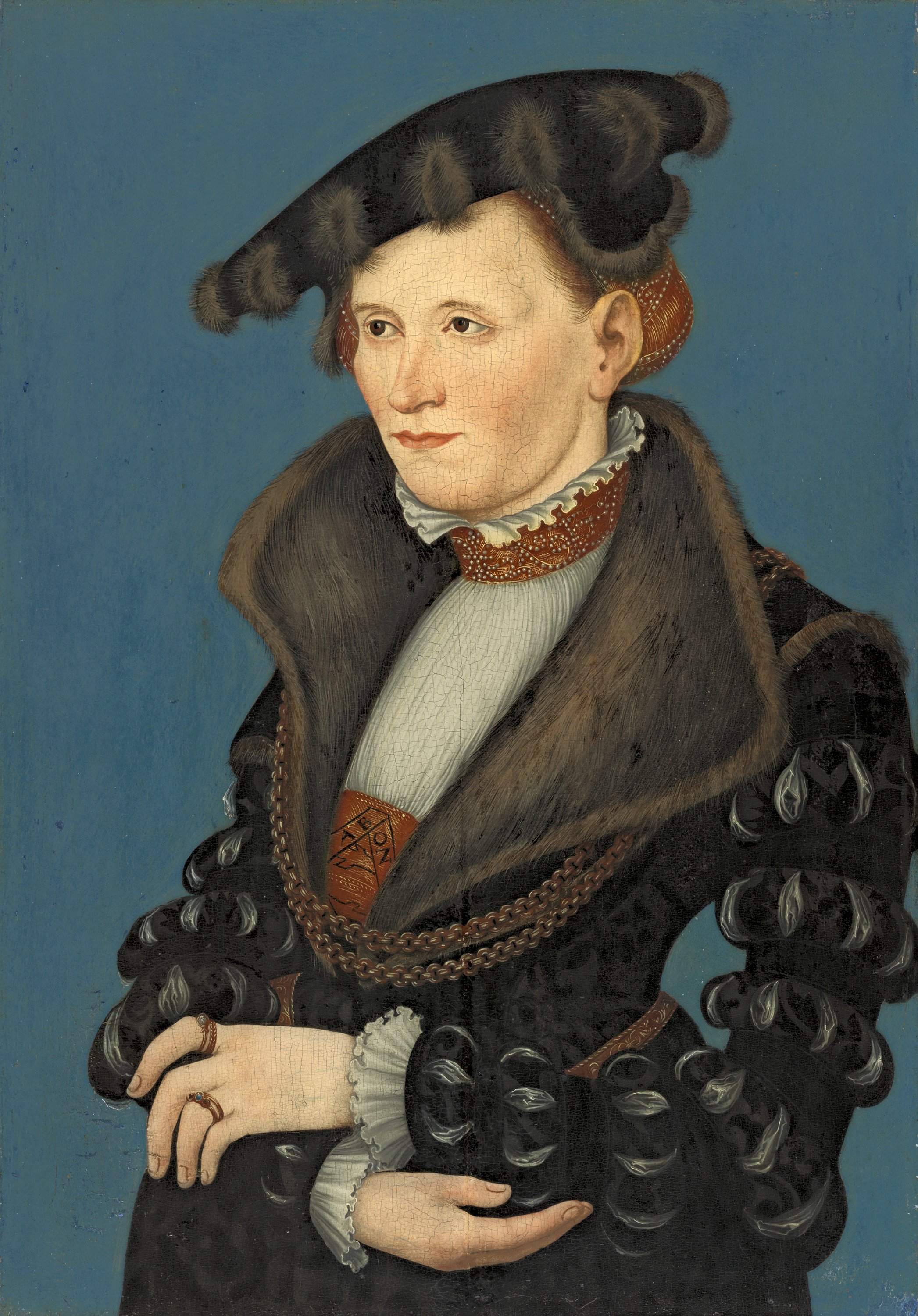
Portrait of a Woman
Son of Lucas Cranach the Elder, the artist trained in his father’s studio, as did his elder brother Hans. Both followed their father’s style. The present portrait depicts a young woman against a vivid, plain blue background in slightly over half-length format. The increasing amount of the sitter’s body included in the image indicates the evolution in portraiture that was taking place at this period.
Cranach the Younger reveals his mastery in the depiction of small details such as the hairnet of pearls that covers the young woman’s hair, her rings, belt and choker. Her sumptuous clothes, trimmed with fur and embellished with numerous jewels, indicates that she is a woman of aristocratic status or perhaps a leading figure at court. The letters “ABON” on her clothing have been read as “A bona fide”, referring to her honesty and obligations. The majority of portraits of this type were executed for a particular occasion such as a matrimonial alliance and this panel may have been commissioned as an individual image or as a pair to another panel. The sitter’s pose, turned slightly to the left, has led art historians to suggest that it had a pair in the form of a male portrait of the same year that is now in the São Paulo Museum (Brazil).
MGA
This Portrait of a Woman is dated to 1539, a period when it is difficult to distinguish the different hands in the family workshop. A number of different attributions have been proposed since it was first published by Campbell Dodgson with an attribution to Lucas the Younger. In his initial study of the work Friedländer gave it to Cranach the Elder, and it appeared as such in the early catalogues of the Collection and in the exhibition at the Neue Pinakothek in Munich. At the present time the painting maintains the attribution of Isolde Lübbeke who compared it in detail with the Portrait of a Man of 1539 in the Museu de Arte de São Paulo, which she suggested forms a pair with the present panel.
The sitter, whose identity remains unknown, is presented standing, half-length, against an attractive blue background. She is elegantly but discreetly dressed with various rings on her fingers and a gold chain around her neck. In addition to the elegance of her clothes, embellished by the fur trimming on her collar and hat, she is further distinguished by the delicate manner in which the face is constructed using soft tones and an emphasis on the bone structure.
To judge from her clothing the sitter would have been a member of the patrician class, although Zimmerman attempted to identify her with the wife of Duke Frederick of Saxony, a suggestion that has been rejected. With regard to its relationship to the panel in São Paolo, both are the same size and are visually well matched. They also share technical and stylistic similarities. The painting in Brazil, in which the man has a wreath of pinks on his head, has been tentatively identified as a nuptial image. On the bodice of the present sitter is an abbreviated inscription that has been related to the motto A bone fine. The painting entered the Thyssen- Bornemisza collection in 1929.
Mar Borobia