The Stewart Children
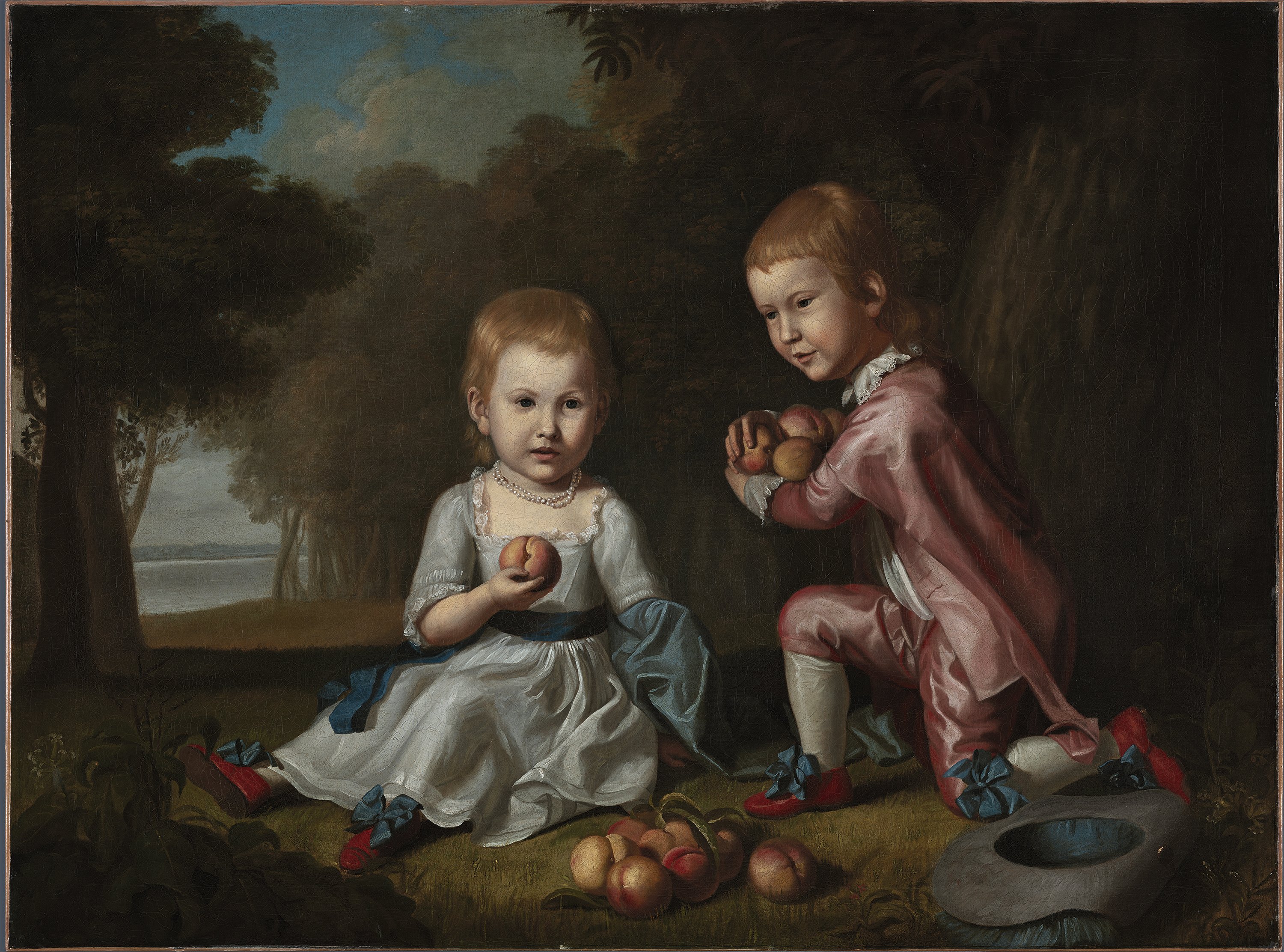
After spending two years in London, where he absorbed the influence of English portraiture, Charles Willson Peale established himself in Maryland in 1769 and soon became one of the painters with the greatest appeal for clients who followed English fashions. The Stewart Children is a clear example of this influence, which is visible particularly in the serpentine lines that are repeated in the composition, both in the folds of the clothing and in Isabella’s pearl necklace and John’s hat, and are derived from the “S” curves that William Hogarth defined as lines of beauty.
The sitters, Isabella and John Stewart, were the children of Anthony and Jean Stewart. Anthony, born in 1738, was the sixth child of James Stewart of Edinburgh and one of the most prominent merchants of Annapolis. Jean Dick was the daughter of James Dick, a native of Maryland. On the basis of the children’s apparent age and the fact that Anthony Stewart’s boat was set fire to during a riot at Annapolis harbour in October 1774, Elizabeth Garrity Ellis dates the painting to between 1773 and mid 1774. The painting furthermore features on a list of unpaid debts compiled by Peale before moving to Philadelphia in 1776.
The work as a whole is a paradigmatic example of one of the painter’s favourite themes: domestic bliss. In his study on this painting, David Steinberg maintains that when Peale painted Anthony Stewart’s children he adapted them to the peculiarities of his patron. Following the tradition of fête gallante scenes, he chose as a setting the scenery of the plantation the family owned on the east coast of Maryland. The children, elegantly dressed, are depicted playing with some peaches grown there. The thistle — the national emblem of Scotland — on the right of the painting may be a reference to their Scottish ancestry.
Nor should we rule out the possibility that Peale wished to imbue the painting with certain biblical connotations, as in a sense the theme alludes to original sin. This hypothesis is not far-fetched bearing in mind that Peale illustrated an edition of Milton’s Paradise Lost with his engravings at the start of his artist’s career.
The portrait remained in the possession of the family of Isabella Stewart (1771‒1817) and was handed down to subsequent generations until shortly before being incorporated into the Baron Thyssen collection in 1980.
Paloma Alarcó