Saint Mark the Evangelist
In the second half of the 17th century, Rome saw the triumph of the late decorative Baroque, a style that had prevailed over the course of that century. This trend first appeared with Pietro Cortina and culminated with Andrea Pozzo. A counterpoint to this triumphal Baroque is represented by the work of Carlo Maratta, whose compositions, with their spare, monumental figures, aimed to combine classicising tendencies with the most decorative ones, achieving a visual equilibrium between line and colour. According to his biographer, Giovanni Pietro Bellori, at a very young age Maratta copied prints that he subsequently sold in his native city. The artist’s talents and abilities brought him to Rome in 1636 under the protection of a family friend, Corintio Benicampi. One year later, in 1637, Maratta was in the studio of Andrea Sacchi where he remained until 1661, the date of his master’s death. During this period of training Maratta studied classical art and the work of Raphael, Annibale Caracci, Domenichino and Guido Reni. His first work as an independent artist was The Adoration of the Shepherds of 1650 painted for the church of San Giuseppe dei Falegnami in Rome. Despite the evident influence of Sacchi, it marks the start of a brilliant career and is the prelude to a series of important commissions.
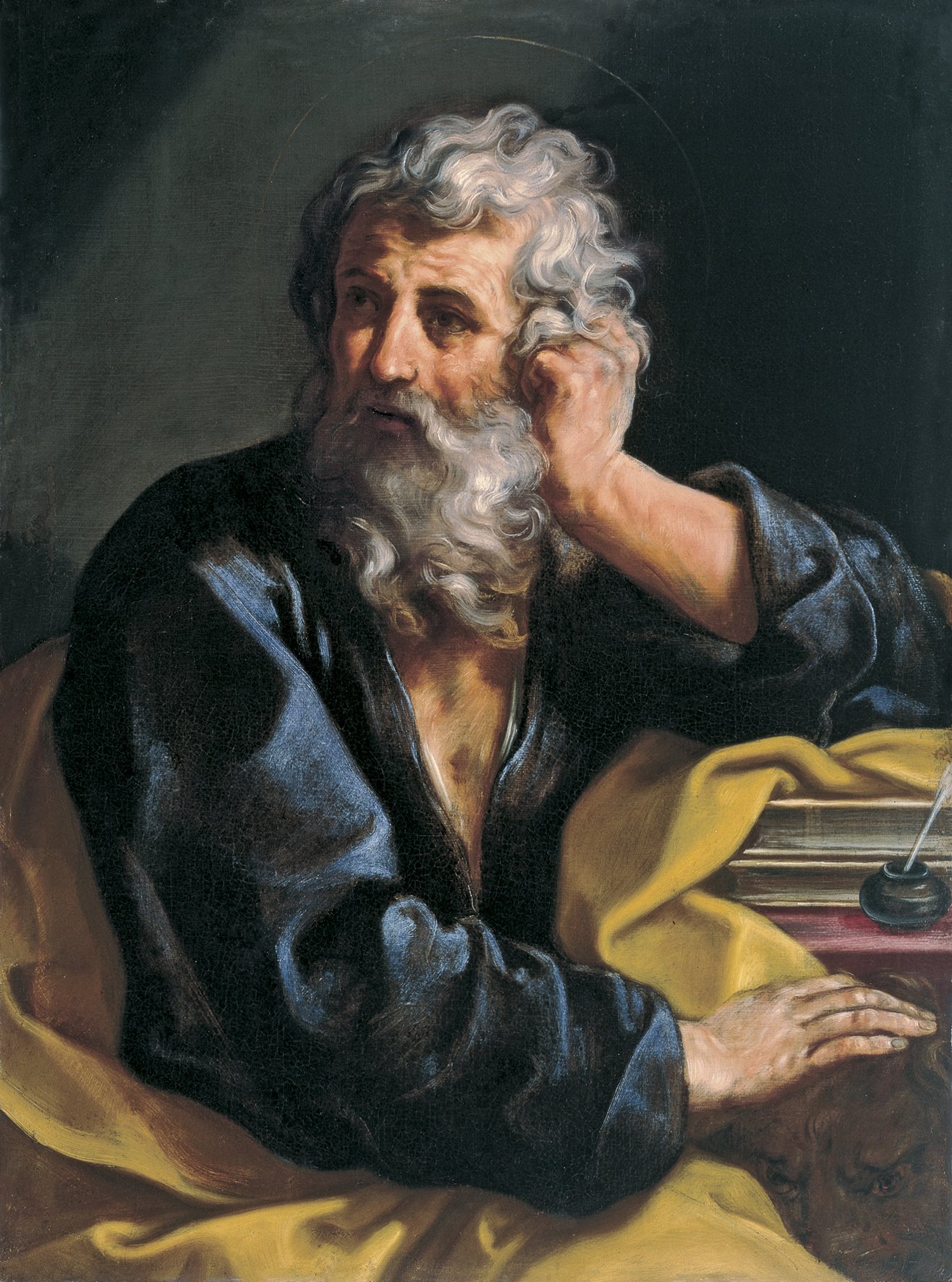
The figure in this canvas has been identified as the Evangelist Mark from the presence of one of his traditional attributes, namely the lion, whose head he is stroking. In addition, we see two thick volumes and an inkwell on the table, which offer a clear reference to his role as author of one of the Gospels. Maratta depicts the Evangelist seated, looking abstractedly to his right in a relaxed, almost spontaneous pose that contrasts with his imposing, dignified physical appearance of a classical type.
It has been suggested that this saint may have been part of a series with the other three Evangelists, but no other work by Maratta is known that can be related to the present canvas. There are, however, written references, including one by Bellori, to two early, half-figures of Apostles by the artist. Mention should also be made of the series of Apostles painted for the Barberini palace. These were commissioned from Andrea Sacchi by Cardinal Antonio Barberini and completed by Maratta with a canvas of Saint Matthew in the late 1690s. However, it is also difficult to associate the present Saint Mark with that series.
Roberto Contini dated the present painting to the second half of the 1650s or early 1660s, considering it an early work. He compared this grave, volumetric head with that of Moses in the fresco of The Glory of Saint Joseph that decorated the chapel of Saint Joseph in the church of San Isidoro in Rome, dated 1652. He also compared this figure with one of the old men in The Raising of Lazarus in the Villa Albani, and with that of Saint Peter in The Apparition of the Virgin to San Filippo Neri (Galleria Palatina, Florence). These examples, as well as a number of drawings by the artist, led Contini to think that the model for this canvas was a standard one that Maratta used in various compositions.
Mar Borobia