Greenwood Lake
Jasper F. Cropsey was an artist associated with the Hudson River School. He embarked on his career as an artist in 1843 following his first visit to Lake Greenwood. From then on Cropsey painted numerous views of this region near New York. His works depict the natural world in a precise, accurate manner with the occasional addition of picturesque elements. Cropsey’s works and his detailed style allowed Europeans to become familiar with the landscape of America, winning him success in Europe during the periods that he spent there.
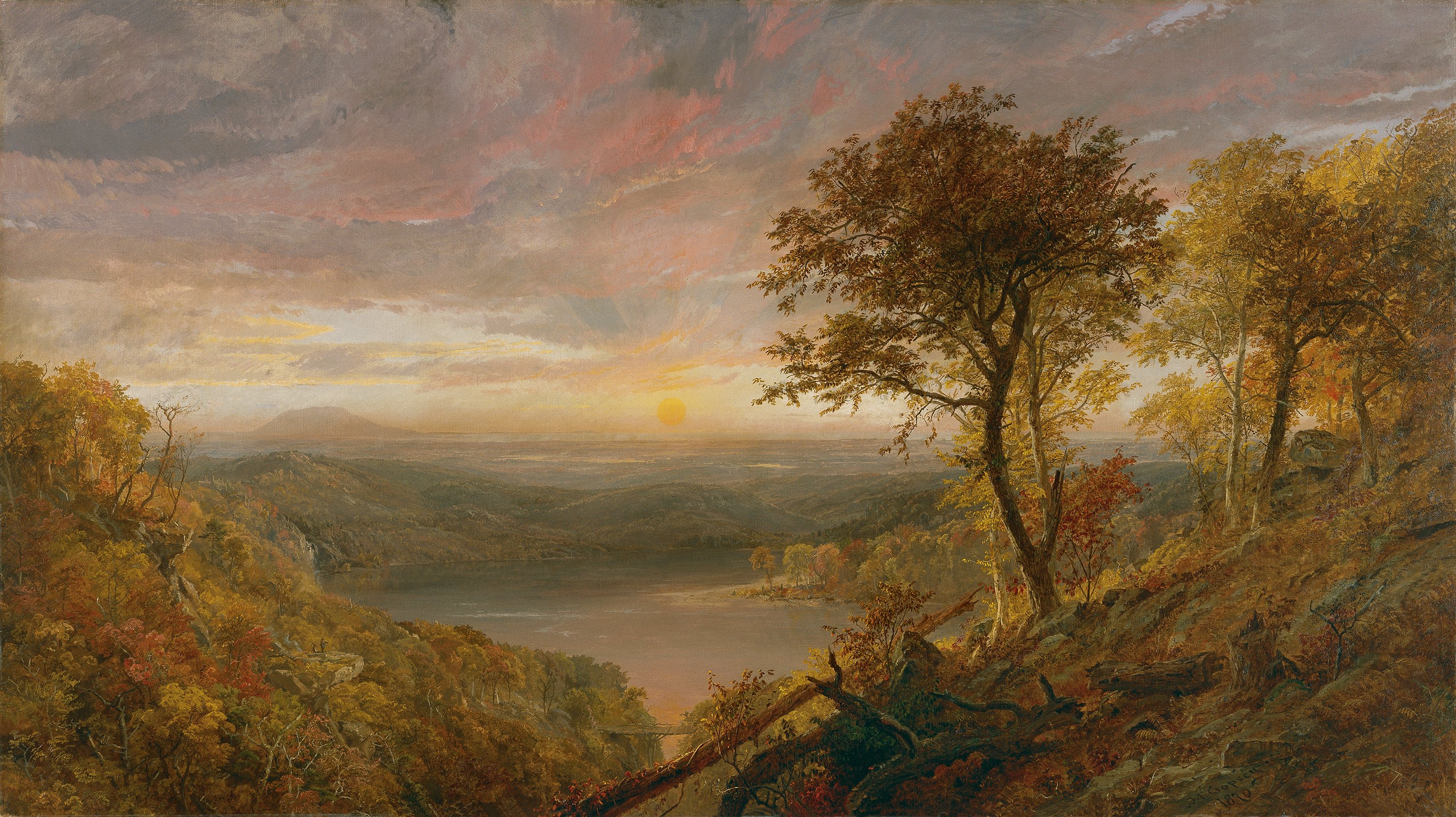
This scene of Lake Greenwood reveals Cropsey’s interest during his mature phase in the effects of light and atmosphere on the landscape. Seen from an elevated viewpoint, the view is framed by foreground trees whose leaves are changing colour with the onset of autumn. In the background the mountains around the lake are depicted in warm, glowing tones that are further developed in the sky. The grandeur of the natural world is emphasised by the presence of tiny figures that observe the landscape from a rocky ledge in the lower left-hand corner.
CM
Greenwood Lake, a late work that Cropsey painted on returning from a stay of several years in London, depicts the explosion of colour that precedes the coming of winter, before the striking American vegetation loses all its colour. The panoramic format, intentionally enlarged horizontally, that began to prevail in American painting towards the mid-twentieth century and, as Kenneth W.Maddox points out, had already been used by Cropsey in earlier works like Lake Ontario, gives greater prominence to the effects of the light and its reflection on the broad horizon and evidences the fresh importance the artist attaches to describing the atmospheric properties of the golden sunset, influenced by the poetics of the Luminist school.
In London, Cropsey, who did not cease to paint American landscapes, completed the most ambitious landscape of his entire career in 1860, Autumn. On the Hudson River, which caused a stir when shown at the London International Exhibition of 1862 and established him as “America’s painter of autumn.” The artist himself commented that his aim was “to convey an idea of the vastness and magnitude of the American landscape, the clearness and beauty of the atmosphere, and the richness and variety of the colour in the foliage during the Indian Summer period of the year.” To Cropsey and his American contemporaries, the autumnal splendour of America’s forests — whose existence was doubted by the Europeans — represented God’s special blessing of their Nation. It is therefore not surprising that the artist, a fervent believer who became a lay elder of the Dutch reformed church over time, should have regarded the apotheosis of autumn as the glorification of life on earth and the celebration of God’s benevolence for allowing mankind to enjoy this glorious season. Furthermore, according to a Bible reference from the book of Isaiah, “all of us wither like a leaf, ” and the vivid colours of autumn are generally interpreted as a metaphor of the passage of time, of the final moment in life when man achieves greater spiritual “enlightenment” as his physical state deteriorates.
However, Cropsey’s metaphorical streak was much more restrained than that of Thomas Cole, his first “master.”His painting was more naturalistic, closer to Asher B. Durand and Frederic Edwin Church, and clearly marked by the influence of John Ruskin, whom he met in England. In this work from the Museo Thyssen-Bornemisza collection, Cropsey combines the broad, dramatic view of the lake with a meticulous depiction of the tiniest details of the vegetation, which the painter renders with utmost care and faithfulness to life. If we peer carefully at the lower left portion, two tiny figures standing on a rocky promontory who gaze at the multicoloured sunset over the lake can be distinguished. These two figures, whom the painter dwarfs in order to exaggerate the grandiosity of nature, irremediably recall the Kindred Spirits Cole and Bryant, who were immortalised by Durand while marvelling at the immensity of the landscape from a rock.
Paloma Alarcó