The Virgin of Humility
ca. 1440
Tempera and gold on panel.
32.5 x 22.5 cm
Museo Nacional Thyssen-Bornemisza, Madrid
Inv. no.
161
(1933.9
)
Room 1
Level 2
Permanent Collection
This panel was in the collection of Enrico Frascione in Naples in 1927. That same year Trübner published it in an article in which he attributed it to Giovanni di Paolo and catalogued it as an early work by the artist. From Naples it passed to the Paul Bottenwieser gallery in New York where it was acquired for the Schniewind collection in 1927 to which it belonged until 1933, when it entered the Thyssen- Bornemisza collection. The attribution of the panel has not been doubted and was confirmed in catalogues of the Collection, with the various experts who examined it in agreement.
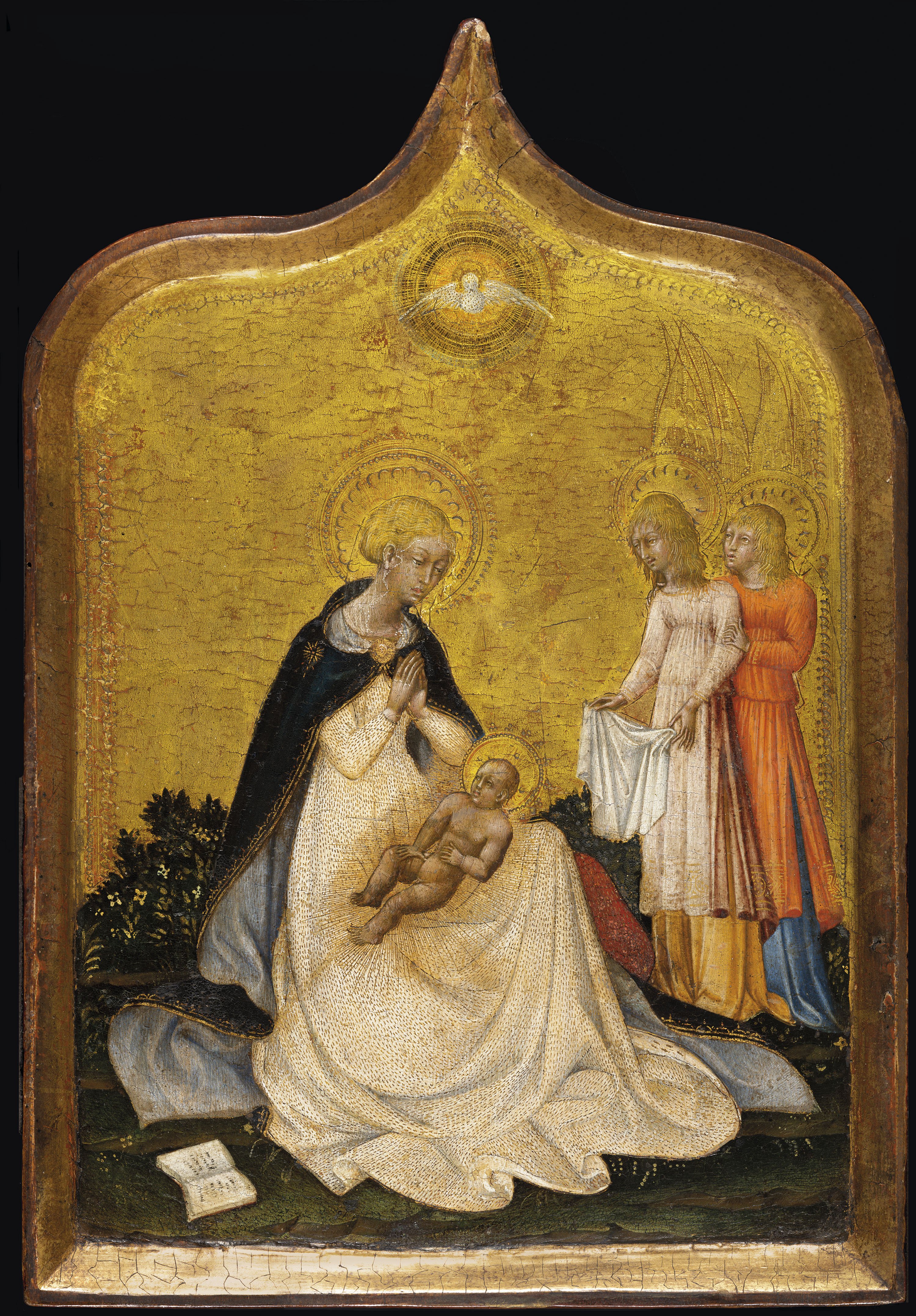
Giovanni di Paolo depicts this intimate Virgin and Child in an exterior in the company of two angels on the right.Mary, who has been reading a devotional book that she has placed on the floor, worships the naked Christ Child on her lap. He emits a divine light depicted with fine, closely aligned gold rays. The dove of the Holy Spirit flies over the scene, surrounded by a halo of light. The composition and setting are original for various reasons. Among the innovations is the presence of the two angels, one looking reverently at the Virgin and the other holding out a cloth to the Virgin in order to cover the Child. This detail is a clear allusion to Christ’s future sacrifice and to the cloth that he would wear at the crucifixion. Another interesting element is the decorative setting, which the artist presents as a garden in which he has taken great care to depict the flowers and plants. This natural setting also has a symbolic meaning in that it associates the scene with Paradise and with the hortus conclusus, a symbol of Mary’s virginity.
The arrangement of the figures, as well as the inclusion of the two angels and the cloth have led to the suggestion that this Virgin of Humility was the left wing of a diptych whose right wing would represent the Crucifixion. If this were the case, the composition would continue via the connecting figure of the angel closest to Mary. Giovanni di Paolo produced a delightful panel with welldefined and constructed figures, using an elegant range of tones including pink, yellow, light red and blue. The painting has beendated to the artist’s mature period around the early 1440s. Despite the problematic issue of this artist’s chronology, Boskovits compared this panel to the panels of a polyptych and two predellas now divided between various European and US museums.
Mar Borobia
Giovanni di Paolo depicts this intimate Virgin and Child in an exterior in the company of two angels on the right.Mary, who has been reading a devotional book that she has placed on the floor, worships the naked Christ Child on her lap. He emits a divine light depicted with fine, closely aligned gold rays. The dove of the Holy Spirit flies over the scene, surrounded by a halo of light. The composition and setting are original for various reasons. Among the innovations is the presence of the two angels, one looking reverently at the Virgin and the other holding out a cloth to the Virgin in order to cover the Child. This detail is a clear allusion to Christ’s future sacrifice and to the cloth that he would wear at the crucifixion. Another interesting element is the decorative setting, which the artist presents as a garden in which he has taken great care to depict the flowers and plants. This natural setting also has a symbolic meaning in that it associates the scene with Paradise and with the hortus conclusus, a symbol of Mary’s virginity.
The arrangement of the figures, as well as the inclusion of the two angels and the cloth have led to the suggestion that this Virgin of Humility was the left wing of a diptych whose right wing would represent the Crucifixion. If this were the case, the composition would continue via the connecting figure of the angel closest to Mary. Giovanni di Paolo produced a delightful panel with welldefined and constructed figures, using an elegant range of tones including pink, yellow, light red and blue. The painting has beendated to the artist’s mature period around the early 1440s. Despite the problematic issue of this artist’s chronology, Boskovits compared this panel to the panels of a polyptych and two predellas now divided between various European and US museums.
Mar Borobia