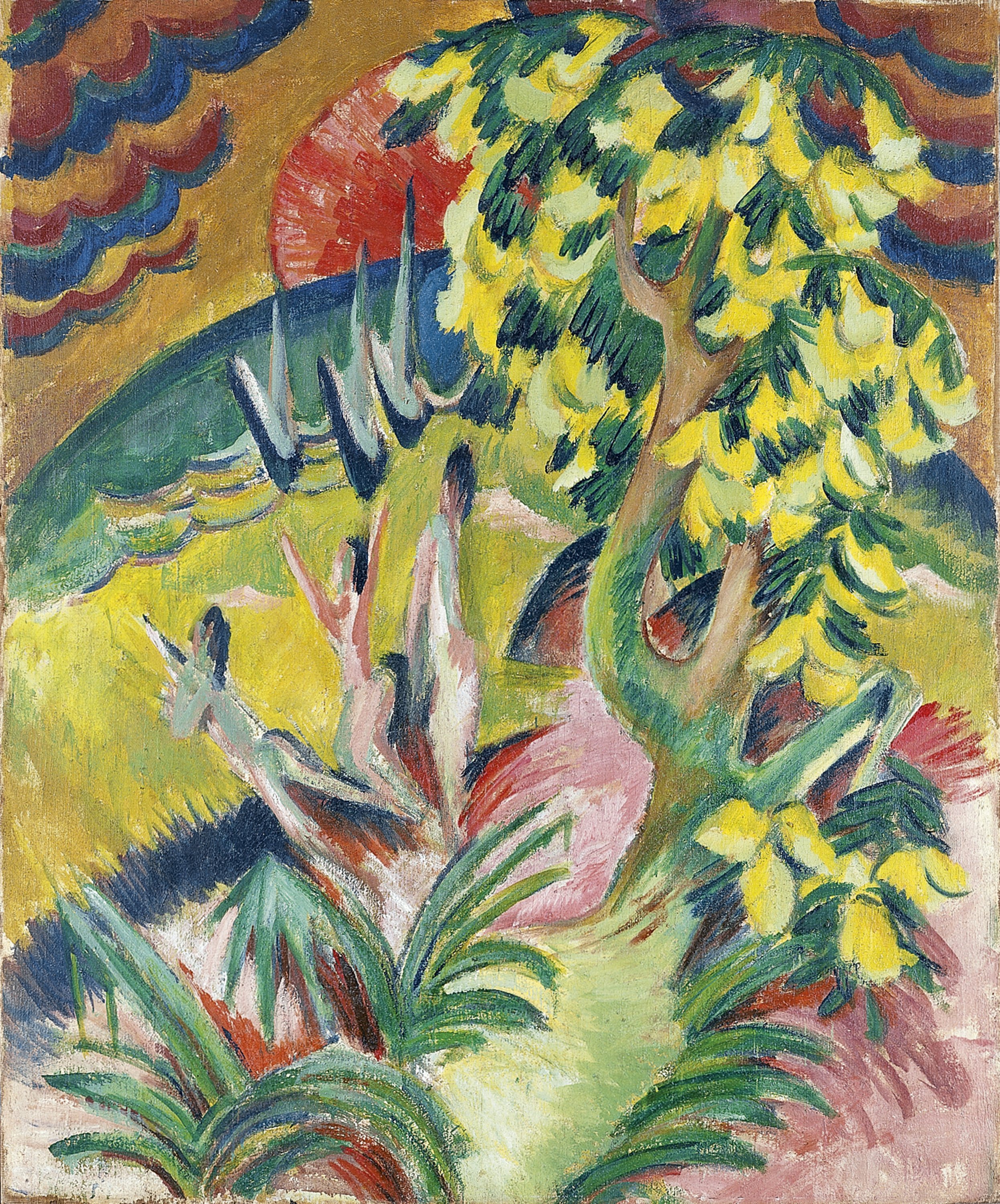
Curving Bay
ca. 1914
Oil on canvas.
146 x 123 cm
Museo Nacional Thyssen-Bornemisza, Madrid
Inv. no.
618
(1987.8
)
Room 38
Level 1
Permanent Collection
In December 1912, on returning from Fehmarn, Kirchner wrote to the lawyer Gustav Schiefler, one of the leading patrons of the Die Brücke artists, “Ochre blue and green are the colours of Fehmarn, a wonderful coast formation often of South Sea opulence, absurd flowers with fat stems.” This small, tranquil Baltic Sea island, connected to the mainland by an elevated pass, had become one of Kirchner’s favourite locations for spending the summer and painting at leisure, away from the bustle of the big city.
The work depicts several bathers in one of the island’s characteristic coves. It recalls the nudes in landscape settings that Kirchner painted by the Moritzburg Lakes in the summers of 1909 and 1910, although the more angular, colourful style of the present painting suggests a later period. Both the figures and the landscape are very similar to those found in other works painted in Fehmarn in 1913, such as Coast at Fehmarn, Laburnum and Bathers on the Beach, Fehmarn. The scene is framed by a large tree that occupies the whole of the right side, while on the left a group of bathers, painted from a bird’s eye view, play on the beach. The movement of the scene led Wolfgang Henze to point out the possibility that Kirchner depicts not three figures but one, shown in several poses. Furthermore, the frenzied movement of the landscape in Curving Bay, the convex horizon and the unrealistically large sun, together with the use of non-naturalistic colouring, hold cosmological connotations. In addition, the marked ascending diagonal of the coastline and the different sized zigzag strokes that represent the dunes heighten the tension of the scene.
Dating the painting poses numerous problems. According to Donald E. Gordon’s notes on the work, which Peter Vergo was able to consult, Kirchner had annotated on page 69 of photo album number 3 of his works “ Goldregenbaum, 1917, 150 x 120, Frau Schlegel, Uttwil, ” which led the aforementioned author to believe that it was based on his memories and to date it to 1917. As Peter Vergo points out, this is practically impossible, as that year, when the war was in full swing, Kirchner was ill and unable to join active military service, and it is unthinkable that the artist would have painted nude bathers amid a landscape at a time of crisis. What is more, Kirchner spent the summer of 1917 in Switzerland, far from the sea, and produced no other pictures of bathers dated that year. Vergo is inclined to think that Curving Bay should be dated to 1914 (although he adds a question mark), on the grounds that the composition is very similar to the artist’s woodcut print entitled Dune Landscape with a Curving Bay, of 1913 or 1914. It is also more similar in colouring and execution to the paintings he produced in 1914.
Paloma Alarcó
The work depicts several bathers in one of the island’s characteristic coves. It recalls the nudes in landscape settings that Kirchner painted by the Moritzburg Lakes in the summers of 1909 and 1910, although the more angular, colourful style of the present painting suggests a later period. Both the figures and the landscape are very similar to those found in other works painted in Fehmarn in 1913, such as Coast at Fehmarn, Laburnum and Bathers on the Beach, Fehmarn. The scene is framed by a large tree that occupies the whole of the right side, while on the left a group of bathers, painted from a bird’s eye view, play on the beach. The movement of the scene led Wolfgang Henze to point out the possibility that Kirchner depicts not three figures but one, shown in several poses. Furthermore, the frenzied movement of the landscape in Curving Bay, the convex horizon and the unrealistically large sun, together with the use of non-naturalistic colouring, hold cosmological connotations. In addition, the marked ascending diagonal of the coastline and the different sized zigzag strokes that represent the dunes heighten the tension of the scene.
Dating the painting poses numerous problems. According to Donald E. Gordon’s notes on the work, which Peter Vergo was able to consult, Kirchner had annotated on page 69 of photo album number 3 of his works “ Goldregenbaum, 1917, 150 x 120, Frau Schlegel, Uttwil, ” which led the aforementioned author to believe that it was based on his memories and to date it to 1917. As Peter Vergo points out, this is practically impossible, as that year, when the war was in full swing, Kirchner was ill and unable to join active military service, and it is unthinkable that the artist would have painted nude bathers amid a landscape at a time of crisis. What is more, Kirchner spent the summer of 1917 in Switzerland, far from the sea, and produced no other pictures of bathers dated that year. Vergo is inclined to think that Curving Bay should be dated to 1914 (although he adds a question mark), on the grounds that the composition is very similar to the artist’s woodcut print entitled Dune Landscape with a Curving Bay, of 1913 or 1914. It is also more similar in colouring and execution to the paintings he produced in 1914.
Paloma Alarcó