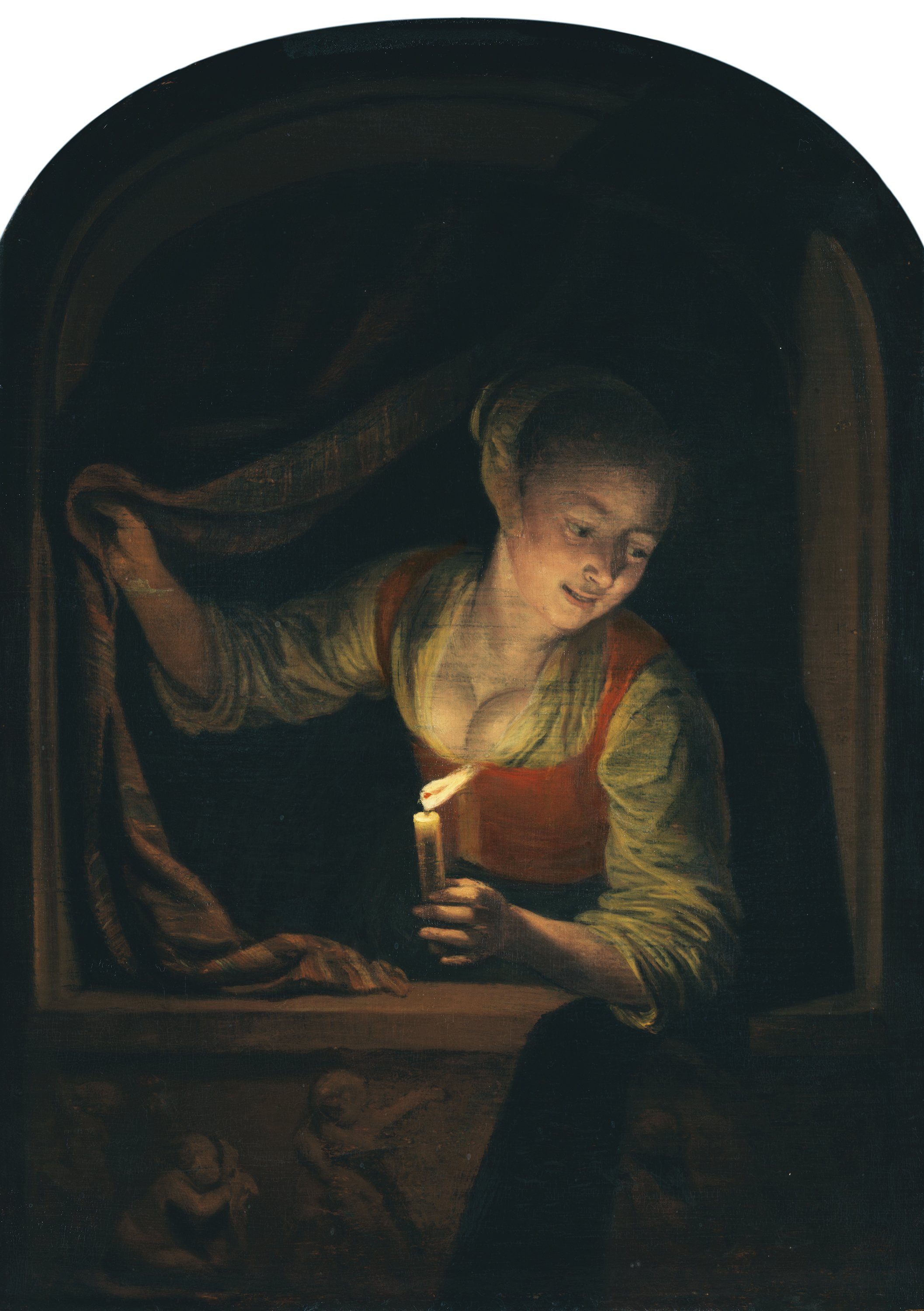
Young Woman with a Lighted Candle at a Window
ca. 1658 - 1665
Oil on panel.
26.7 x 19.5 cm
Museo Nacional Thyssen-Bornemisza, Madrid
Inv. no.
132
(1930.21
)
Room 25
Level 2
Permanent Collection
Like his father, Gerrit Dou became an artist and worked as a printmaker between 1625 and 1627, the years when he is recorded in the artists’ guild of his native city. One year later in 1628 he entered the studio of the young Rembrandt in Leiden where he spent three years as an apprentice. By the time of Rembrandt’s move to Amsterdam, Dou was an independent master. He developed a painstaking, highly detailed style that brought him fame, specialising in small-format works that were most suited to his precise technique and which were also characteristic of the Leiden school.
The type of painting seen here was known as a “niche piece” or “window niche”. The figure is framed by a window whose ledge contributes to the construction of the pictorial space, as does the curtain. Scenes through windows or figures leaning out of windows appear in Dou’s work from around the mid-1640s and one of his earliest examples is the work in the Louvre entitled The Stallholder. The precedents for this type of composition are to be found in the work of Rembrandt. Another element popularised by Dou was the use of artificial lighting, here in the form of the candle held by the young woman, a device found in his work from the 1650s. According to Naumann, both motifs, the young woman at a window and the artificial lighting, appear in his work from the mid-1650s and the earliest example is a panel formerly in the Gemäldegalerie in Dresden (destroyed in World War II).
The decoration of the area below the window is also characteristic of the artist and here takes the form of a relief with putti. Reliefs of this type were inspired by the work of the Flemish sculptor François Duquesnoy who executed examples of this type from the early 1650s.
Some of Dou’s compositions have been interpreted in a moralising key or have been seen as moral exemplars. It has been suggested that the present painting has an erotic significance based on the lit candle, an idea not shared by Gaskell.
The panel was in the Schönborn collection and passed down by inheritance to members of that family during the 18th and 19th centuries. The painting was in the collection of Camillo Castiglione in Vienna until 1925 and was auctioned by Frederik Muller in Amsterdam that year. It was acquired for the Thyssen-Bornemisza collection prior to 1930. During the 19th century it was stated to be in poor condition, for which reason the attribution was questioned.
Mar Borobia
The type of painting seen here was known as a “niche piece” or “window niche”. The figure is framed by a window whose ledge contributes to the construction of the pictorial space, as does the curtain. Scenes through windows or figures leaning out of windows appear in Dou’s work from around the mid-1640s and one of his earliest examples is the work in the Louvre entitled The Stallholder. The precedents for this type of composition are to be found in the work of Rembrandt. Another element popularised by Dou was the use of artificial lighting, here in the form of the candle held by the young woman, a device found in his work from the 1650s. According to Naumann, both motifs, the young woman at a window and the artificial lighting, appear in his work from the mid-1650s and the earliest example is a panel formerly in the Gemäldegalerie in Dresden (destroyed in World War II).
The decoration of the area below the window is also characteristic of the artist and here takes the form of a relief with putti. Reliefs of this type were inspired by the work of the Flemish sculptor François Duquesnoy who executed examples of this type from the early 1650s.
Some of Dou’s compositions have been interpreted in a moralising key or have been seen as moral exemplars. It has been suggested that the present painting has an erotic significance based on the lit candle, an idea not shared by Gaskell.
The panel was in the Schönborn collection and passed down by inheritance to members of that family during the 18th and 19th centuries. The painting was in the collection of Camillo Castiglione in Vienna until 1925 and was auctioned by Frederik Muller in Amsterdam that year. It was acquired for the Thyssen-Bornemisza collection prior to 1930. During the 19th century it was stated to be in poor condition, for which reason the attribution was questioned.
Mar Borobia