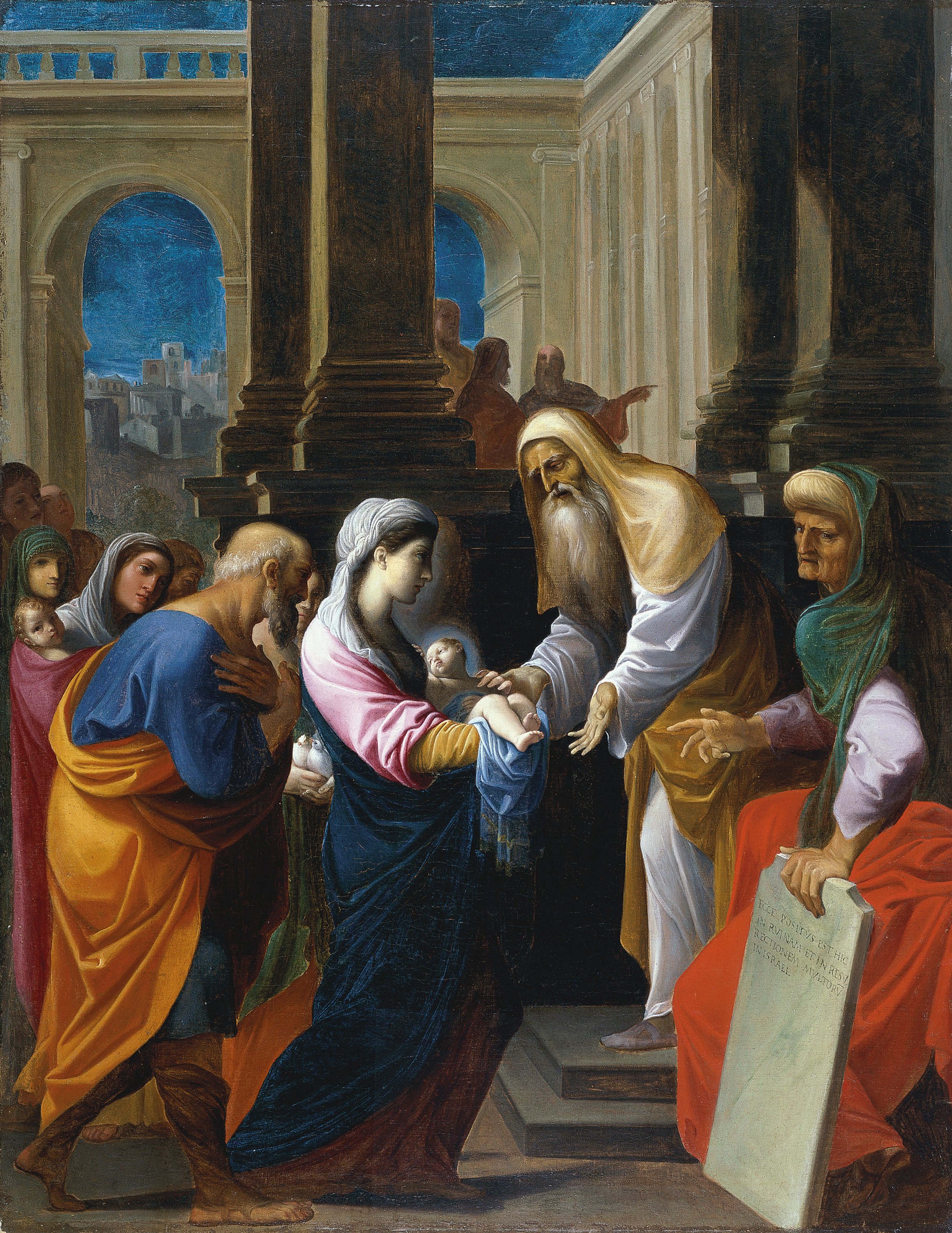
The Presentation of the Christ Child in the Temple
ca. 1605
Oil on canvas.
122.6 x 94.8 cm
Thyssen-Bornemisza Collection, on deposit with the Museu Nacional d'Art de Catalunya (MNAC)
Inv. no.
84
(1977.16
)
Not on display
Level 2
Permanent Collection
Level 1
Permanent Collection
Level 0
Carmen Thyssen Collection and Temporary exhibition rooms
Level -1
Temporary exhibition rooms, Conference room and EducaThyssen Studio
The present canvas remained unpublished until the 1970s. It belonged to the Earl of Seafield whose collection was auctioned at Sotheby’s in 1975. The work was correctly attributed in the sale catalogue, where it formed a pair with a Presentation of the Virgin now considered to be by Pietro Faccini (ca. 1562–1602). Attempts have been made to identify the present canvas as the one recorded among the possessions of the Ludovisi family, but this has not been proved as the description of the painting in the 1678 inventory is too imprecise. The present canvas entered the Thyssen-Bornemisza collection in 1977.
The episode of the Presentation of the Christ Child in the Temple is only recounted in the Gospel of Saint Luke. The passage in question mentions the principal figures depicted here in the foreground. These figures are Simeon, the old man with his head covered who leans forward to receive the Christ Child in his arms and who would not die until he had set eyes on the Saviour, as the Holy Spirit had told him; Anne, holding a stone tablet with the words of Simeon; and the Holy Family. The modest offering of a pair of small turtledoves is located in the middle-ground, visible in a gap between the Virgin and Saint Joseph where the birds’ brilliant white plumage makes them a striking element. Following the Gospel account, the scene takes place on the steps that lead into the temple and Carracci remains close to the biblical text.
The painting has been dated to after Carracci’s trip to Rome in 1602, during which time he saw the decoration of the Palazzo Farnese by his cousin Annibale, and close to the period that he spent in Piacenza between 1605 and 1609 where he worked for Bishop Claudio Rangoni in collaboration with Camillo Procaccini (ca. 1555–1629). Various works from this period have been compared to the present canvas. They include The Birth of the Virgin (ca. 1605–9) in Piacenza, which, according to Roberto Contini, reveals similarities in the setting and in the figure types. Secondly, The Birth of Saint John the Baptist in the Pinacoteca Nazionale, Bologna, has a similar figure of the Virgin, while in general the folds of the drapery and the manner in which it falls is similar in both works, and the figure of Saint Elizabeth in the Bologna canvas is comparable to that of the Prophetess Anna in this work.
In a report by Carlos Volpe written in 1977 and now in the Museum’s archive the painting is dated to around 1605 at a time when, according to that author, Carracci’s painting adopted a Neomannerist manner that corresponds to his last great lyrical phase.
Mar Borobia
The episode of the Presentation of the Christ Child in the Temple is only recounted in the Gospel of Saint Luke. The passage in question mentions the principal figures depicted here in the foreground. These figures are Simeon, the old man with his head covered who leans forward to receive the Christ Child in his arms and who would not die until he had set eyes on the Saviour, as the Holy Spirit had told him; Anne, holding a stone tablet with the words of Simeon; and the Holy Family. The modest offering of a pair of small turtledoves is located in the middle-ground, visible in a gap between the Virgin and Saint Joseph where the birds’ brilliant white plumage makes them a striking element. Following the Gospel account, the scene takes place on the steps that lead into the temple and Carracci remains close to the biblical text.
The painting has been dated to after Carracci’s trip to Rome in 1602, during which time he saw the decoration of the Palazzo Farnese by his cousin Annibale, and close to the period that he spent in Piacenza between 1605 and 1609 where he worked for Bishop Claudio Rangoni in collaboration with Camillo Procaccini (ca. 1555–1629). Various works from this period have been compared to the present canvas. They include The Birth of the Virgin (ca. 1605–9) in Piacenza, which, according to Roberto Contini, reveals similarities in the setting and in the figure types. Secondly, The Birth of Saint John the Baptist in the Pinacoteca Nazionale, Bologna, has a similar figure of the Virgin, while in general the folds of the drapery and the manner in which it falls is similar in both works, and the figure of Saint Elizabeth in the Bologna canvas is comparable to that of the Prophetess Anna in this work.
In a report by Carlos Volpe written in 1977 and now in the Museum’s archive the painting is dated to around 1605 at a time when, according to that author, Carracci’s painting adopted a Neomannerist manner that corresponds to his last great lyrical phase.
Mar Borobia