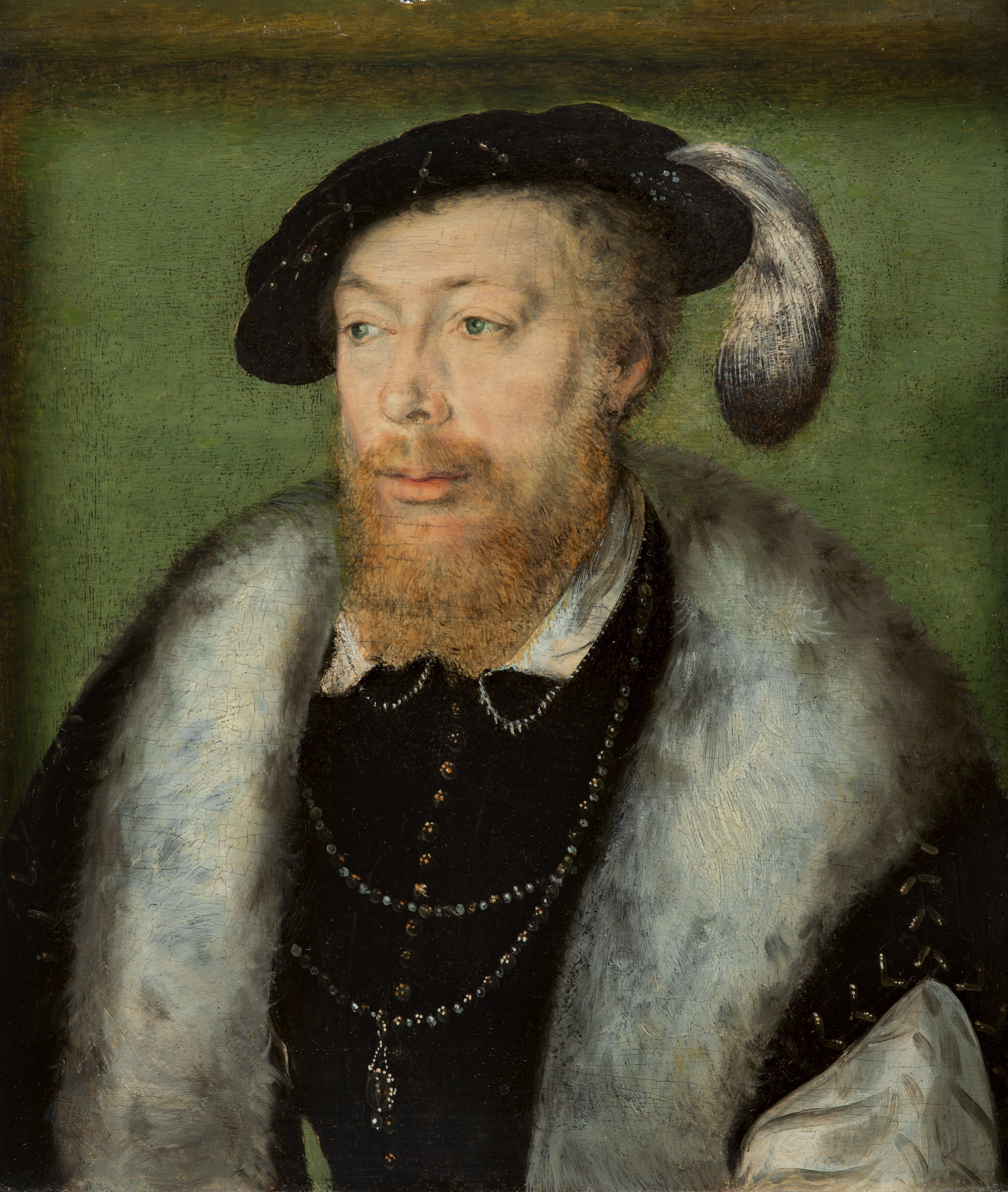
Portrait of Robert de la Marck, 4th Duke of Bouillon
Almost nothing is known of the Dutch painter Corneille de Lyon before he moved to Lyon in France, where his name appears in documents from 1533. His technique, with its naturalistic modelling, indicates the influence of Flemish painting and he probably trained in Holland. A year after he is first mentioned in Lyon, Corneille was working for Leonor of Austria, second wife of François I. In 1541 he was in the service of the Dauphin, the future Henry II. In 1547, the year that Henry was crowned King of France, Corneille obtained French citizenship and in 1548 was appointed court painter and valet de chambre to the new monarch.
A series of small-format portraits have been attributed to this artist, all based on a similar format and presentation of the sitter with slight variations. Corneille worked for the French monarchs, courtiers, members of the nobility and the middle-classes. The body of work attributed to the artist was carefully revised in the 20th century, identifying workshop productions that were copies and replicas of Corneille’s originals. None of the works by this celebrated painter are signed, for which reason the Portrait of Pierre Aymericof 1534 in the Musée du Louvre is important as it has an inscription on the reverse indicating that it was painted by this artist and completed on 11 April 1534. It thus provides the most solid reference point for establishing Corneille’s oeuvre.
The present panel was in the Tabourier collection in France, entering the Thyssen-Bornemisza collection in 1928 via the Paul Cassirer gallery. At the time of purchase it was accompanied by a brief report by Friedländer that attributed it to Corneille de Lyon. This attribution has been maintained in the catalogues of the collection from the time of its first publication in the Munich exhibition of 1930.
The Duke’s physiognomy is comparable to that of the sitter in a portrait formerly at Strawberry Hill, which had a 17th-century inscription on the reverse identifying the model as De la Marck. Various other portraits are known of Robert de la Marck, including one in the Palace at Versailles and another by his workshop in the Philadelphia Museum of Art.
Known as the “Young Adventurer”, Robert de la Marck was born around 1510.Marshal of France in 1547, he was a valiant combatant who in 1553 recaptured his castle at Bouillon from enemy forces but was taken prisoner when defending the fortress at Hesdin and died soon after he was liberated.
The panel reveals features characteristic of Corneille de Lyon’s style. They include the use of a plain green background with the sitter positioned bust-length or half-length. The clothes are relatively summarily painted but the head is executed in great detail. In most other portraits by the artist the heads are presented frontally with the sitter looking directly outwards. In the present panel, De la Marck’s face is precisely drawn with great delicacy in the nose and cheekbones. Most striking, however, are the light coloured eyes with their intense gaze.
Mar Borobia