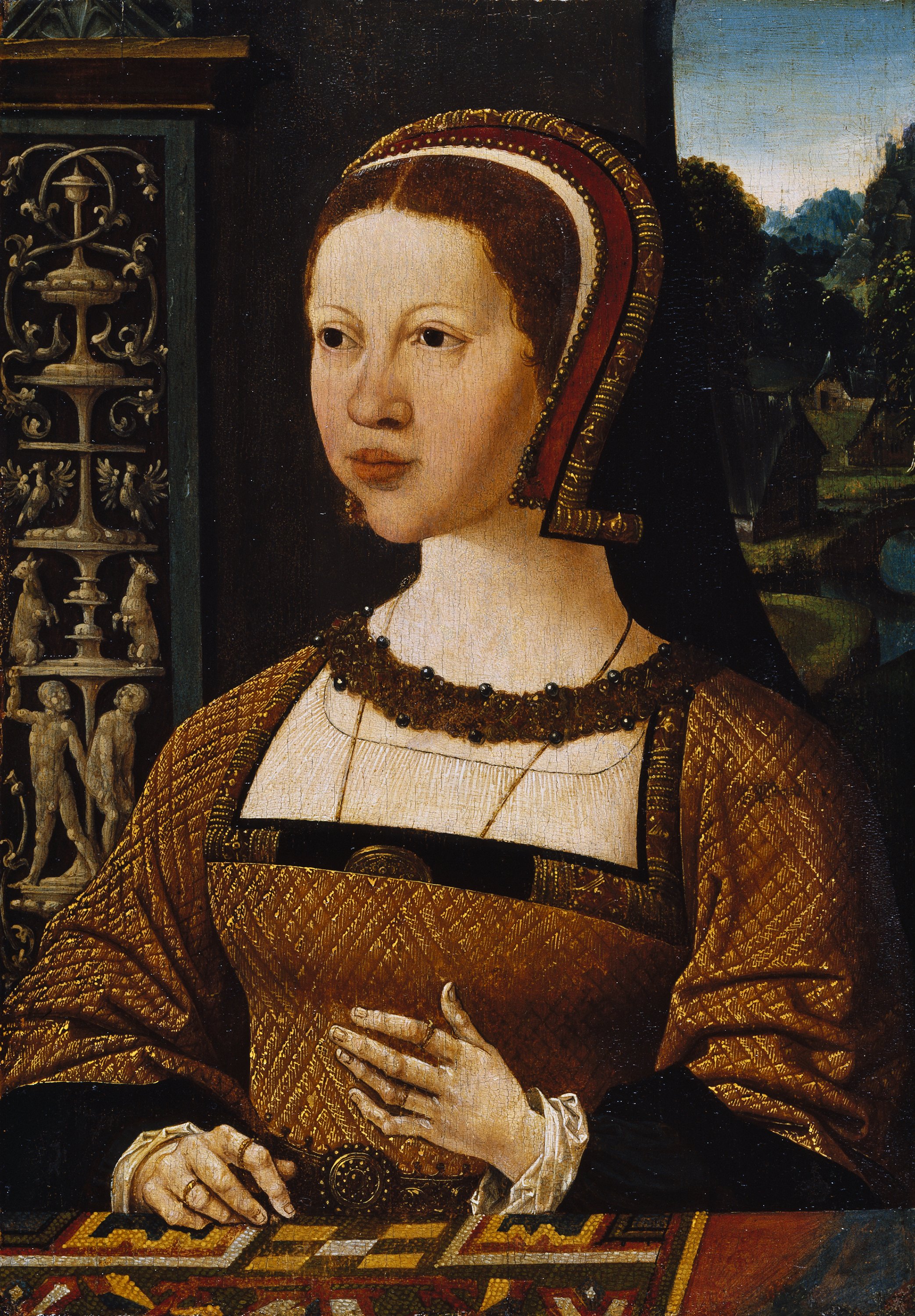
Portrait of a woman, possibly Elisabeth of Denmark
Jacob Cornelisz. van Oostsanen belonged to a family of artists and both his son Dirk Jacobsz., and his brother Cornelius Buys I, known as the Master of Alkmaar, were painters. His work evolved over the course of his career as he assimilated various stylistic trends. As a result, his early panels conform to the late Gothic style of the Haarlem school while his late ones reveal the new Renaissance influence of Jan Gossaert and Jan van Scorel. The present portrait has been the subject of debate among experts both with regard to its date and to the identity of the sitter. According to Kurt Steinbart it depicts Elizabeth of Denmark, wife of King Christian II, an identification made on the basis of a comparison with a drawing attributed to a follower of Van Oostsanen in the Kupferstich Kabinett in Berlin. The painting has recently been dated to the 1520s, executed either after the Queen arrived in the Low Countries or possibly after her death. The sitter is located in a room with a column with Renaissance style ornamentation and a window opening onto a landscape in the tradition of Flemish painting.
NR
According to Karel van Mander, Jacob Cornelisz. van Oostsanen was from Oostzaan. Almost nothing is known regarding this painter’s early training although art historians have detected the influence of Geertgen tot Sint Jans in his early work. It has also been suggested that he might have trained as a goldsmith or designer of engravings due to the linear style of his early output. Van Oostsanen’s earliest paintings date from the first decade of the 16th century, including the Noli me tangere in the Staatliche Museum, Kassel, of 1507, painted when the artist was already in his thirties.
The present panel has been dated by Colin Eisler to around 1524, also the period of Salome with the Head of Saint John the Baptist and Saul and the Witch of Endor (both Rijksmuseum, Amsterdam). This panel was in the collection of Sir Herbert Cook, then with the Matthiesen gallery in Berlin in 1928 from where it entered the Thyssen-Bornemisza collection. It was included with the present attribution in the 1930 exhibition held at the Neue Pinakothek in Munich. The panel was published by Paul Wescher two years after it entered the Thyssen-Bornemisza collection, while the suggestion regarding the sitter’s identity was made by Kurt Steinbart.
Both the date and the identity of the sitter have been the subject of debate. Steinbart based his suggestion on a drawing in the Kupferstich Kabinett in Berlin, attributed to one of the painters who worked in Van Oostsanen’s workshop in the mid-1520s. The drawing depicts a portrait notably similar to the present one which forms a pair with a male portrait identified as King Christian II of Denmark, from which it can be deduced that the woman is Queen Elizabeth of Denmark (1501–1526). Elizabeth was the sister of Charles V and niece of Margaret of Austria, regent of the Low Countries. After her husband Christian II abandoned the throne for a variety of reasons, the couple moved to the Netherlands and the present portrait has been dated to just after her arrival or just after her death. Steinbart’s suggestion that it was a posthumous image was not rejected by Friedländer. Glück suggested that the Berlin drawings were inspired by a lost portrait by Bernaert van Orley. Various authors, including Ebbinge-Wubben have referred to the general similarity between this image and a Mary Magdalen by Van Oostsanen in the Art Museum in Saint Louis. The present sitter, whose face is slightly lacking in personality, is depicted in an interior that opens onto a landscape in a composition of a standard Flemish type. The setting is adorned with a pilaster with Renaissance decorative motifs of a type that became more common in the artist’s work in the 1520s. The figure is well defined with a particular focus on the accessories and jewels, which are crisply modelled. The hands, however, are small and slightly out of proportion to the body.
Mar Borobia