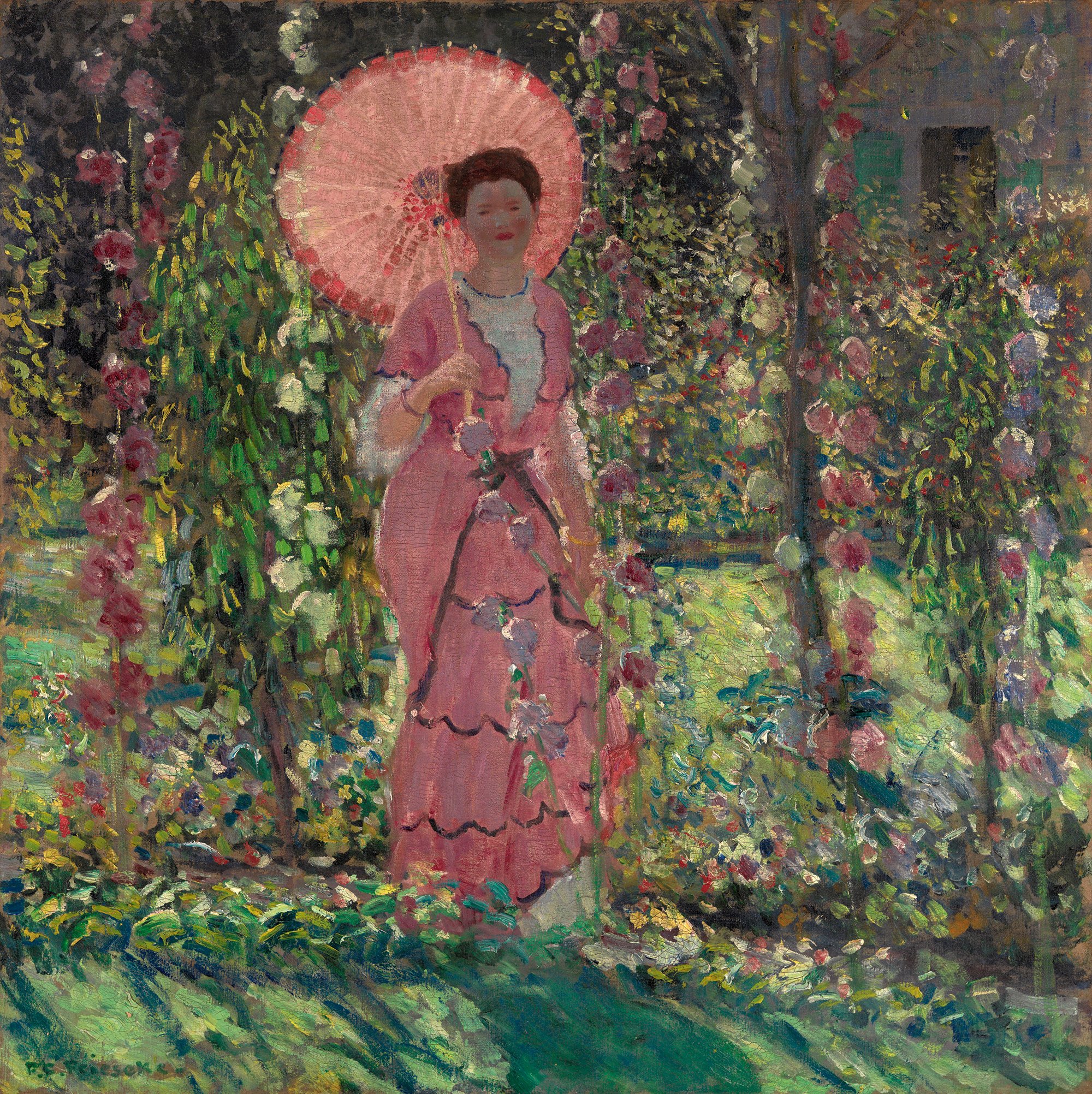
Hollyhocks
During the first two decades of the 20th century Frieseke isolated himself at Le Hameau, a house adjacent to Monet's at Giverny, and painted images of a garden world. Uninterested in urban life or modern art, he claimed that he rarely looked at a newspaper. Instead Frieseke chose to perpetuate a late 19th-century Impressionist vision long after Monet himself had considerably modified his aims and means.
The theme of the monumental, graceful woman with a parasol appeared often in Monet's and Renoir's works of the 1870s and 1880s and in Frieseke's oeuvre between 1909 and 1915. Though he spoke with disdain of convention, Frieseke's full-bodied female figures and nudes resembled those of Renoir-whom he considered the "head of the Impressionists"-and in his mind were also associated with those of other artist-celebrators of feminine grace, including Botticelli, Titian and Watteau. In this composition the centrally-located figure of the woman, probably modelled on Frieseke's wife, is articulated in a smooth, unbroken mass. Frieseke framed her curvilinear shape against a vertical and horizontal grid of flowers and pathways and played her solidity off against the decorative background of small, scintillating brushstrokes. Considerations of design were foremost in the artist's method. Through a symmetrical treatment of the square canvas, he emphasised the flat, decorative quality of the surface and floated the figure upon it. Around her-the solid and centrally placed female figure-revolves the entire composition.
Frieseke frankly admitted that his approach to nature was selective. Following the dictates of "pure Impressionism" established by Monet in the 1870s however, he also tried to record his feeling for nature as spontaneously as possible and attempted to observe the fleeting effects of light and colour in a scientific manner. Relishing Impressionistic experimentation he painted out-of-doors in the presence of the motif and sought to capture new, accidental effects.
In Hollyhocks Frieseke conveyed the heat and light of a summer afternoon through strong contrasts of black, deeply saturated blue and green strokes with pure yellows and high-keyed pinks and mauves. He achieved something of a technical tour de force in the effect of backlighted forms, which heighten the feeling of late afternoon light. In sensitising the viewer to the strange effects of light, Frieseke thus signals his fascination with the transience of nature. With the edges of the woman bathed in a soft glow and the light shining through the translucent fabrics of the Japanese parasol and the delicate tissues of petals, the painter's manipulation of light most of all serves his enduring fascination with the private mysteries of the feminine world.
Kathleen Pyne