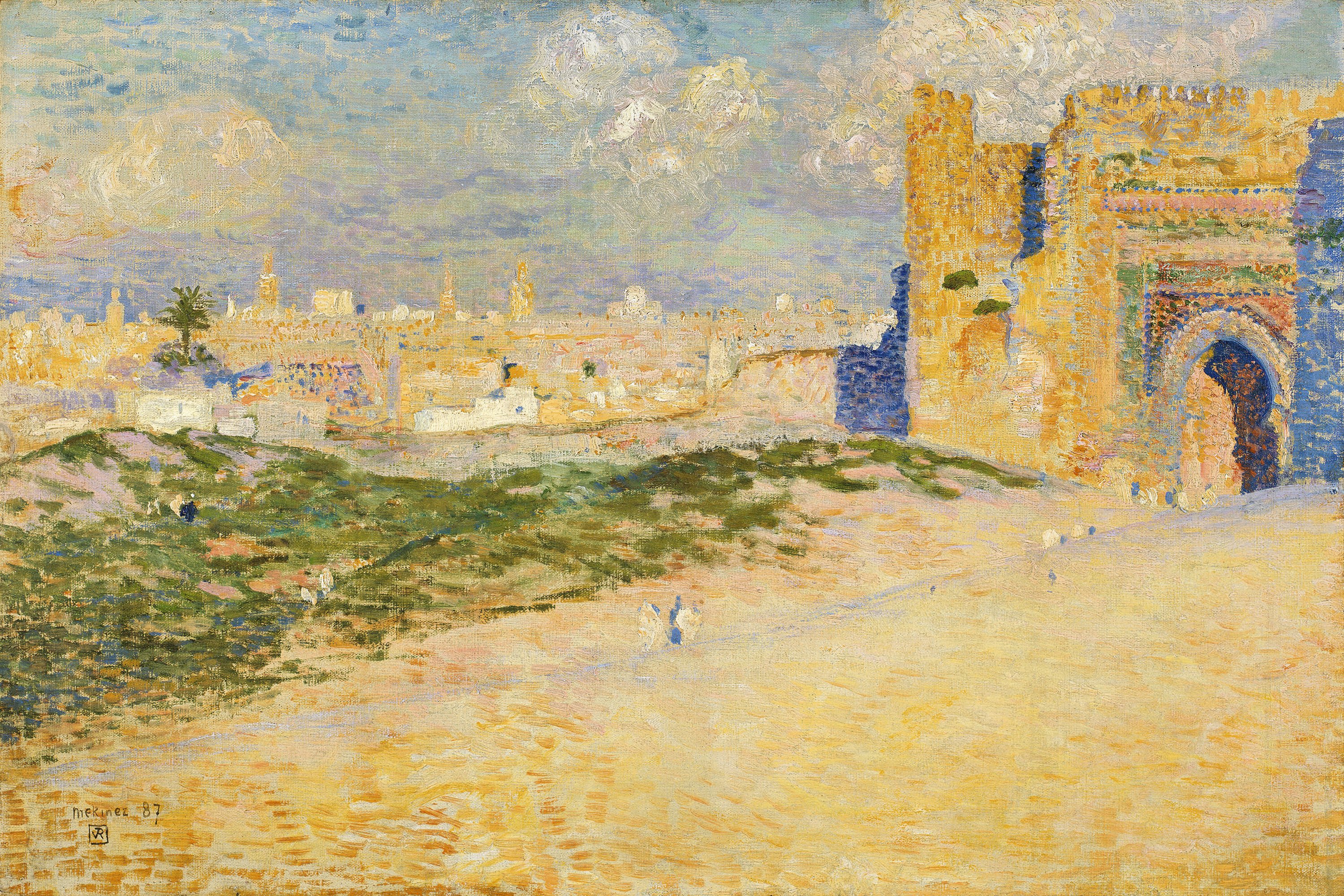
The El Khemis Gate in Meknes, Morocco
Théo Van Rysselberghe was a keen traveller, and it was during his third sojourn in Morocco, from 4 December 1887 to 5 March 1888, that he painted this view of Meknès. He was accompanying the Belgian jurist and writer Edmond Picard on his official mission to the Sultan Moulay Hassan. His task was to make sketches that would later illustrate Picard's work entitled El Moghreb Al Aksa. Une mission belge au Maroc. The book, now rare and much sought-after, was published in 1889 in Brussels by Larcier, with a frontispiece by Odilon Redon and 27 full-page lithographs in black and white or red by Van Rysselberghe. The artist reveals in them all the magnificence and mystery of that far-away land. Van Rysselberghe, who had begun his career as a realist painter and had later moved to an autochthonous Impressionist style, had just come across Seurat and French neo-Impressionism, thanks to his friend the Belgian poet Emile Verhaeren. They had seen together La Grande-Jatte in Paris in 1886 and visited the Salon des XX in Brussels in February 1887. When he left for Morocco, Van Rysselberghe was still in a state of shock from that discovery.
Initially disconcerted by this new technique which, according to the scientific principles put forth by Chevreul and Rood, juxtaposes touches of pure colours which the eye then synthesises, Van Rysselberghe quickly adopted this revolutionary artistic process, adapting it to his own personality and pictorial requirements. He remained faithful to a realistic vision of things and maintained his intrinsic originality, while at the same time borrowing from Seurat his technical procedure, although he never adopted its hieratic stylisation. He fragmented his brushstroke and varied its size, obtaining a greater sense of light, compared with his former practice, when he mixed the coloured pigments on the palette. Thanks to the many letters he wrote from Morocco, in particular to his friend Verhaeren, we know to what extent the artist was impressed by that country, by its light, its colours and its extremely particular atmosphere. They are all aspects which are reflected in this painting, and which made the artist write: "I would like people to feel it is hot [...]" and also "[...] the weather is wonderful, so beautiful, so mild, that nothing could give you an idea of it. That is the point when I do not dare paint. My colours seem so dirty, heavy, dull. How can I convey the fluidity, the transparency, the pure taste of the air? How can I convey the colours made up of so many different shades, all so pure, so bright [...] And I must say I do try [...] I make notes of colours, and I will develop in Brussels some of the motifs I have sketched, and which would in any case be impossible to paint here in a somewhat definitive manner: the effects disappear quickly, the subject is too beautiful, it stifles the effort put into rendering it [...] I look, I observe, I write [...] I collect notes, I accumulate a thousand things which I fix in my mind and which I will reconstitute later, according to my sketches. This sojourn will remain for me one of the most beautiful memories of my life."
Was this view of Meknès painted from nature or in the studio after his return? We know that the artist took with him on his trip six blank canvases, two or three of which were already "daubed" when he arrived in Meknès. But the place of creation has little importance, only the result matters. In the six works painted in or inspired by Morocco which he exhibited at the Salon des XX in Brussels in 1889, Van Rysselberghe showed his great originality. His light and lively brushstroke is entirely different from the systematic pointillism of Seurat. It is able to convey the special atmosphere, the beauty of the colours, the light playing on the surfaces of the buildings, the rustle of the wind and the clouds crossing the sky.
Giséle Ollinger-Zinque