Shipping on the Clyde
John Atkinson Grimshaw's depictions of the docks of Victorian Britain are lyrically beautiful evocations of the industrial era. Grimshaw transcribed the fog and mist so accurately as to capture the chill in the damp air, and the moisture penetrating the heavy clothes of the few figures awake in the misty early morning.
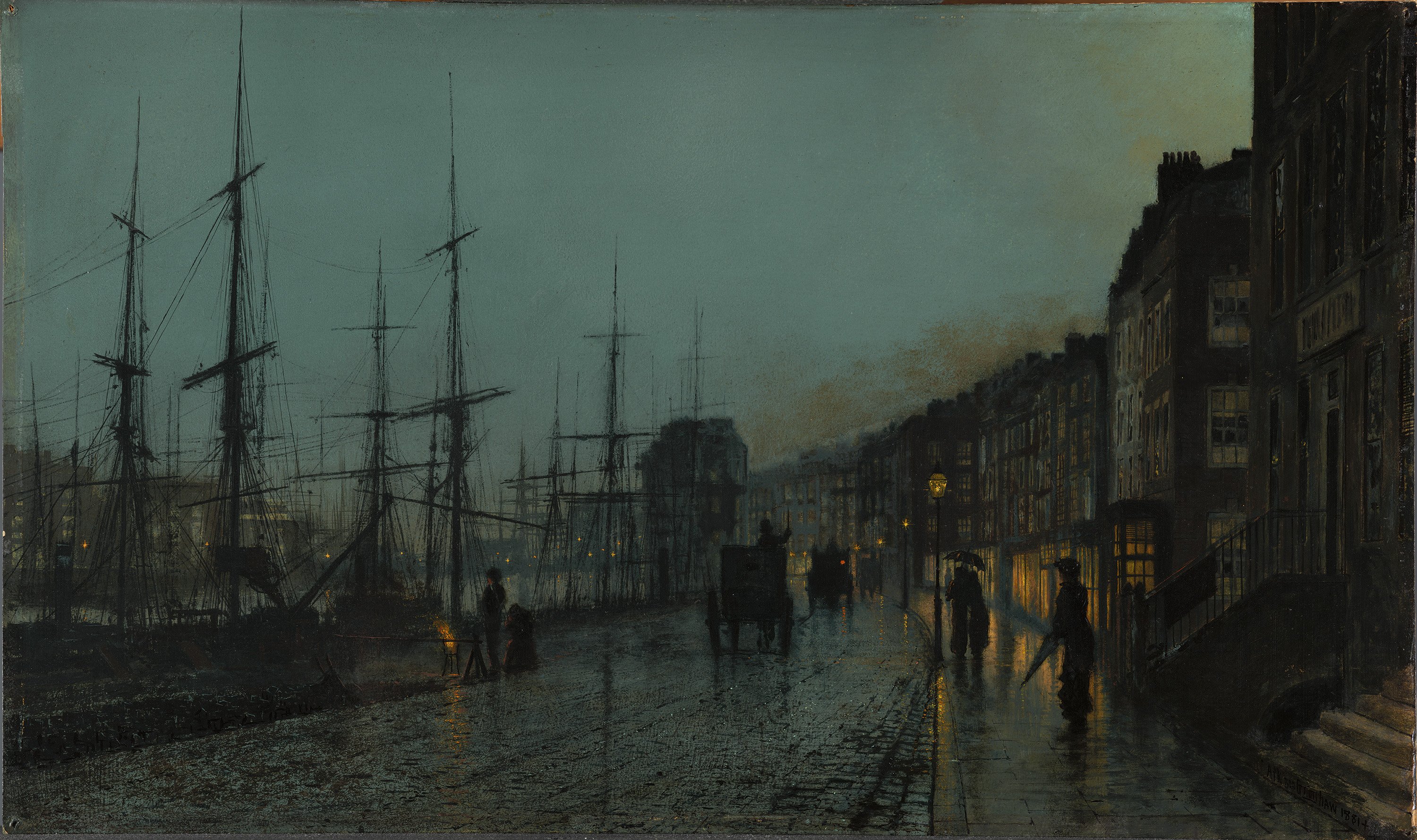
Grimshaw contrasted the different light sources in his paintings, using the moon, the gaslights from the shop interiors, the street and vehicle lamps to variegate the pattern of reflections on the rain-drenched pavement and roads. In Shipping on the Clyde, sparkling highlights are produced from a small fire which is burning at the road-side, beside which two dock workers are warming themselves.
Glasgow's commercial prosperity dates from the 17th century when the port on the River Clyde began importing tobacco, sugar, cotton and other goods. Due to its location in the west of the country, Glasgow was well positioned to then re-export a large percentage of these goods to France, Germany, Italy, Holland, Norway and the West Indies and America.
In the 18th century the River Clyde was widened and deepened and by the 19th century Glasgow was the leading port in Scotland. Glasgow became involved in shipbuilding and by 1835 half the tonnage of steam ships produced in Britain were built on the River Clyde. In the 19th century, in response to employment opportunities in the dockyards and the railways, the population of Glasgow grew rapidly going from a population of 77, 000 in 1801 to 420, 000 in 1861.
John Atkinson Grimshaw's paintings depict the modern world, but manage to escape the depressing, dirty reality of the northern industrial towns. He was inspired by literary figures, particularly Lord Tennyson, by John Ruskin's "Truth to Nature" theories, and by Celtic and Classical legends, which imbued an atmosphere of bygone eras into his contemporary depictions. His paintings display visually the verbal descriptions found in 19th-century novels, with an abundance of texts dedicated to the night, such as Bleak House by Charles Dickens: "Smoke lowering down from chimney-pots, making a soft black drizzle, with flakes of soot in it as big as full-grown snowflakes-gone into mourning, one might imagine for the death of the sun [...] Fog everywhere. Fog up the river, where it flows among green aits and meadows; fog down the river, where it rolls defiled among the tiers of shipping, and the waterside pollutions of a great (and dirty) city [...]".
Although here Dickens is referring to London, he could just as aptly be describing the characteristics of Glasgow, seen here in Shipping on the Clyde, and captured with such poetry and romance.
Nicole Ayton