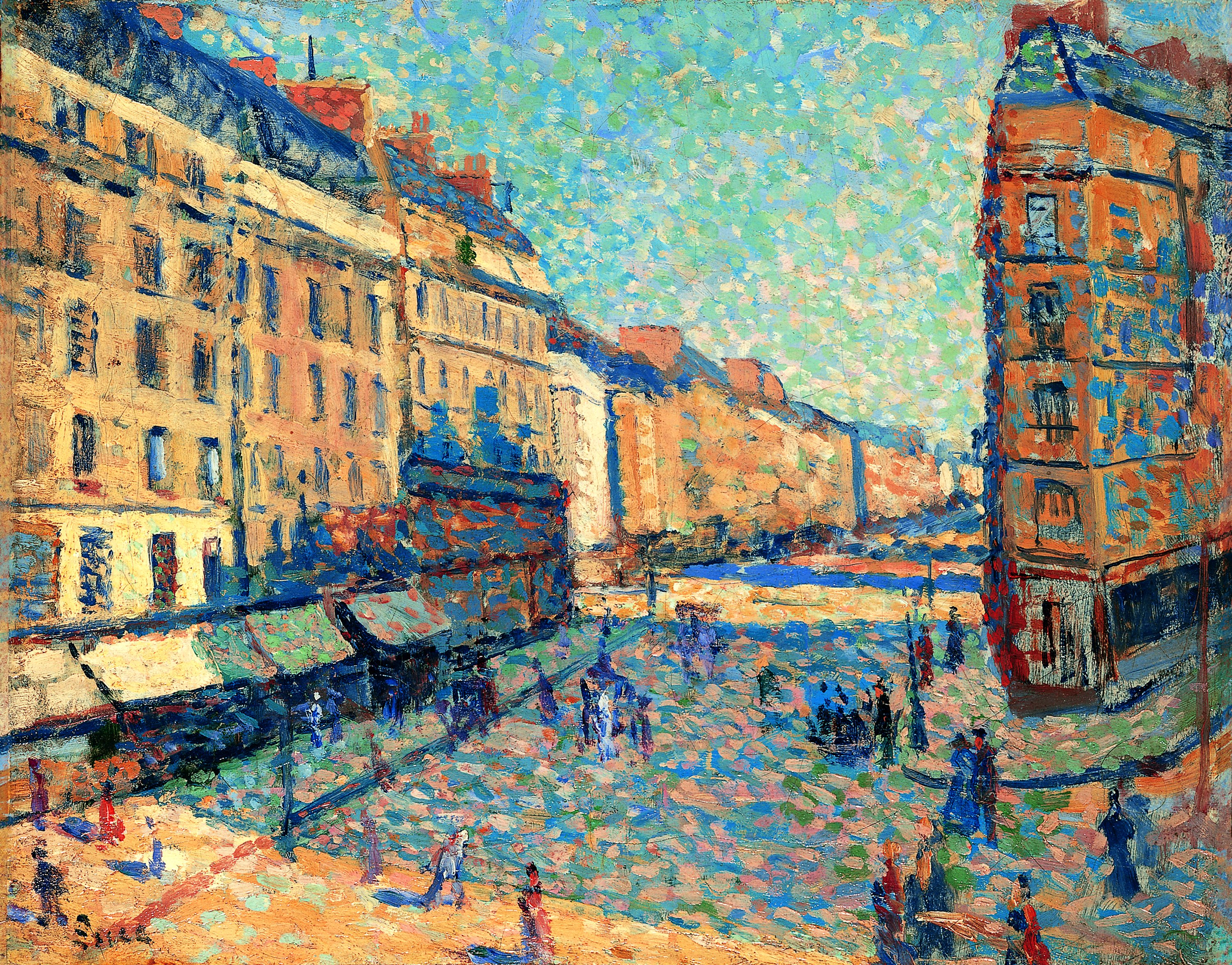
Calle de París
Maximilien Luce was born in Paris on 13 March 1858. His father was a Parisian rail worker and his mother came from the Beauce, which may explain the fact that he was equally interested in town and country. From the age of 16 he served as an apprentice in a wood carving workshop, but he soon started attending evening classes at the Académie Suisse, where he met Carolus-Durand.
After his military service, he earned a living as an engraver in the Froment workshop where he met Léo Gausson and Cavallo-Peduzzi, who already belonged to the "Groupe des Indépendants". These contacts proved crucial for Luce's future career.
The Impressionist revolution had a powerful effect on the young artist, who until then had only painted rather sombre family portraits and austere-if promising-indoor scenes.
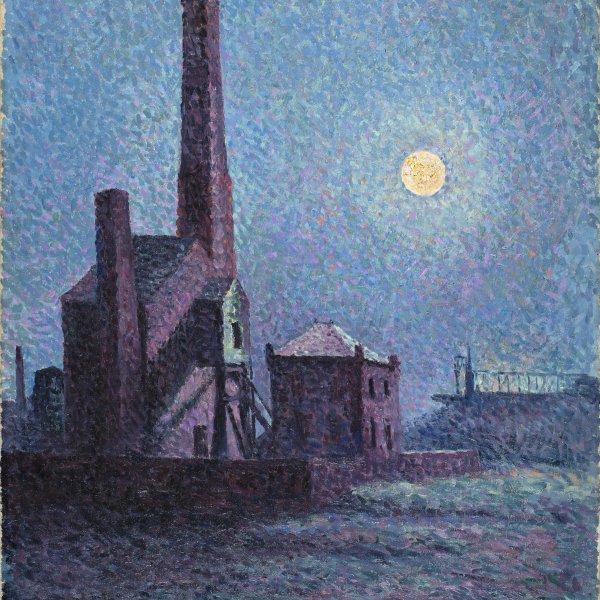
However, while Luce could clearly not remain indifferent to the experience of colour division, he never assimilated without restriction the neo-Impressionist influence. His independent character could not accept without reticence a theory with such clearly defined limits. Let us say that he remained, with regard to the neo-impressionists, a sympathiser who knew how to assimilate their experiments and their use of pure colour. But this did not prevent him from having his own views; Luce let himself more willingly be guided by his instinct than by theory, following in this regard the example of Pissarro, who only experimented with Pointillism for a short period.
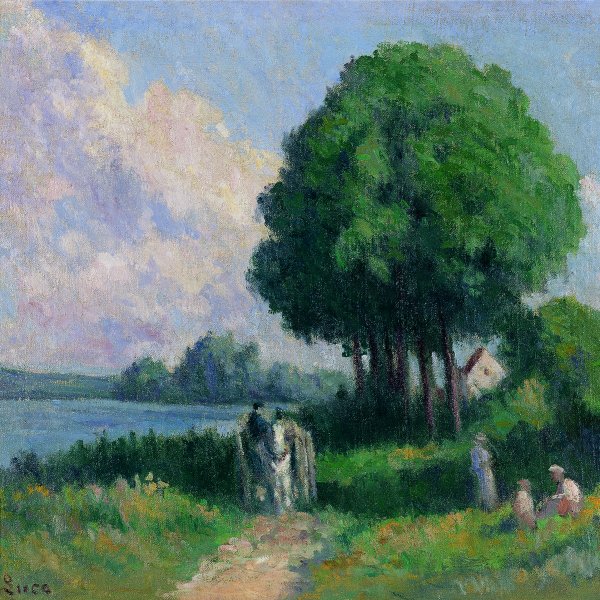
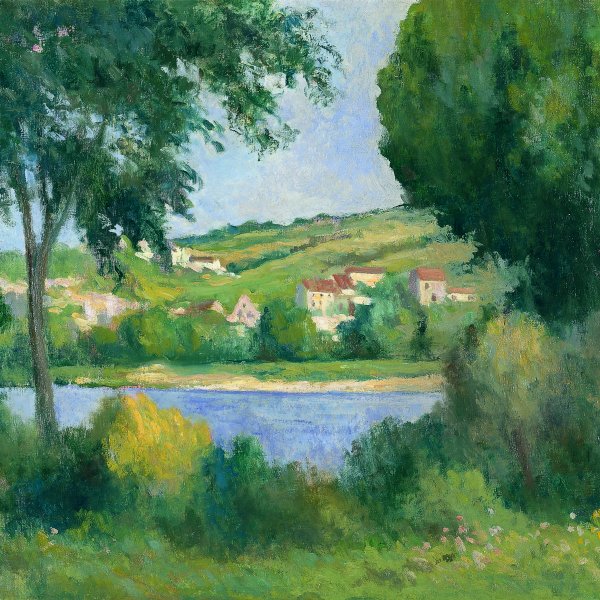
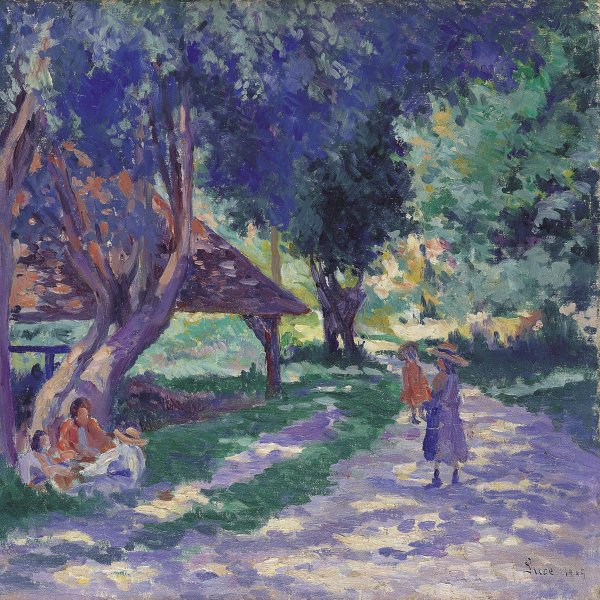
This explains the fact that Luce alternated between the divisionist technique, which marked most of his works between 1888 and 1897, and a freer style, with a wider brushstroke. Clearly, the divided stroke slows down the process of painting, and this became an annoying curb for such a spontaneous painter as Luce proved to be.
Between 1888 and 1892 he exhibited every year in the Salon des Indépendants, where he presented mainly views of Paris and of its suburbs.
This Street of Paris, composed entirely in perspective, dates from this period. It is one of the many paintings in which Luce, bearing witness to his time, enjoyed showing the bustling streets and river banks, where each character of the crowd is not only present but alive. After studying them through many sketches, Luce painted them with a few quick brushstrokes.
In his preface to the catalogue of the 1958 retrospective at the Maison de la Pensée Française, Georges Besson wrote about Luce in the following terms: "What other contemporary painter was such a penetrating portraitist? Who evoked with such power of means the misery of the soldiers on leave at the Gare de l'Est in 1916, the housewives queuing outside the shops [...] the shattered streets lined with hovels in Paris, the world of the embankers, of the rolling-mill workers, [...] the cobbler's stall [...] or else, The Worker having a Wash [...]?".
This Street of Paris of 1888 clearly illustrates Luce's acceptance of neo-Impressionism, and his resistance towards theory: the stroke is divided, but with a certain degree of freedom; the same freedom shown in the passers-by walking along the street or crossing it, attending to their business or going to work. The painting also recalls the different versions of La Rue des Abbesses made a few years later, once Luce had mastered his art.
But analysing his works, one feels that even when Luce was tempted to escape from the theory, he still integrated its principles in his art, which is impregnated with them. The paintings of 1895 show a degree of freedom in which divisionism, while not predominant, remained perceptible for a long time.
Denise Bazetoux