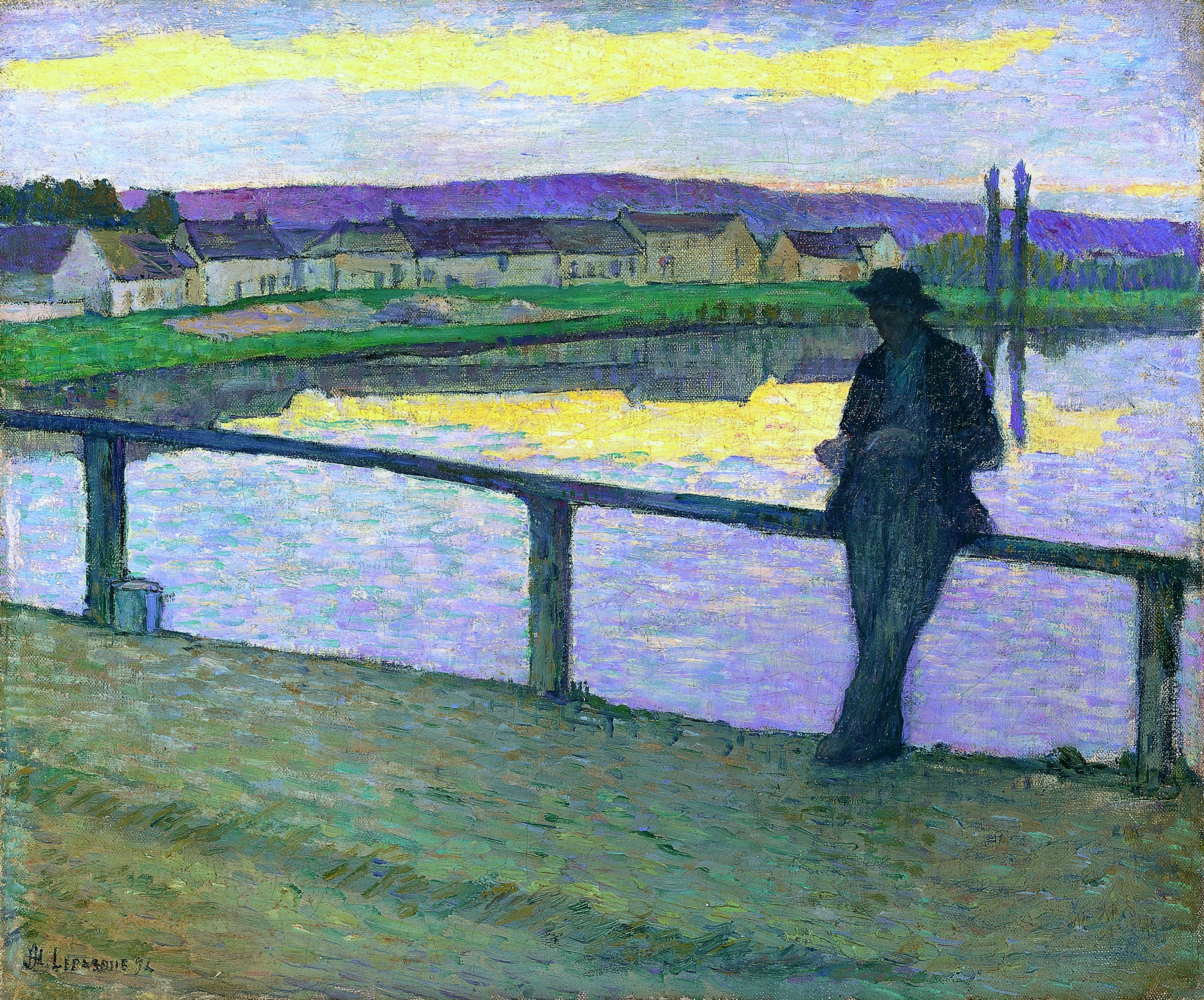
Sunset on Pont-Aven (Young Man by the Sea)
In his initial years, and until about 1892, Lebasque had only painted rather gloomy portraits of his family, with the exception of his contribution to the decorative panels for the Pantheon, for which he was employed by M. Humbert.
At the time when Lebasque began his artistic career, Impressionism had finally been acknowledged and was highly appreciated. Artists were paying attention to the principles of neo-Impressionism which appeared publicly for the first time in 1886.
A little hesitantly, but tempted by his own desire to escape the teachings he had received, Lebasque did not dare to reject from the outset everything he had learned from León Bonnat; for some time the works he painted bore witness to the changes that were taking place within him.
Besides, all his life Lebasque remained rather unconcerned with detail; his manner of painting depended much more on the places where he was and their atmosphere, than on influences and techniques.
If Lebasque has often been compared with Bonnard, it is probably more due to the similarity of the themes they dealt with; if he was said to be under the influence of the Fauves, it is simply because he exhibited next to them at the Salon d'Automne, which he helped to create.
As to the outburst of bright colours in Lebasque's works, its origin should be sought for more in his discovery of the light of the Midi, than in the influence of Matisse, Rouault or Manguin, although he was friends with the latter.
It is therefore from 1892 that we can perceive Lebasque's attempts to break free. Gradually his eyes opened to the world of light, and it is through intuition rather than following a scientific method that Lebasque entered the 1890s.
It was at the beginning of this crucial period, in which he distanced himself both from Bonnat's teaching and from Pointillism, that Lebasque painted this Sunset on Pont-Aven (Young man in from of the Sea) of 1894.
In 1894, Lebasque had known Luce and Signac for only one year, which explains the fact that this painting shows the influence of neo-Impressionism in the iridescent hues of the water and in the way the sky is depicted; but also the calm and serenity are in contrast with Luce's works from Charleroi.
Then, very shortly, Lebasque began to paint intuitively, even though he cultivated assiduously his gifts all his life, without wasting time on sad, gloomy subjects.
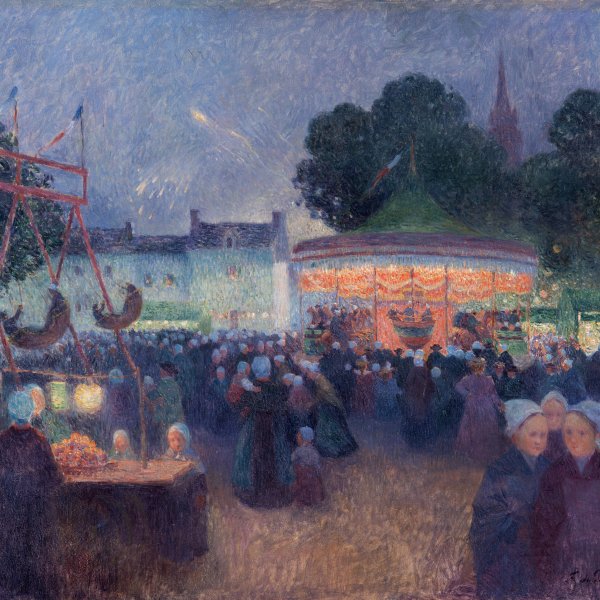
His talent was never so apparent as when he placed in his landscapes one or more characters, which in fact become the main subject of the painting. The presence, in this painting of 1894, of the backlit figure of the young man already foretells his future compositions, which often include his daughters and his son. Although in 1894 his eldest daughter Marthe had not yet been born, as soon as she arrived his paintings brightened up. This is the case of the portrait of Madame Lebasque sitting in a garden with baby Marthe on her knees, or those paintings executed after 1897, the year of his stay in Lannion, including landscapes peopled with Breton women or with members of his family, which show the progress made by Lebasque in such a short time once he felt free.
Denise Bazetoux